
This article's table of contents introduction:
- What is it? (Core Characteristics)
- Typical Design & Construction
- Common Applications (Where you find them)
- Key Selection Criteria (For Purchasing)
- Advantages & Disadvantages
- A manufacturer's example:
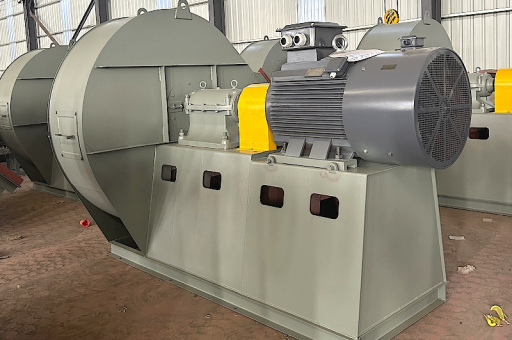
This sounds like you are describing a specific category of industrial fan: low-pressure, high-volume centrifugal fans, often used for general ventilation, combustion air, or material handling in industrial settings.
While "AC Industrial Centrifugal Fan" is a generic term, the specific combination of Low Pressure and Large Capacity (Gas Delivery) points to a very common fan design.
Here is a detailed breakdown of what this fan is, its common applications, and its key features.
What is it? (Core Characteristics)
This is a Centrifugal Fan (also called a squirrel-cage fan) designed to move a very large volume of air or gas against relatively low resistance (static pressure, typically under 10-15 inches w.g.).
- Low Pressure: The fan is not designed to push air through long, narrow ducts or dense filters. It moves air freely or through large, open ducts.
- Large Capacity: The primary design goal is high airflow (CFM - Cubic Feet per Minute). The impeller and housing are sized to move massive volumes of gas.
- Gas Delivery: The fan is capable of handling air, clean gas, or slightly dirty industrial air.
Typical Design & Construction
-
Impeller Type: The most common design for this application is a Backward Inclined (BI) or Airfoil (AF) impeller.
- Backward Inclined (BI): Paddle-like blades curved away from the direction of rotation. Efficient, non-overloading (motor won't burn out if airflow is restricted), and handles some dust.
- Airfoil (AF): A more efficient version of the BI impeller with hollow, airfoil-shaped blades. Very quiet and efficient for large volumes of clean air. This is the "gold standard" for large capacity gas delivery.
-
Housing: Typically a heavy-gauge steel scroll housing. Inlets are often ventilated or fitted with inlet boxes for smooth air entry.
-
Drive: Almost always Belt-Driven. This allows the operator to change the fan speed (RPM) by changing the pulley size. This is critical for matching the fan's performance to the system's resistance. The motor itself is an AC Induction Motor (typically TEFC or ODP).
-
Bearings: Heavy-duty, self-aligning ball or roller bearings, designed for continuous industrial operation. Often housed in pillow blocks outside the fan housing.
Common Applications (Where you find them)
The "Low Pressure, Large Capacity" spec makes them ideal for:
- Power Plants: Forced draft (FD) fans supplying combustion air to boilers. Induced draft (ID) fans pulling exhaust gases through scrubbers (at lower pressure).
- HVAC Systems: Large commercial building ventilation (air handling units), cooling towers, and air curtains.
- Process Drying: Blowing hot air across paper, textiles, or food products in large drying ovens.
- Fume Extraction: Moving large volumes of mildly contaminated air from welding booths, paint booths, or general ventilation.
- Material Handling (Light Duty): Transporting light, non-abrasive materials like sawdust, wood chips, or paper trim (using a special impeller design).
Key Selection Criteria (For Purchasing)
If you are specifying or looking to buy this fan, you need to know these parameters:
- Airflow (CFM): How much gas do you need to move? (e.g., 10,000 CFM, 50,000 CFM)
- Static Pressure (SP): The resistance the fan must overcome. Measured in inches of water gauge (in. w.g.). For this type of fan, it's typically 1" to 10" w.g.
- Gas Temperature: Is it ambient air (70°F) or hot exhaust gas (up to 200-400°F)? This affects the material (steel vs. stainless steel) and the bearing cooling.
- Motor Power (HP): Calculated from the CFM and SP.
- Drive Type: Belt-driven is standard for flexibility.
- Construction: Standard steel, stainless steel, or coated for corrosion/abrasion.
Advantages & Disadvantages
Advantages:
- High efficiency (especially Airfoil models)
- Stable operation - does not surge easily
- Non-overloading power characteristic (BI impellers) - motor amps drop as airflow decreases, preventing burnout.
- Low noise compared to high-pressure fans.
Disadvantages:
- Not for high pressure (e.g., over 15-20 in. w.g.).
- Not for heavy dust - Airfoil blades will wear quickly with abrasion.
- Larger physical size compared to a high-pressure fan of the same CFM.
A manufacturer's example:
A classic example is the Chicago Blower "Series 30" or "Series 60" , or a New York Blower "GI" or "LS" fan. These are the industry standbys for this exact application. You can also find them from brands like Greenheck, Twin City, or Aerovent.
Summary: You are looking at the workhorse of industrial ventilation. It's a large, belt-driven centrifugal fan designed to move a lot of air at low pressure efficiently and quietly. It is NOT a high-pressure compressor or a heavy-duty material handling fan.





