
This article's table of contents introduction:
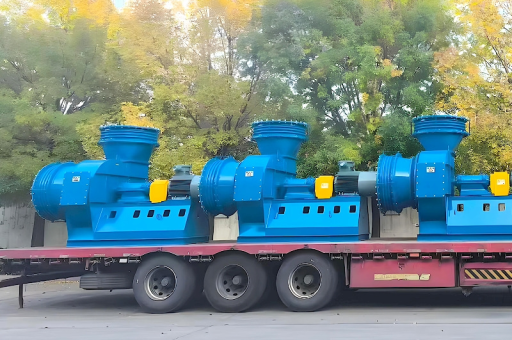
This appears to be a technical specification or model name for a highly specialized industrial fan. It combines several distinct engineering features into a single unit.
Here is a breakdown of what each term means and the type of fan you are describing.
The Name Breakdown
-
Double Suction (Double Inlet):
- Air enters the fan from both sides of the impeller.
- Why use it? It dramatically increases the airflow capacity for a given fan size. Compared to a single-suction fan, it offers roughly double the flow rate with better bearing balance (reducing axial thrust).
-
Anti-Abrasive:
- The fan is designed to handle air that contains particulate matter (dust, grit, ash, or debris).
- Design features: Thicker impeller blades (often steel or hardened alloys), wear-resistant liners on the volute (casing), and reinforced blade tips. It is built to withstand erosion.
-
Smoke Exhaust:
- The fan is certified or designed for emergency and continuous smoke evacuation.
- Critical features: It must operate at high temperatures for a defined period (e.g., 250°C for 2 hours or 400°C for 30 minutes, per standards like UL 793 or EN 12101-3). It uses high-temperature motors (often external to the airstream or with special grease). Seals prevent smoke leakage.
-
High Temperature:
- The fan can continuously handle air/gas temperatures significantly higher than standard fans (typically >200°C up to 600°C or more).
- Construction: The impeller shaft is often cooled via a "cooling wheel" or insulated bearing housing. The motor is often mounted separated from the fan casing (shaft-driven via a coupling).
-
Centrifugal Fan:
- The airflow is generated by a rotating impeller that flings air outward (at a 90-degree angle to the inlet).
- Why Centrifugal? It generates high pressure, making it ideal for moving heavy air (smoke, dusty air) against the resistance of ductwork and filters.
The "Put-Together" Application
This is not a standard HVAC fan. It is a heavy-duty industrial fan designed for a very specific, punishing job.
The "Anti-Abrasive" and "Smoke Exhaust" features are somewhat conflicting in pure engineering terms (anti-abrasive adds weight, smoke exhaust needs fast spinning), so the design is a compromise.
Primary Use Cases:
- Cement Plants / Steel Mills: Fume extraction that contains hot, abrasive dust.
- Mining: Ventilation of hot, dusty shafts or material handling.
- Power Generation (Biomass/Coal): Induced draft fans handling hot flue gas with fly ash.
- Tunnel Ventilation: Emergency smoke extraction in long tunnels where dust is present.
- Industrial Boiler Exhaust: For boilers burning dirty fuel (coal, wood, waste) where the exhaust gas is both hot and abrasive.
Summary of Key Components You Would Look For
If you are purchasing, specifying, or maintaining this fan, these are the critical points:
| Feature | What to Look For |
|---|---|
| Casing Material | High-strength steel or Hardox with removable wear plates. |
| Impeller | Radial tipped or backward curved blades with thick leading edges and welded wear strips. |
| Bearings | Heavy-duty spherical roller bearings, mounted outside the airstream, possibly with forced cooling. |
| Shaft Seal | Graphite packing or labyrinth seal to prevent hot gas/smoke from hitting the bearings. |
| Motor | Usually separate from the airstream (shaft-driven). Must be rated for ambient temperature. |
| Cooling | A cooling impeller (fan on the shaft) to draw cool air over the shaft before it reaches the bearings. |
| Connections | Flexible expansion joints to handle thermal expansion. |
In short: You are looking at a high-pressure, high-volume, robust industrial fan designed to survive in the worst possible conditions (hot, dirty, abrasive smoke). It is expensive, heavy, and specialized.





