
This article's table of contents introduction:
- Table of Contents
- Introduction – The Role of Blower Fans in Cement Manufacturing
- What Is a Medium Pressure Industrial Cement Mill Blower Fan With V Belt Drive?
- Key Design Features and Components
- How the V Belt Drive System Enhances Performance
- Applications in Cement Mill Processes
- Benefits of Using a Medium Pressure Blower Fan in Cement Plants
- Common Challenges and Troubleshooting
- Frequently Asked Questions (FAQ)
- Best Practices for Maintenance and Longevity
- Conclusion
Optimizing Material Transport: The Medium Pressure Industrial Cement Mill Blower Fan With V Belt Drive – Design, Benefits, and Maintenance Insights**
Table of Contents
- Introduction – The Role of Blower Fans in Cement Manufacturing
- What Is a Medium Pressure Industrial Cement Mill Blower Fan With V Belt Drive?
- Key Design Features and Components
- How the V Belt Drive System Enhances Performance
- Applications in Cement Mill Processes
- Benefits of Using a Medium Pressure Blower Fan in Cement Plants
- Common Challenges and Troubleshooting
- Frequently Asked Questions (FAQ)
- Best Practices for Maintenance and Longevity
- Conclusion
Introduction – The Role of Blower Fans in Cement Manufacturing
In the modern cement industry, material handling and pneumatic conveying are vital for maintaining operational efficiency. One of the most crucial pieces of equipment in this process is the Medium Pressure Industrial Cement Mill Blower Fan With V Belt Drive. This fan is responsible for transporting raw materials, cement powder, and additives through pipes and cyclones under moderate pressure conditions.
Unlike high-pressure fans that consume excessive energy, medium pressure fans strike a balance between airflow volume and static pressure, making them ideal for cement mills where both dust control and material movement are required.
This article delves into the construction, working principle, advantages, and maintenance of this fan type, offering actionable insights for plant engineers and procurement managers.
What Is a Medium Pressure Industrial Cement Mill Blower Fan With V Belt Drive?
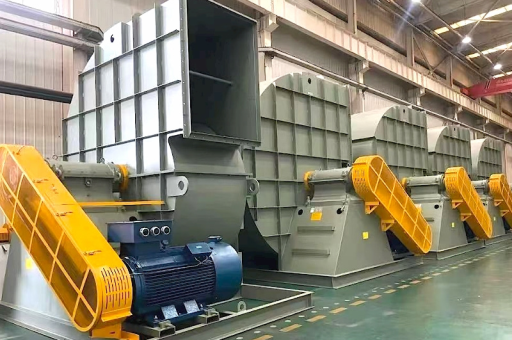
A medium pressure industrial cement mill blower fan is a centrifugal fan designed to generate static pressures between 1000 Pa and 4000 Pa (approximately 4 – 16 inches WG). It is driven by a V belt drive system, which connects the motor to the fan impeller via pulleys and multiple rubber belts.
Key characteristics:
- Impeller type: Forward-curved or radial blades, depending on dust load.
- Housing: Mild steel or abrasion-resistant alloy, with replaceable wear liners.
- Drive system: V-belt pulleys allowing speed adjustment by changing pulley diameter.
- Pressure range: Medium pressure, optimized for long-distance pneumatic transport.
This fan is not a high-pressure blower like a roots blower, nor a low-pressure ventilator. It is a specialized solution for cement mills that need to move material without overcompressing the air.
Key Design Features and Components
1 Impeller and Blade Geometry
The impeller is the heart of the fan. For cement mill applications, forward-curved blades produce higher flow at moderate pressure, while radial blades provide better wear resistance. Most manufacturers now use hardened steel or stainless steel impellers with dynamic balancing to ISO G6.3.
2 V Belt Drive Assembly
The V belt drive consists of:
- A motor pulley (driver)
- A fan pulley (driven)
- Multiple V-belts (A, B, or C-section)
This system allows for speed variation without a VFD, offering a cost-effective way to adjust airflow by replacing pulleys.
3 Bearing Housing and Lubrication
Heavy-duty pillow block bearings with grease nipples ensure smooth rotation under dusty conditions. Some designs include temperature sensors for early failure detection.
4 Inlet and Outlet Connections
The fan inlet often includes a damper or inlet box with a butterfly valve for flow control. The outlet is connected to a piping system leading to the cement mill classifier or baghouse.
How the V Belt Drive System Enhances Performance
The V belt drive is not just a power transmission method—it is a strategic component that influences the fan’s efficiency and adaptability.
Advantages of V belt drive in cement mill blower fans:
- Speed flexibility: Changing the motor pulley diameter alters fan speed and hence airflow.
- Load protection: Belts slip slightly under sudden overload, preventing motor burnout.
- Cost efficiency: Lower initial cost compared to direct-coupled or VFD-driven fans.
- Simple maintenance: Belt tension can be adjusted with a simple tool; replacement is fast.
Disadvantages to consider:
- Belt wear over time (typically 6–12 months in dusty cement environments).
- Power transmission loss (about 3–5% compared to direct drive).
- Requires regular alignment checks.
For most cement mill applications, the V belt drive offers the best balance of cost, maintenance simplicity, and performance.
Applications in Cement Mill Processes
This fan is used in the following key areas:
- Pneumatic conveying of raw meal from the raw mill to the homogenization silo.
- Cement mill ventilation – extracts fine dust from the grinding chamber.
- Separator fan system – provides air for dynamic separators to classify cement particles.
- Dust collector baghouse fan – maintains negative pressure in filter systems.
- Cooling air supply – for clinker cooling or mill bearing cooling.
In each application, the fan operates at medium pressure (typically 1500 – 3000 Pa) and delivers air volumes from 10,000 to 100,000 m³/h.
Benefits of Using a Medium Pressure Blower Fan in Cement Plants
| Benefit | Explanation |
|---|---|
| Energy efficiency | Lower power consumption than high-pressure blowers for the same flow. |
| Reduced wear | Medium pressure means lower particle velocity, reducing impeller erosion. |
| Simple speed control | Pulley changes or belt tension adjustments alter performance without expensive electronics. |
| Dust tolerance | Designed with abrasion-resistant materials and large clearances. |
| Low noise | Compared to positive displacement blowers, these fans generate less vibration and noise. |
| Ease of installation | Compact footprint and modular design. |
These benefits translate into lower total cost of ownership and higher plant uptime.
Common Challenges and Troubleshooting
Even the best-designed fan can face issues in harsh cement environments. Below are common problems and solutions:
| Problem | Cause | Solution |
|---|---|---|
| Excessive vibration | Impeller imbalance or bearing wear | Re-balance impeller; replace bearings |
| Overheating motor | Restricted airflow or belt slippage | Clean inlet ducts; adjust belt tension |
| Reduced airflow | Blocked duct or worn impeller | Inspect piping; repair or replace impeller |
| Belt squealing | Loose belts or misaligned pulleys | Tension belts; align pulleys with laser tool |
| Increased power draw | Damper closed too far or fan running outside design range | Open damper; verify system resistance |
Regular inspection every 500 operating hours is recommended.
Frequently Asked Questions (FAQ)
Q1: What pressure range defines a "medium pressure" cement mill blower fan?
A: Typically 1000 Pa to 4000 Pa (4 – 16 inches WG). This range is ideal for pneumatic conveying in cement mills.
Q2: Can a V belt drive fan be converted to direct drive?
A: Yes, but it requires a different motor base and coupling. Most plants prefer to keep V belt for speed flexibility.
Q3: How often should V belts be replaced in a cement mill environment?
A: Every 6 to 12 months, depending on dust exposure, belt quality, and tension maintenance.
Q4: What is the typical lifespan of a medium pressure blower fan impeller?
A: With proper abrasion protection, 3 – 5 years. In harsh conditions, replaceable wear plates can extend life.
Q5: Is a VFD better than a V belt drive for speed control?
A: VFD offers continuous speed control and higher efficiency, but at a higher initial cost. V belt is simpler and cheaper for fixed speed changes.
Q6: How do I calculate the required fan power for my cement mill?
A: Use the formula: Power (kW) = (Flow m³/s × Static Pressure Pa) / (1000 × Fan Efficiency). Consult fan curve from manufacturer.
Best Practices for Maintenance and Longevity
To maximize the life of your Medium Pressure Industrial Cement Mill Blower Fan With V Belt Drive, follow these guidelines:
- Daily: Listen for unusual noise; check belt tension and bearing temperature.
- Weekly: Inspect inlet and outlet for dust buildup; clean if necessary.
- Monthly: Grease bearings; check belt alignment with a straightedge.
- Quarterly: Remove and inspect impeller for wear; re-balance if needed.
- Annually: Replace belts regardless of visible condition; check motor windings.
Pro tip: Use matched belt sets from the same batch to ensure equal tension. Never replace just one belt in a multi-belt drive.
Conclusion
The Medium Pressure Industrial Cement Mill Blower Fan With V Belt Drive remains a workhorse in cement plants worldwide. Its ability to balance airflow, static pressure, and energy consumption makes it ideal for pneumatic conveying, mill ventilation, and dust collection.
The V belt drive system adds flexibility, cost effectiveness, and simplicity that modern variable speed drives cannot always match—especially in older plants or budget-constrained operations.
By understanding its design, properly sizing it for your system, and maintaining it with regular inspection, you can ensure reliable, efficient operation for years.
Remember: A well-chosen and well-maintained fan is not just a component—it is a strategic investment in your plant’s production capacity.
For more technical specifications or to request a fan performance curve suitable for your cement mill, contact your local industrial fan manufacturer or distributor.





