
This article's table of contents introduction:
- Article Directory
- 1. Introduction: Why Air Supply Matters in Rotary Kilns
- 2. The Working Principle of Centrifugal Flow Fans in Kiln Systems
- 3. Key Design Parameters for Air Supply Optimization
- 4. Common Challenges in Air Distribution and Fan Performance
- 5. Q&A Section: Expert Answers to Top Industry Questions
- 6. Best Practices for Maintenance and Longevity
- 7. Future Trends: Smart Fans and AI-Driven Airflow Control
- Conclusion
Article Title:
Optimizing Combustion Efficiency: The Critical Role of Air Supply Systems in Industrial Rotary Kilns with Centrifugal Flow Fans
Article Directory
- Introduction: Why Air Supply Matters in Rotary Kilns
- The Working Principle of Centrifugal Flow Fans in Kiln Systems
- Key Design Parameters for Air Supply Optimization
- Common Challenges in Air Distribution and Fan Performance
- Q&A Section: Expert Answers to Top Industry Questions
- Best Practices for Maintenance and Longevity
- Future Trends: Smart Fans and AI-Driven Airflow Control
Introduction: Why Air Supply Matters in Rotary Kilns
Industrial rotary kilns are the backbone of many high-temperature processes, from cement clinker production to mineral roasting and waste incineration. Without precise control over the air supply, kilns suffer from incomplete combustion, excessive fuel consumption, and elevated emissions. The centrifugal flow fan is the unsung hero of this system—it provides the forced draft required to deliver combustion air, maintain flame stability, and regulate temperature profiles across the kiln’s length.
Modern kilns demand air volumes ranging from 50,000 to over 500,000 cubic meters per hour, depending on the kiln diameter and production capacity. A poorly designed or worn centrifugal fan can lead to uneven air distribution, hot spots, and reduced refractory life. In this article, we break down the engineering fundamentals and practical solutions for selecting, operating, and maintaining centrifugal fans for rotary kiln air supply systems.
The Working Principle of Centrifugal Flow Fans in Kiln Systems
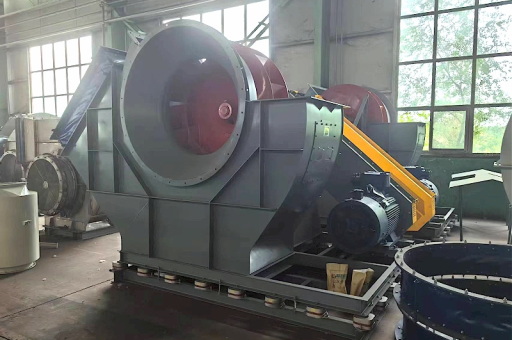
A centrifugal fan converts rotational kinetic energy into airflow by accelerating air radially outward through an impeller. In a rotary kiln context, the fan typically operates in one of three roles:
- Primary Air Fan: Delivers air directly to the burner nozzle for fuel combustion.
- Secondary Air Fan: Provides preheated air from the cooler to the kiln inlet.
- Tertiary Air Fan: Supplies air to the calciner or preheater tower.
The fan’s performance curve must match the system resistance curve—a mismatch causes surging, vibration, or insufficient airflow. Key characteristics include:
- Pressure rise: Typically 1,500–6,000 Pa for industrial kiln fans.
- Flow rate: Dictated by stoichiometric oxygen demand plus excess air (usually 10–20%).
- Impeller type: Backward-curved blades are preferred over forward-curved for high-efficiency, dust-laden environments.
Real-world example: A cement plant in Germany reduced specific fuel consumption by 8% after replacing a worn axial fan with a high-efficiency centrifugal fan equipped with variable inlet guide vanes. This upgrade allowed precise airflow modulation without resorting to damper throttling.
Key Design Parameters for Air Supply Optimization
To achieve optimal combustion in a rotary kiln, the air supply system must be engineered with the following parameters in mind:
| Parameter | Recommended Range | Impact on Performance |
|---|---|---|
| Air velocity | 20–35 m/s at burner tip | Affects flame shape and NOx formation |
| Excess air ratio | 05–1.20 | Balances complete combustion vs. thermal efficiency |
| Fan static efficiency | ≥ 82% | Reduces power consumption by up to 30% |
| Temperature tolerance | Up to 400°C (primary air) | Requires high temp bearings & shaft cooling |
Computational Fluid Dynamics (CFD) is now widely used to model airflow distribution inside the kiln. For example, CFD simulations can predict recirculation zones near the burner quarl and help engineers adjust fan speed or duct geometry to eliminate stagnation pockets.
Common Challenges in Air Distribution and Fan Performance
Even well-designed fans encounter operational issues:
- Erosion from dust particles: Cement raw meal or coal ash can wear blade tips within months. Solutions include hard-facing with chromium carbide or using liners.
- Vibration from imbalance: Uneven dust buildup on impeller blades causes imbalance. Regular cleaning or online washing systems are recommended.
- Temperature excursions: If the cooler fails, secondary air temperature can spike above 500°C, damaging the fan. Thermocouples and bypass dampers are essential safety measures.
Case study: A lime kiln in India experienced repeated fan motor overloads. Analysis revealed that the fan was operating far to the right of its performance curve due to a clogged air filter. After installing a differential pressure sensor and automatic filter cleaning, motor current dropped by 22%.
Q&A Section: Expert Answers to Top Industry Questions
Q1: What is the ideal fan speed for a cement kiln secondary air fan?
A: It depends on the kiln’s thermal load. Typically, fans operate at 750–1,200 RPM for large kilns. Variable frequency drives (VFDs) allow dynamic adjustment to match changing production rates, reducing energy waste during low-load periods.
Q2: Can a centrifugal fan handle hot air above 350°C?
A: Yes, but special materials are required. For air temperatures above 350°C, fans use alloy steel impellers (e.g., 16Mo3 or Inconel) and external bearing cooling. Above 500°C, ceramic coatings or air-cooled shaft liners become necessary.
Q3: How does air supply affect NOx emissions?
A: Insufficient air creates reducing zones that lower NOx but increase CO. Excess air, however, raises flame temperature and NOx formation. Staged combustion, enabled by controlled air distribution from primary and secondary fans, is the standard method to keep NOx below 400 mg/Nm³.
Q4: What maintenance schedule should I follow for centrifugal fans?
A: At minimum:
- Monthly: Check vibration levels and bearing temperatures.
- Quarterly: Inspect impeller for erosion or dust buildup.
- Annually: Perform dynamic balancing and replace seals.
Best Practices for Maintenance and Longevity
To extend the life of a centrifugal fan in a rotary kiln duty:
- Implement predictive maintenance using vibration analysis. A spike in the 1x RPM frequency often indicates unbalance, while high-frequency peaks suggest bearing wear.
- Monitor differential pressure across the fan. A steady increase signals dust accumulation on the impeller or ductwork restriction.
- Use inlet guide vanes instead of dampers for flow control. Vanes reduce power consumption by up to 15% compared to throttling.
- Protect against reverse rotation. When a kiln fan stops with hot gases still rising, the fan can spin backwards. Install a non-return damper or a brake system.
Pro tip: Many modern fans come with IoT-ready sensors that transmit real-time data to a central control room. This allows remote diagnostics and early detection of developing faults.
Future Trends: Smart Fans and AI-Driven Airflow Control
The industry is moving toward adaptive air supply systems that integrate:
- Machine learning algorithms that predict optimal airflow based on kiln shell temperature, fuel type, and raw material moisture.
- Digital twins of the fan-duct system to simulate the effect of changes before implementation.
- High-speed direct-drive motors (10,000+ RPM) coupled with magnetic bearings, eliminating gearboxes and lubrication systems.
For example, a pilot project in a Spanish calcining plant used reinforcement learning to control the secondary air fan speed. The AI system reduced fuel consumption by 5.2% over six months while maintaining clinker quality, outperforming the plant’s standard PID controller.
Conclusion
The centrifugal flow fan is not merely an auxiliary component—it is a central enabler of efficient, low-emission combustion in industrial rotary kilns. By understanding fan performance curves, selecting appropriate materials for high-temperature duty, and adopting smart monitoring technologies, operators can reduce energy costs, extend equipment life, and comply with tightening emission regulations.
When planning a new kiln line or retrofitting an existing one, remember: your air supply fan is the lungs of the process. Neglect it, and the entire combustion system will struggle to breathe.





