
This article's table of contents introduction:
- Deconstructing the Terms
- The Machine Explained
- Specific Application Contexts
- Key Considerations for this Specification
- Summary Table
- Is there a specific parameter you need?
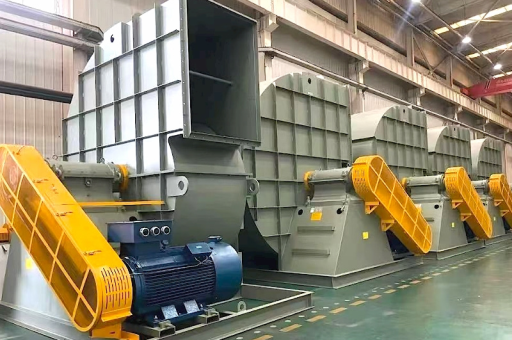
Based on the combination of terms you've provided, it appears you are describing (or looking for information on) a heavy-duty centrifugal fan constructed from a specific high-strength steel, designed for a harsh industrial environment.
Let's break down the terminology to understand the specific piece of equipment and its intended use.
Deconstructing the Terms
- Hg785 / HG785 (High-Strength Steel):
- What it is: This is a Chinese standard high-strength low-alloy (HSLA) structural steel. Specifically, HG785 is known for a minimum yield strength of 785 MPa (approximately 114 ksi). It is the higher-strength sibling of Q690 (e.g., Q690D).
- Why it's used: It is used to make the fan casing, impeller, or shaft significantly thinner and lighter while maintaining the same strength as a standard carbon steel (Q235) fan. This is critical for large fans where rotational inertia and weight are concerns, and where the fan must resist high pressure without deformation.
- Alloyed Steel:
This confirms that the steel (HG785) contains alloying elements like manganese (Mn), chromium (Cr), molybdenum (Mo), and nickel (Ni). These elements improve hardenability, toughness, and wear resistance compared to plain carbon steel.
- Single Suction:
- Design: The fan "sucks" air (or gas) into the impeller from only one side (the inlet cone).
- Application: Single suction fans are the standard configuration for most industrial applications (boilers, ventilation, dust collection). Double suction fans are typically used for extremely high volume, low-pressure applications (like large HVAC units).
- Ventilation:
- Function: The primary purpose is to move air (for combustion, cooling, or exhaust). In a boiler context, this usually implies intake air (forced draft) or flue gas (induced draft).
- Boiler:
- Application: This fan is specifically designed for a boiler system. This implies the gas being moved might be hot, corrosive (containing SOx, NOx, or fly ash), or abrasive.
- Centrifugal Flow:
- Mechanism: Air enters axially (straight in) and is expelled radially (turned 90 degrees) outward by a spinning impeller. This generates high pressure.
- Types: In a boiler context, the impeller is almost certainly backward-curved (or backward-inclined). This type is non-overloading (meaning motor power peaks at a specific flow rate) and more efficient for handling dirty gases.
- Fan:
The complete assembly: motor, bearings, shaft, impeller, and casing.
The Machine Explained
What you are describing is a High-Pressure Industrial Boiler Draft Fan.
- Casing/Impeller: Made from 785 MPa yield strength steel to handle the structural loads of high-pressure operation and the high rotational speeds needed for forced draft (pushing air into the furnace).
- Wear Resistance: HG785 is often used in the impeller blades of Induced Draft (ID) fans. ID fans move hot flue gas which contains abrasive fly ash particles. The higher hardness of the alloyed steel helps resist erosion, extending the fan's life.
- Single Suction Design: This is standard; the fan has one inlet.
Specific Application Contexts
- Forced Draft (FD) Fan: Pushes ambient air into the boiler furnace. The HG785 steel is used for strength in large fans rotating at high RPM to overcome the pressure drop across the air heater and furnace.
- Induced Draft (ID) Fan: Pulls hot flue gas (often 140-200°C/280-390°F) out of the boiler and through the chimney/scrubber. The HG785 alloy is critical here because the blades and casing must remain strong at elevated temperatures while resisting corrosion and abrasion from fly ash.
- Primary Air (PA) Fan: Supplies high-pressure air to pulverize and transport coal to the furnace.
Key Considerations for this Specification
- Weldability: HG785 requires pre-heating (typically 150-200°C / 300-400°F) and special welding consumables (low-hydrogen electrodes) to prevent cracking.
- Cost: It is significantly more expensive than standard Q235 or Q345 steel. It is only chosen where weight savings, high rotational speeds, or abrasion resistance justify the cost.
- Heat Treatment: The fan components (especially the impeller) made from HG785 may require stress relieving after welding to maintain dimensional stability at high RPM.
Summary Table
| Term | Meaning | Relevance |
|---|---|---|
| HG785 | 785 MPa Yield Strength Steel | High strength, wear resistance, allows lighter construction |
| Alloyed Steel | Contains Mn, Cr, Mo, Ni | Improves toughness and high-temp performance |
| Single Suction | Air inlet on one side | Standard design for most boiler fans |
| Ventilation | Air/Gas movement | Refers to forcing or inducing draft |
| Boiler | Industrial heat exchanger | Gas may be hot, corrosive, or abrasive |
| Centrifugal | Radial airflow | High pressure, suitable for dirty gases |
Is there a specific parameter you need?
- Performance: Flow rate (m³/h or CFM) and Total Pressure (Pa or inWG)?
- Temperature: Max gas temperature (e.g., 300°C/572°F for a typical ID fan)?
- Impeller Type: Backward curved, radial tipped, or forward curved?
- Size: Impeller diameter (e.g., 1.2m / 47 inches)?
If you have a specific model or engineering drawing, I can provide more targeted technical analysis.





