
This article's table of contents introduction:
- Material: Q235 (Carbon Steel)
- Key Feature: Anti-Wear
- Key Feature: Heat Dissipation
- Power: 22 kW (Approx 30 HP)
- Typical Fan Types (Matching your description)
- Important Considerations for Purchasing / Specifying
- Summary Table
- Recommendation
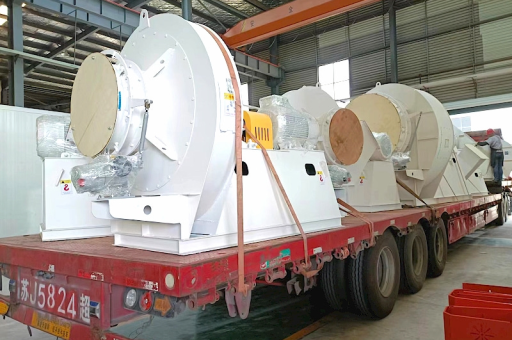
It looks like you're describing a Q235 steel, anti-wear, heat-dissipating 22kW boiler fan. This is a common type of industrial fan used in thermal power plants, industrial boilers, or HVAC systems where the air is hot and contains abrasive particles (like fly ash or dust).
Here’s a breakdown of what that specification typically means and the key considerations for such a fan:
Material: Q235 (Carbon Steel)
- Q235 is a Chinese standard (GB/T 700) carbon structural steel, equivalent to A36 (ASTM) or S235JR (EN 10025).
- Pros: Good weldability, moderate strength, low cost.
- Cons: Not inherently stainless or highly corrosion-resistant (will rust if not painted/protected).
- For this application: The Q235 is likely used for the housing, base, and impeller. It is often coated with a high-temperature anti-corrosion paint to handle the boiler environment.
Key Feature: Anti-Wear
- Why it's needed: Boiler fans (especially Induced Draft fans) handle flue gas containing fly ash, soot, and unburned carbon particles. These erode the blades and housing rapidly.
- How it's achieved:
- Wear Liners: Hardox, NM400, or ceramic tiles welded/bolted to the leading edges of the blades and the volute tongue (the area that takes the most abuse).
- Thicker Blades: The impeller blades are made thicker than standard (e.g., 8mm-12mm).
- Hardfacing: Welding a layer of hard alloy (e.g., Stellite) on the blade edges.
Key Feature: Heat Dissipation
- Why it's needed: Boiler fans handle air temperatures from 100°C to 250°C (sometimes up to 400°C for special boilers).
- How it's achieved:
- Shaft Cooling Fins: A fan-wheel-like structure on the shaft between the bearing and the impeller to pull cool ambient air toward the bearing.
- Bearing Housing: Often designed with cooling jackets or extended cooling fins.
- Material Stability: The impeller is designed to avoid thermal expansion distortion (often with a radial slot or expansion ring on the backplate).
Power: 22 kW (Approx 30 HP)
- This is a medium-sized fan motor.
- Typical Parameters (approximate):
- Flow Rate: 20,000 to 35,000 m³/h (depending on pressure).
- Static Pressure: 2,000 to 4,000 Pa.
- Speed: 1,450 RPM (4-pole motor) or 2,900 RPM (2-pole motor) – 4-pole is more common for boiler fans to reduce wear.
- Motor: Usually a Y/Y2/YE3 series (IE3/IE4 efficiency) TEFC (Totally Enclosed Fan Cooled) motor, often with a VFD (Variable Frequency Drive) for speed control.
Typical Fan Types (Matching your description)
Your specifications match two main fan types:
A. Centrifugal Fan (Most Likely)
- Type: 9-19 or 9-26 high-pressure series (common for forced draft) or Y5-47 / Y5-48 series (common for induced draft in China).
- Blade Profile:
- Forward-curved (Multi-blade): Good for high flow, low noise, but less wear-resistant.
- Backward-curved (Aerofoil): Highly recommended for anti-wear and efficiency. Less prone to dust accumulation.
- Radial blades: Best for anti-wear (dust hits blades head-on with less angle), but less efficient.
- Application: Forced Draft (FD) fan pushing cold air into the boiler, or Induced Draft (ID) fan pulling hot exhaust out.
B. Axial Fan (Less Common but Possible)
- Used for low-pressure, high-volume systems. Less common for 22kW anti-wear applications.
Important Considerations for Purchasing / Specifying
- Temperature Rating: Is this for FD Fan (Cold air ~20°C to 40°C) or ID Fan (Hot flue gas ~120°C to 250°C)? This changes the bearing type, lubrication, and shaft material.
- Dust Concentration: Is the air heavily dusty (e.g., biomass or coal boiler > 100 mg/Nm³)? If so, you need ceramic anti-wear lining.
- Drive Type:
- Direct Drive (D-type): Impeller on motor shaft. Compact but harder to adjust speed.
- Belt Drive (B/C-type): Allows speed adjustment via pulley change. Easier to match pressure/flow.
- Inlet/Outlet Orientation: Standard orientation is often 0° (left 90° or right 90°). You must specify the rotation direction (CW or CCW) from the drive side.
Summary Table
| Feature | Typical Specification for your request |
|---|---|
| Material | Q235 Steel (Housing, Impeller) |
| Anti-Wear | Thick blades (10mm+), NM400 or Ceramic Tiles on leading edge |
| Heat Dissipation | Shaft cooling fin, extended bearing housing fins, high-temp grease |
| Power | 22 kW (30 HP) |
| Voltage | Common: 380V / 660V / 690V / 3Ph / 50Hz or 60Hz |
| Fan Series | Y5-47 / Y5-48 (ID Fan) or 9-19 / 9-26 (FD Fan) |
| Speed | 1450 RPM (Recommended) or 2900 RPM |
| Outlet Size | Approx. DN250 to DN400 (depending on design) |
Recommendation
If you are sourcing this fan:
- Confirm the medium: Is it cold air (FD) or hot flue gas (ID)? This changes the deisgn.
- Ask for a "Lining" specification: "Q235 with 5mm ceramic tile lining on volute and impeller" is a typical anti-wear spec.
- Check the bearing brand: For heat dissipation, SKF, NSK, or FAG bearings with high-temperature grease (e.g., Shell Dolium Grease) are critical.
- Request a performance curve: Ensure the fan operates near its best efficiency point (BEP) to avoid vibration and wear.
Would you like me to help you search for a specific manufacturer or provide details on the electrical connection (Star/Delta starter or VFD) for a 22kW fan?





