
This article's table of contents introduction:
- The "Standard" Material: Carbon Steel (with Coatings)
- Application-Specific Materials
- Critical Material Selection Criteria for Drying
- Summary Recommendation
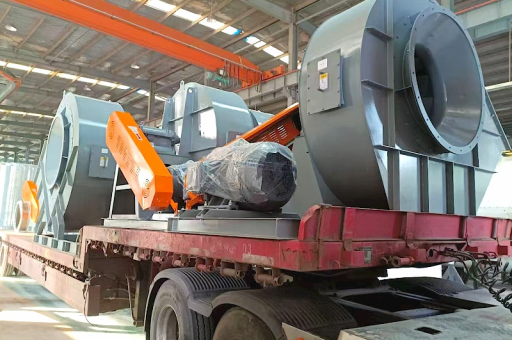
A Backward Curved Centrifugal Fan (often referred to as a BC or BI fan) is the industry standard for industrial drying processes due to its high efficiency, stable pressure curve, and ability to handle particulate-laden air at moderate temperatures.
Here is a breakdown of the specific materials used in these fans for drying applications, why they are used, and how they resist the specific challenges of drying.
The "Standard" Material: Carbon Steel (with Coatings)
For most drying applications (textiles, paper, wood, general industrial parts drying), the fan housing and wheel are made of Carbon Steel (typically mild steel or Corten steel).
- Why it is used: Low cost, high structural strength for large wheels.
- The Challenge: Rust from humidity and corrosion from acidic vapors (ex: drying wood releases acetic acid; drying textiles releases lint-laden moisture).
- The Solution: The carbon steel is painted or coated.
- Standard: Two-part epoxy or polyurethane paints (good for humidity up to 200°F/93°C).
- High-End: Phenolic resin coating or Heresite (used in paper and textile drying to prevent rust and allow easy cleaning).
Application-Specific Materials
Depending on the type of drying, the material changes significantly.
| Drying Application | Ideal Material | Why this material? | Resistance Target |
|---|---|---|---|
| High Humidity / Steam (Tunnel dryers, food dehydrators) | 304/316 Stainless Steel | Resists moisture permanently. 316 is needed if chlorides (salt, cleaning chemicals) or acidic fruit vapors are present. | Atmospheric rust, pitting. |
| High Temperature (>400°F / 204°C) (Spray dryers, kilns) | Carbon Steel for housing; Alloy Steel (A-36, Corten) for wheel. | Standard steel loses strength at high temp. Special alloys hold shape. No paint needed (paint burns off). Coatings are fire-cured silicone (up to 450°F) or no coating. | Thermal fatigue, creep (wheel deformation). |
| Abrasive Drying (Sand, Fertilizer, Cement) | AR (Abrasion Resistant) Steel (e.g., Hardox, T-1) | The high tip speed of a backward curved fan creates particle impact. The dust acts like sandpaper on the blades and housing. | Erosion, thinning of blades. |
| Corrosive Chemical Drying (Pharma, Acid drying) | FRP (Fiberglass Reinforced Plastic) or PVDF (Polyvinylidene Fluoride) | Metals corrode instantly in HCl, H2SO4, or halogen vapors. FRP is inert and light. (Note: These are typically forward curved or radial fans, but high-end BC fans exist in FRP). | Chemical attack. |
| Food / Hygiene Drying (Washing tunnels, bakeries) | 304/316 Stainless Steel (Polished) | FAD (Food & Drug) regulations. Smooth finishes prevent bacteria growth. Welds must be ground flush. | Biofilm, Sanitizer chemicals, CIP (Clean-in-Place) washdown. |
Critical Material Selection Criteria for Drying
When selecting the material for a Backward Curved fan in a drying system, avoid these common mistakes:
- Do not use Aluminum for high-humidity drying. Aluminum corrodes rapidly in wet, alkaline environments (common in concrete or paper drying).
- Do not use Stainless Steel in high-temp drying (>500°F) unless it is a specialized high-chrome alloy (310 Stainless). Regular 304/316 loses tensile strength and warps.
- Consider the "Dew Point." In a drying system, the air is hot and wet. If the fan housing is cold (e.g., in a cold warehouse), moisture condenses inside the fan. This makes carbon steel rust even if the air is dry. If this is your layout, you must use Stainless Steel or a specific Condensation-Resistant Epoxy.
Summary Recommendation
- General Purpose Drying: Carbon Steel + Epoxy Paint (Cost-effective, replaceable).
- Food / Pharma / Humid: 304 Stainless Steel (Hygienic, long life).
- High Temp / Abrasive: Carbon Steel with Hardened Tip Inserts (e.g., Tungsten carbide strips welded to the leading edge of the backward curved blades).
Bottom Line: For most drying systems, the Backward Curved wheel is made of Carbon Steel coated for humidity. If you have steam or condensation, upgrade to 304 Stainless Steel.





