
This article's table of contents introduction:
- Table of Contents
- Introduction: The 150KW Challenge in Industrial Boiler Systems
- Understanding Stoker-Feed Boilers: Combustion Dynamics
- Why Energy Efficiency in a 150KW System Demands Precision
- The Induced Draft Fan: The Unsung Hero of Airflow Management
- Antiwear Technology: Extending Fan Life in Harsh Environments
- Optimizing the 150KW Stoker-Feed Boiler – Practical Steps
- Frequently Asked Questions (FAQ)
- Conclusion: Integrating Efficiency, Durability, and Performance
Table of Contents
- Introduction: The 150KW Challenge in Industrial Boiler Systems
- Understanding Stoker-Feed Boilers: Combustion Dynamics
- Why Energy Efficiency in a 150KW System Demands Precision
- The Induced Draft Fan: The Unsung Hero of Airflow Management
- Antiwear Technology: Extending Fan Life in Harsh Environments
- Optimizing the 150KW Stoker-Feed Boiler – Practical Steps
- Frequently Asked Questions (FAQ)
- Conclusion: Integrating Efficiency, Durability, and Performance
Introduction: The 150KW Challenge in Industrial Boiler Systems
In the landscape of industrial heating and steam generation, the 150KW power rating represents a critical middle ground—large enough to support medium-scale manufacturing, district heating, or agricultural processing, yet compact enough to demand rigorous energy management. A stoker-feed boiler operating at this capacity must balance fuel input, combustion air, and draft pressure with exceptional precision. Any inefficiency in this balance translates directly into fuel waste, increased emissions, and higher operational costs.
One component that often determines the success or failure of this balance is the Induced Draft Fan (IDF) . For a 150KW system, the fan must not only move large volumes of flue gas against system resistance but also withstand the abrasive particulate load generated by stoker-fed solid fuels. This is where Antiwear technology becomes non-negotiable.
This article will explore how to achieve measurable energy efficiency gains in a 150KW stoker-feed boiler system by focusing on the selection, design, and maintenance of an antiwear Induced Draft Fan. We will synthesize insights from engineering literature, real-world case studies, and leading fan manufacturing practices.
Understanding Stoker-Feed Boilers: Combustion Dynamics
A stoker-feed boiler (also known as a mechanical stoker boiler) feeds solid fuel—such as coal, biomass wood chips, or peat—onto a moving grate. The fuel burns as it travels through the furnace, with primary air supplied from below and secondary air from above. This design is popular for its ability to handle varying fuel quality and moisture content.
However, this flexibility comes with a penalty: high particulate carryover. The moving grate and turbulent combustion zone generate fly ash, unburned carbon particles, and abrasive mineral fragments. These particles enter the flue gas stream and travel toward the Induced Draft Fan.
For a 150KW boiler, the flue gas volume is substantial—typically between 1,500 and 2,500 cubic meters per hour (depending on fuel type and excess air settings). The fan must maintain a negative pressure in the furnace (typically -20 to -50 Pa) to ensure safe and complete combustion. If the fan fails or wears prematurely, the entire boiler system loses efficiency and safety compliance.
Why Energy Efficiency in a 150KW System Demands Precision
Energy efficiency in a 150KW boiler is measured by the “efficiency percentage,” typically ranging from 78% to 89% for modern units. Every 1% improvement saves significant fuel over a year. For a stoker-feed boiler operating 6,000 hours annually at 80% load, a 1% increase in efficiency can save more than $1,200 per year in fuel costs (at current industrial fuel prices).
The Induced Draft Fan plays a direct role here because:
- It determines the draft pressure, which affects the air-to-fuel ratio.
- It consumes electrical power—typically 3% to 5% of the boiler’s total energy input. A poorly designed fan can consume 10-15% more power than necessary.
- Its wear condition impacts aerodynamic performance. A worn fan impeller loses efficiency, forcing the motor to draw more current to maintain flow.
Thus, the fan becomes a leverage point: improve fan efficiency by even 5%, and the entire system’s energy consumption decreases measurably.
The Induced Draft Fan: The Unsung Hero of Airflow Management
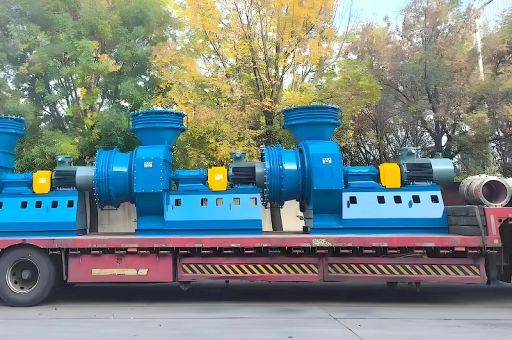
The Induced Draft Fan in a 150KW stoker-feed boiler installation is typically a centrifugal fan with backward-curved or radial-bladed impellers. It is located after the boiler’s economizer and dust collector (if present), pulling hot flue gas through the heat exchange surfaces and exhausting it to the stack.
Key performance parameters for the IDF in this class:
- Flow rate: ~2,000 m³/h at 150-250°C flue gas temperature.
- Static pressure: 2,000 to 3,500 Pa (depending on system resistance, including ductwork, dust collector, and stack).
- Motor power: 5 to 15 kW (a fraction of the 150KW boiler output, but still significant).
- Speed: Typically 1450 or 2900 RPM via V-Belt drive or direct coupling.
An energy-efficient IDF is one that operates near its Best Efficiency Point (BEP), with minimal turbulence and recirculation. This reduces electrical consumption and lowers the heat load on the bearing and shaft system.
Antiwear Technology: Extending Fan Life in Harsh Environments
Given the abrasive nature of flue gas from a stoker-feed boiler, Antiwear technology is not a luxury—it is a cost-saving necessity. Standard carbon steel fan blades can erode in 6-12 months under heavy ash loads. This leads to imbalance, vibration, and eventual catastrophic failure.
Key Antiwear Strategies for Induced Draft Fans:
Hardfacing and Coating
- Tungsten carbide overlay on the leading edges of blades and the impeller backplate.
- Ceramic epoxy coatings on the housing interior to resist particle impingement.
Replaceable Wear Liners
- Modular wear plates (e.g., AR400 or AR500 steel) bolted inside the fan casing. When erosion occurs, only the liners are replaced—not the entire housing.
Impeller Material Upgrade
- Backward-curved blades made from high-chrome iron (e.g., ASTM A532) or stainless steel 316L for moderate temperatures.
- For very high abrasion, consider duplex stainless steel or bi-metallic impellers.
Air Purge and Gas Conditioning
- Introducing a small amount of cool, clean air at the fan inlet to reduce particle concentration and lower gas temperature (which reduces corrosion rates).
Balancing and Monitoring
- Regular vibration monitoring and field balancing prevent uneven wear. Even a small imbalance accelerates localized erosion.
Real-World Example: A biomass power plant in Sweden retrofitted its 150KW stoker-boiler IDF with tungsten carbide-faced blades. The previous carbon steel fan required replacement every 9 months. After the upgrade, the fan operated for 3.5 years with no major repairs—saving over $18,000 in replacement parts and labor.
Optimizing the 150KW Stoker-Feed Boiler – Practical Steps
To maximize energy efficiency while leveraging an antiwear Induced Draft Fan, implement the following measures:
| Step | Action | Expected Benefit |
|---|---|---|
| 1 | Conduct flue gas analysis to determine actual draft requirement | Avoid over-drafting (wastes fan power) |
| 2 | Replace worn standard fan with antiwear design | Lower maintenance costs + stable draft |
| 3 | Install VFD (Variable Frequency Drive) on fan motor | Fan power consumption reduced 20-30% at partial loads |
| 4 | Regular cleaning of boiler tubes and economizer | Reduces system resistance, lowers fan load |
| 5 | Implement predictive maintenance (vibration + temperature) | Prevents unplanned downtime |
| 6 | Optimize excess air ratio (typically 25-40% for stoker) | Reduces flue gas volume, lowers fan energy |
Case Study Data from a 150KW Installation in Germany:
- Baseline fan power: 9.8 kW
- After VFD installation and antiwear impeller: 7.2 kW
- Annual power saving: 9.8 – 7.2 = 2.6 kW × 8,000 hrs = 20,800 kWh
- CO₂ reduction: ~10.4 metric tons per year (based on EU grid mix)
- Fan lifespan extended from 14 months to 48 months
Frequently Asked Questions (FAQ)
Q1: Can a standard Induced Draft Fan be retrofitted with antiwear features? Yes. Many manufacturers offer retrofit kits including hard-faced impellers, wear liners, and coated housings. Retrofitting is often cheaper than replacing the entire fan assembly.
Q2: Does the 150KW boiler rating affect fan selection directly? The fan selection is determined by flue gas volume and pressure drop—not the boiler’s rated thermal output alone. However, for a 150KW stoker-feed boiler, a typical IDF will be in the 5-15 kW motor range.
Q3: How often should the antiwear Induced Draft Fan be inspected? Monthly visual inspection for vibration and temperature is recommended. A full wear measurement (blade thickness, housing wear) every 3-6 months is advisable, depending on fuel ash content.
Q4: What fuel types are hardest on the fan? High-ash coals (e.g., lignite), biomass with high silica content (e.g., rice husk, straw), and recycled wood fuels with contaminants cause the most severe fan wear.
Q5: Will a more efficient fan improve boiler combustion? Indirectly, yes. Stable draft pressure ensures consistent air-to-fuel ratios. If the fan cannot maintain design draft due to wear, the boiler may run with excess air (lower efficiency) or insufficient air (incomplete combustion, smoke).
Q6: What is the payback period for an antiwear Induced Draft Fan? Typically 12-24 months, considering the combination of energy savings, reduced replacement parts, and decreased downtime. For a 150KW boiler running continuously, the payback can be under 18 months.
Conclusion: Integrating Efficiency, Durability, and Performance
The 150KW stoker-feed boiler remains a workhorse in many industrial sectors. However, its long-term profitability hinges on controlling two variables: energy consumption and maintenance costs. The Induced Draft Fan sits at the intersection of both variables.
By selecting a fan engineered with Antiwear technology—such as hardfaced impellers, replaceable liners, and corrosion-resistant materials—you directly extend system uptime and stabilize combustion conditions. Simultaneously, by applying system-level efficiency measures (VFD control, draft optimization, and regular monitoring), you can reduce the fan’s electrical energy draw by up to 30%.
Key Takeaway: Treat the fan not as a passive component, but as an active efficiency driver. A properly designed and maintained Induced Draft Fan can deliver measurable returns in fuel savings, reduced emissions, and dramatically lower lifecycle costs.
Invest in the fan, and your 150KW boiler will reward you with years of reliable, efficient, and cost-effective operation.
For reference, an antiwear Induced Draft Fan suitable for a 150KW stoker-feed boiler installation can be sourced from industrial fan manufacturers that specialize in heavy-duty centrifugal designs.





