
This article's table of contents introduction:
- The System: CFB Boiler ID Fan
- The Coupling: The Critical Link
- Key Engineering Considerations for "Coupling" in this Context
- Critical Maintenance Check: "Coupling Drifting"
- Operational "Do Not" for Backward Curved Fans
- Summary Recommendation
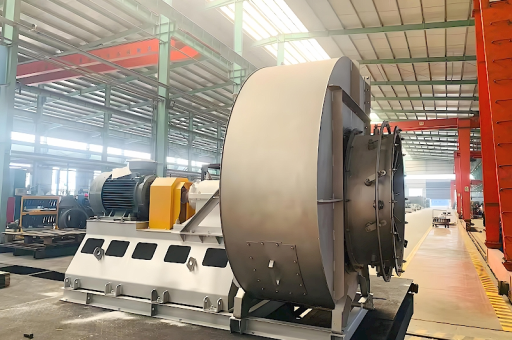
Based on your query, you are likely referring to a Centrifugal Fan (specifically a Backward Curved type) used as an Induced Draft (ID) Fan in a Circulating Fluidized Bed (CFB) Boiler, with the key point being the coupling (the mechanical connection between the motor and the fan).
Here is a detailed breakdown of that specific application, the type of coupling typically used, and the critical engineering considerations.
The System: CFB Boiler ID Fan
- Role: The ID fan pulls flue gas through the boiler (economizer, air heater, baghouse/ESP) and creates negative pressure (draft) in the furnace.
- Challenge: CFB boilers produce gas with high dust loading (ash, sand) and abrasive particles. Even with dust collectors, the ID fan sees erosive wear.
- Fan Type: Backward Curved (BC) Centrifugal Fan.
- Why: High efficiency, stable pressure curve, non-overloading power characteristics (motor won't burn out if duct is clogged). However, they are sensitive to dust buildup on blades.
The Coupling: The Critical Link
The coupling connects the motor shaft to the fan shaft. For a large industrial CFB boiler ID fan (typically 500 kW to several MW), the standard choice is a Geared (Gear) Coupling or a Diaphragm Coupling.
| Coupling Type | Used For | Pros | Cons |
|---|---|---|---|
| Gear Coupling | Most Common (Legacy & New) | High torque density, low cost, allows for angular/parallel misalignment, robust. | Requires lubrication; can fail if lubrication is lost; backlash can cause vibration. |
| Diaphragm Coupling | High-Speed / Critical Duty | Zero maintenance (no lube), no backlash, handles high misalignment, excellent for high RPM. | More expensive; stiffer (can transmit more vibration if unbalanced). |
| Elastomeric (Tire/Jaw) | Small fans (<200kW) | Dampens vibration, isolates motor, low cost. | Cannot handle high torque of large ID fans; poor heat/chemical resistance in hot boiler area. |
Conclusion: For a large CFB ID fan, a Lubricated Gear Coupling or a Non-Lubricated Diaphragm Coupling is the industry standard. Many modern plants are switching to diaphragm couplings to eliminate the maintenance risk of oil leaks in the high-heat environment.
Key Engineering Considerations for "Coupling" in this Context
When specifying or troubleshooting the coupling for a Backward Curved CFB ID Fan, you must address these specific issues:
A. Vibration (The #1 Issue)
- Backward Curved Blades are prone to unstalled flow if the fan is operated too far left on its curve (low flow vs. high pressure). This causes severe aerodynamic vibration.
- Effect on Coupling: This vibration is transmitted directly to the coupling. Gear couplings can "hammer" and wear out teeth.
- Solution: Ensure the fan operates within its design flow range. Use a diaphragm coupling (no teeth to wear) or ensure a gear coupling has very tight clearance.
B. Erosion & Imbalance
- Problem: CFB fly ash erodes the leading edges of the backward curved blades. This causes the rotor to become unbalanced over time.
- Effect on Coupling: An unbalanced fan rotor applies a high cyclic radial load on the coupling and bearings.
- Solution: The coupling must be robust enough to handle this residual imbalance. Spacer couplings (a long piece between two flex halves) are used to allow the removal of the fan shaft without moving the motor (important for maintenance).
C. High Ambient Temperature
- Location: ID fans are often located outdoors or near the stack, but they handle gas that can reach 150°C - 180°C (after air heater). This heat conducts down the shaft.
- Coupling Impact: Lubrication in gear couplings can degrade. Grease may melt. Oil may carbonize.
- Solution: Use high-temperature grease (e.g., polyurea based) for gear couplings or switch to diaphragm couplings (metal only, no heat-affected lubricant).
D. Thermal Growth (Shaft Expansion)
- Problem: The fan shaft (getting hot from the gas) expands more than the motor shaft (cooler). This causes axial movement.
- Solution: The coupling must allow for axial float. A Lubricated Gear Coupling has a hub that can slide on the gear teeth (harder to move). A Diaphragm Coupling is naturally stiff axially. Most ID fans use: Motor Side: Fixed Hub; Fan Side: Floating Hub (or a single flexing element that absorbs the growth).
Critical Maintenance Check: "Coupling Drifting"
In CFB boilers, a common failure mode is "Coupling Drift" or shift.
- Cause: The fan rotor slowly moves axially due to thrust from the gas flow or bearing failure.
- Result: The coupling slides off the gear teeth (gear coupler) or the gap in the diaphragm collapses.
- Check: You must install a shaft alignment indicator (monitoring axial position). If the coupling gaps are not maintained, the fan and motor will wreck.
Operational "Do Not" for Backward Curved Fans
A crucial point regarding the coupling and the fan curve:
- Do NOT operate a Backward Curved fan at Zero Flow (closed damper) for extended periods.
The pressure spikes high, the motor load drops, but the fan can surge violently. This surge torque (torsional vibration) is transmitted directly through the coupling and can shear the coupling bolts or break the flex elements.
Summary Recommendation
For an industrial CFB Boiler Backward Curved ID Fan:
- Preferred Coupling: Lubricated Continuous-Sleeve Gear Coupling (for high torque) or Contoured Diaphragm Coupling (for low maintenance).
- Feature: Must have a spacer (for maintenance disassembly) and must allow axial thermal growth.
- Material: Shaft material must be heat-treated (e.g., AISI 4140 or 4340).
- Alignment: Must be aligned very precisely (< 0.002" TIR) to avoid pre-loading the bearings, which are already stressed by the heavy rotor and erosion imbalance.
- Protection: Coupling guard is mandatory (OSHA). Ensure it does not trap heat from the fan shaft.
If you are experiencing vibration spikes or coupling failure on this specific fan, the root cause is almost certainly either erosion of the fan blades (optical imbalance) or thermal misalignment (cold alignment does not match hot alignment).





