
This article's table of contents introduction:
- "Stainless Steel"
- "Energy Saving"
- "Backward Curved" (Blade Type)
- "CFB Boiler" (Circulating Fluidized Bed)
- "Induced Draft Fan"
- Key Design & Material Specifications
- Typical Applications (Beyond just power generation)
- Summary for Procurement
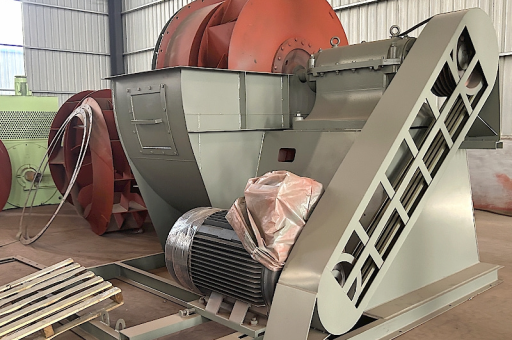
This is a highly specific piece of industrial equipment. Let's break down the terminology to understand exactly what this fan is and where it is typically used.
Core Definition: This is a high-efficiency, heavy-duty centrifugal fan designed to move hot, potentially abrasive flue gases from a Circulating Fluidized Bed (CFB) boiler to the atmosphere (typically through a baghouse or electrostatic precipitator and then a chimney).
Here is a detailed breakdown of each component of the description:
"Stainless Steel"
- Why it's used: The flue gas from a CFB boiler is extremely harsh.
- Corrosion: It contains acidic components (sulfur oxides, nitrogen oxides) that, when combined with moisture, can cause severe corrosion.
- Erosion: It contains high concentrations of fly ash and unburned carbon particles moving at high velocity.
- Material Grade: Typically Duplex Stainless Steel (e.g., 2205) or Austenitic Stainless Steel (e.g., 316L, 310S for higher temperatures). The impeller (wheel) is almost always stainless steel, and the housing (volute) may be lined with stainless steel or have a stainless steel cladding.
- Benefit: Extends the fan's lifespan significantly compared to carbon steel, which would require heavy coatings (like rubber or ceramic) that can fail over time.
"Energy Saving"
- How it achieves this:
- High Efficiency: Backward curved blades are inherently 10-15% more efficient than forward curved or radial blades.
- Variable Speed Drive (VSD): In modern plants, this fan is almost always paired with a VFD (Variable Frequency Drive) on the motor. This allows the fan speed to precisely match the boiler's load, avoiding wasteful throttling with dampers.
- Aerodynamic Design: CFD (Computational Fluid Dynamics) optimized inlets and volutes reduce turbulence and internal friction.
"Backward Curved" (Blade Type)
This is the most critical design feature. The blades curve away from the direction of rotation.
| Feature | Advantage | Why for CFB Boilers |
|---|---|---|
| Self-Limiting Power | The power curve peaks at a certain flow rate. If the system resistance decreases (unlikely), the motor won't overload. | Safety: Protects the motor from burn-out during upset conditions. |
| High Efficiency | The airflow exits the impeller with minimal turbulence. | Cost: Lower electricity consumption over the life of the plant. |
| Non-Clogging | The smooth, curved shape handles particle-laden gas better than radial blades. | Reliability: Less build-up of ash on the blades, reducing vibration. |
"CFB Boiler" (Circulating Fluidized Bed)
- The Application: This is the "job" the fan does.
- Role: The Induced Draft (ID) Fan is the "vacuum cleaner" of the boiler. It pulls the hot, dirty flue gas through the boiler's backpass (superheater, economizer, air heater), through the pollution control equipment (baghouse/ESP), and finally out the stack.
- Operating Conditions:
- Flow: Extremely high (hundreds of thousands to millions of CFM).
- Pressure: Moderate to high (typically 20-40 inches w.g. or 5-10 kPa).
- Temperature: Hot (typically 140°C to 180°C / 280°F to 360°F after the air heater, but can be higher in upset conditions).
- Gas: Abrasive (high ash content) and corrosive.
"Induced Draft Fan"
- Positioning: Located at the end of the flue gas path (after the pollution control equipment).
- Function:
- It creates negative pressure (draft) in the furnace to ensure safe combustion.
- It overcomes the pressure drop caused by the boiler itself, the air heater, the baghouse/ESP, and the ductwork.
Key Design & Material Specifications
For a project specifying this fan, you would typically look for:
- Impeller Material: SS 316L (for typical temperatures) or SAF 2205 (Duplex, for higher strength and corrosion resistance). The blades must be thick and reinforced to resist erosion.
- Housing Material: Stainless steel or carbon steel with a stainless steel liner in the high-wear areas (the cut-off / "tongue" of the scroll).
- Shaft: Stainless steel or forged steel with a stainless steel sleeve where it passes through the shaft seal.
- Bearings: Heavy-duty, oversized self-aligning spherical roller bearings with a high-temperature grease system or an oil bath.
- Bearing Cooling: A fan housing heat shield and a cooling fan on the shaft to prevent heat from the hot gas from reaching the bearings.
- Shaft Seal: A high-temperature, low-leakage seal (labyrinth or mechanical) to prevent air from leaking in (which wastes energy) or gas from leaking out (which is a safety hazard).
- Coupling: A flexible coupling designed to handle the high torque, often with a spacer for easy bearing removal.
- Motor: Typically a high-voltage (e.g., 6.6kV or 11kV) , high-efficiency squirrel-cage induction motor. Must be rated for VFD (Variable Frequency Drive) use.
Typical Applications (Beyond just power generation)
- Utility Power Plants (Coal/Biomass) : The most common application.
- Industrial Boilers: For chemical plants, refineries, paper mills, and sugar mills.
- Waste-to-Energy Plants: Where the gas is particularly corrosive due to plastics and other waste.
Summary for Procurement
If you are specifying or purchasing this fan, your inquiry should include:
- Fluid: Flue gas from CFB coal/biomass combustion.
- Flow (ACFM/Nm³/hr): [Value]
- Static Pressure (in wg / kPa): [Value]
- Gas Temperature (°C/°F): [Normal & Maximum]
- Gas Density: [Value]
- Dust Loading (gr/ft³ or mg/Nm³): [Value]
- Material: Impeller in Duplex 2205, Housing in SS 316L.
- Drive: Direct drive with VFD.
- Standards: API 673 (for heavy-duty centrifugal fans) or ISO 1940 (for balancing).
In short: This is a top-tier, specialized piece of rotating equipment. It's not a standard ventilation fan. It's a custom-engineered machine designed for maximum reliability and efficiency in the most demanding industrial environment: a large-scale CFB boiler.





