
This article's table of contents introduction:
- The Core Concept: The "Zero-Leakage" Imperative
- Key Engineering Features for Zero-Leakage & Industrial-Grade Protection
- Application Scenarios
- Critical Specifications to Demand
- Major Manufacturers for This Fan Type
- Final Verdict
Your query highlights two critical, non-negotiable requirements for industrial ventilation in hazardous environments: Zero-Leakage and Industrial-Grade Protection.
Here is a detailed breakdown of what this type of fan is, the engineering behind it, and the specific standards it must meet to operate safely in explosive or corrosive atmospheres.
The Core Concept: The "Zero-Leakage" Imperative
In hazardous environments (e.g., chemical plants, oil refineries, hydrogen handling), the fan is not just moving air; it is often moving explosive, toxic, or corrosive gases. Zero-leakage means the fan's shaft penetration (where the rotating shaft exits the fan housing to connect to the motor) must have a 100% seal. Any leak here could:
- Cause an Explosion: Release flammable gas into the surrounding environment where the motor or drive components could ignite it.
- Create Toxic Exposure: Release lethal gases (e.g., H₂S, CO, chlorine) into the work area.
- Waste Product: Lose expensive process gases (e.g., hydrogen, helium, specialty chemicals).
Key Engineering Features for Zero-Leakage & Industrial-Grade Protection
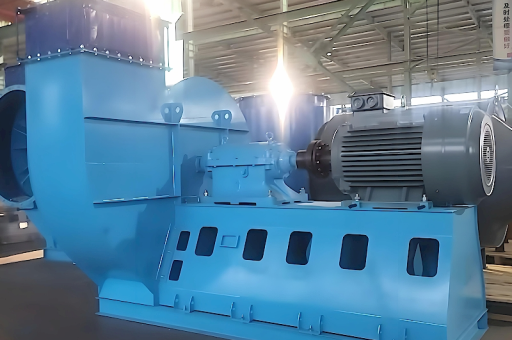
A standard industrial fan is not suitable. This specific application requires a "Gas-Tight" or "Hermetically Sealed" centrifugal fan design. Here are the critical components:
The Shaft Seal (The Most Critical Component)
This is the primary defense against leakage. Several technologies are used, depending on the gas and pressure:
- Magnetic Drive (Canned Motor): The ultimate zero-leakage solution. No shaft penetration exists. The motor's rotor is enclosed in a "can" (a thin metal barrier) and driven magnetically through the can by an external stator. The gas is completely isolated.
- Best for: Highly toxic, explosive, or expensive gases.
- Dual Mechanical Seal with Buffer Fluid: The shaft is sealed by two mechanical seals in tandem. The space between them is filled with a pressurized, inert buffer fluid (e.g., nitrogen or clean oil) at a pressure higher than the process gas. If a seal fails, the buffer leaks into the gas stream (or out to a safe vent), preventing gas from escaping.
- Best for: High-pressure, high-temperature hazardous gases.
- Gas Barrier Seal (Labyrinth + Purge): A non-contacting, multi-stage labyrinth seal is continuously purged with an inert gas (N₂) at a pressure higher than the fan's internal pressure. The clean gas flows both inward (into the fan) and outward (to the atmosphere), creating a barrier that prevents process gas leakage.
- Best for: Lower pressure, direct-drive applications.
Spark-Resistant Construction (ATEX/IECEx Compliance)
"Industrial-Grade Protection" in hazardous environments is defined by ATEX (in Europe) or IECEx (International) and NEC Class/Division (in North America). For a gas-tight fan, the most common zones are:
- Zone 1/Division 1: Explosive atmosphere is likely to occur.
- Zone 2/Division 2: Explosive atmosphere is not likely to occur normally.
Construction features:
- Impeller Material: Aluminum or non-ferrous alloys (to prevent sparks from impact).
- Housing Material: Steel or stainless steel.
- Minimum Radial Clearance: The gap between the impeller and housing is larger than standard (e.g., >1/70th of impeller diameter) to prevent metal-to-metal contact from thermal expansion or debris.
- Earthing/Bonding: All components must be electrically bonded to prevent static discharge.
- External Motor: Must be an explosion-proof motor with the correct temperature class (T-class) for the gas.
Robust Casing Design
- Weld Integrity: Welds must be fully penetrated and leak-tested (e.g., hydrostatic test at 1.5x working pressure, followed by a helium leak test for vacuum-level tightness).
- Drain Connections: Designed with minimal dead space to prevent gas accumulation, often with a plugged connection for leak testing rather than constant draining.
- Flanges: Standard raised-face or ring-type-joint flanges for secure, leak-tight pipe connections.
Application Scenarios
| Application | Hazard Type | Recommended Fan Type |
|---|---|---|
| Fume Hood Exhaust (Pharma/Lab) | Toxic, flammable vapors | Magnetic drive, PTFE or stainless steel wetted parts. |
| Offshore Oil/Gas Flare Gas | High-pressure flammable gas, corrosive trace elements | Dual mechanical seal with buffer fluid, ATEX II 2G, high-temperature bearings. |
| Hydrogen Ventilation | Extremely flammable, very light gas | Gas barrier seal with N₂ purge (to prevent H₂ migration), explosion-proof motor. |
| Chlorine Transfer | Highly toxic, corrosive, poisonous | 100% magnetic drive (canned motor), Hastelloy or PVDF housing (for corrosion). |
| Solvent Recovery (Printing/Paint) | Flammable solvent vapors, typically low temperature | Spark-resistant aluminum impeller, gas barrier seal (to prevent vapor escape into the motor area). |
Critical Specifications to Demand
When specifying a fan for this purpose, you must ask for the following documentation from the manufacturer:
- ATEX / IECEx Certificate: Must state the specific gas group (I, IIA, IIB, IIC) and temperature class (T1-T6) for the entire fan assembly (not just the motor).
- Leak Rate Testing: The manufacturer should provide a certified leak test report. A "zero-leakage" fan is often spec'd to a Leak Rate of < 1.0 x 10⁻⁶ mbar·L/s He (Helium leak test). This is effectively zero leakage.
- Material Certificates: Mill test reports (EN 10204 3.1 or 3.2) for all wetted components, especially the shaft, impeller, and housing.
- Critical Speed Analysis: A rotor dynamics analysis to ensure the shaft runs safely below its first critical speed, preventing destructive vibration.
- Vibration Limit: Must meet ISO 1940 G2.5 or G1.0 balance grade to ensure long seal life.
Major Manufacturers for This Fan Type
You will need to speak with specialized, high-end industrial fan manufacturers, not general HVAC suppliers:
- Howden (Heavy process gas, magnetic drive, double-sealed)
- Körting Hannover (German specialist in gas-tight and vacuum fans)
- Cincinnati Fan (North American leader in spark-resistant, gas-tight custom fans)
- New York Blower (Heavy industrial, high-temperature, and ATEX-rated fans)
- Dynaseco (Canadian specialist in zero-leakage chemical fans)
Final Verdict
A Zero-Leakage Industrial Centrifugal Fan for Hazardous Environments is a highly engineered, custom-built safety device. The "zero-leakage" requirement dictates a Gas-Tight design, with Magnetic Drive (Canned Motor) being the safest and most absolute solution, followed by a Dual Mechanical Seal with Pressurized Buffer Fluid.
You cannot buy this "off the shelf." You must provide the manufacturer with:
- The exact gas composition and concentration.
- Operating temperature and pressure.
- Flow rate (CFM/m³/hr) and static pressure (inches w.g./Pa).
- Required ATEX/IECEx zone and gas group.
Safety Note: Never attempt to use a standard ventilation fan in a hazardous environment by adding a simple seal. The risk of catastrophic failure (fire, explosion, toxic release) is extremely high. Always consult with a certified hazardous location engineer and use a fan tested and certified to the applicable standards (ATEX, IECEx, NEC).





