
This article's table of contents introduction:
- Why This Setup is Ideal for Smelting Furnaces
- Key Technical Components of the System
- Potential Failure Modes & Maintenance
- Summary Table
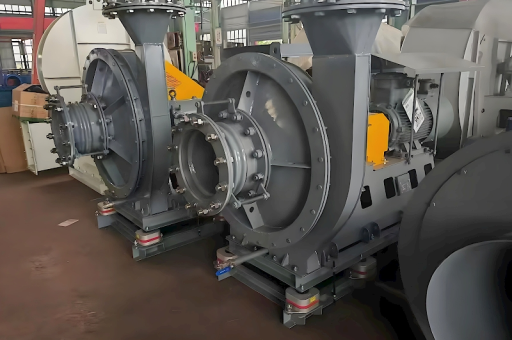
It sounds like you are describing a heavy-duty industrial centrifugal fan system where a V-belt drive is used to power a ventilation fan for a smelting furnace.
This is a very common and robust configuration in metallurgy, foundries, and high-heat manufacturing. Here is a breakdown of why this specific combination ("V-Belt Drive, Steady Operating, Durable") is ideal for this application, along with key technical considerations.
Why This Setup is Ideal for Smelting Furnaces
Smelting furnaces create a brutal environment: extreme heat, airborne particulates (dust, slag), and corrosive gases. The V-belt driven centrifugal fan is the workhorse of this environment.
V-Belt Drive (The "Flexible" Power Link)
- Motor Protection: The belt acts as a mechanical fuse. If the fan jams (e.g., from debris or bearing failure), the belt will slip or break instead of burning out the electric motor.
- Speed Control (Tensioning): You can easily change the fan speed (RPM) by changing the pulley diameters (sheaves) on the motor or fan shaft, allowing you to tune the ventilation rate without expensive VFDs.
- Vibration Dampening: The belt absorbs minor shocks and vibrations from the motor, preventing them from transferring to the fan bearings and the furnace structure.
- Cost-Effective: V-belts and standard motors are significantly cheaper than direct-drive (shaft-mounted) or gear-driven solutions for high-horsepower applications.
Steady Operating (The "Run 24/7" Factor)
- Heat Dissipation: The belt drive allows the motor to be placed outside the direct heat zone of the furnace. This is critical. The motor can be mounted on a floor stand or wall bracket 10-20 feet away.
- Continuous Duty: Smelting is often a batch or continuous process. A properly tensioned multi-groove V-belt (e.g., B-section or C-section) can run for thousands of hours with minimal maintenance.
- Consistent Airflow: Properly aligned pulleys and matched belt sets ensure the fan turns at a constant, predictable speed, which maintains the critical draft needed to control furnace temperature and exhaust toxic fumes (CO, SO2, etc.).
Durable (The "Survivor" Factor)
- Fan Material: The centrifugal fan itself is typically heavy-gauge steel or stainless steel (for corrosion resistance against acid gases) with a robust radial or backward-curved blade design.
- Shaft Seals: A durable shaft seal prevents hot, dirty air from entering the fan bearings.
- Belt Life: While belts wear, they are a sacrificial component. Replacing a $50 belt every 6 months is far better than replacing a $5,000 motor or gearbox. Industrial belts (like Gates or Fenner) are designed for high-tension, high-temperature environments.
Key Technical Components of the System
- The Motor: Usually a TEFC (Totally Enclosed Fan Cooled) or TEBC (Totally Enclosed Blower Cooled) motor rated for high ambient temperatures. Often oversized by 10-15% to account for belt losses and start-up torque.
- The Pulleys (Sheaves):
- Motor Sheave (Driver): Smaller diameter, high-speed.
- Fan Sheave (Driven): Larger diameter, slower speed (fans run slower than motors).
- Material: Cast iron or steel. Keyed and bushed for a tight fit.
- The Belts:
- Type: V-belts (A, B, C, D sections, or banded belts for high power).
- Quantity: 2, 3, or 4 belts in parallel (matched sets).
- The Fan:
- Type: Centrifugal (Squirrel Cage).
- Housing: Scroll type, robust.
- Inlet/Outlet: Designed for ductwork and high static pressure.
- The Base: A heavy steel base (I-beam or channel) that can handle the weight and vibration. Often includes adjustable motor sliding rails for belt tensioning.
Potential Failure Modes & Maintenance
- Belt Slippage: The most common issue. Caused by wear, overtensioning (bearing failure), or undertensioning (slipping). Fix: Tension with a belt tension gauge.
- Belt Misalignment: Causes rapid belt wear and noise. *Fix: Align pulleys with a straightedge or laser.**
- Bearing Failure: On the fan and motor. Caused by heat, dust ingress, or belt tension. Fix: Greasing schedule + heat-resistant grease.
- Fan Imbalance: Buildup of dust (dust cake) on the fan blades. Fix: Periodic cleaning or a "water wash" system.
- Pulley Wear: Grooves wear down over time, causing belt failure. Fix: Replace pulleys every 2-3 belt changes.
Summary Table
| Component | Why it's the right choice | Key Specification |
|---|---|---|
| V-Belt Drive | Motor protection, speed change, dampening | B-section, 3-5 belts |
| Steady Operating | 24/7 reliability, constant draft | Continuous duty, matched belts |
| Durable | Survives heat, dust, corrosion | Cast iron pulleys, sealed fan bearings |
| Centrifugal Fan | High static pressure, handles heavy air | Radial or Backward-inclined blade |
| Smelting Furnace | Extreme heat, toxic gases, heavy dust | Inlet damper for flow control |
In short: This is a proven, low-maintenance, and highly reliable industrial standard. If you are sourcing or maintaining this system, the critical success factors are pulley alignment, belt tension, and selecting heat-resistant belts.





