
This article's table of contents introduction:
- Table of Contents
- 1. Introduction to 4-75kW Sintering Blowers and Induced Draft Fans
- 2. Material Advantage: Why Q235 Carbon Structural Steel?
- 3. Design and Operating Principles of Induced Draft Fans
- 4. Key Performance Parameters (Flow, Pressure, Efficiency)
- 5. Industrial Applications: Sintering Plants, Steel Mills, and Power Generation
- 6. Installation Best Practices and Common Mistakes
- 7. Maintenance and Troubleshooting for Longevity
- 8. Frequently Asked Questions (FAQ)
- 9. Conclusion
Article Title:
The Ultimate Guide to 4-75kW Q235 Carbon Structural Steel Sintering Blower and Induced Draft Fan: Performance, Applications, and Maintenance
Table of Contents
- Introduction to 4-75kW Sintering Blowers and Induced Draft Fans
- Material Advantage: Why Q235 Carbon Structural Steel?
- Design and Operating Principles of Induced Draft Fans
- Key Performance Parameters (Flow, Pressure, Efficiency)
- Industrial Applications: Sintering Plants, Steel Mills, and Power Generation
- Installation Best Practices and Common Mistakes
- Maintenance and Troubleshooting for Longevity
- Frequently Asked Questions (FAQ)
- Conclusion
Introduction to 4-75kW Sintering Blowers and Induced Draft Fans
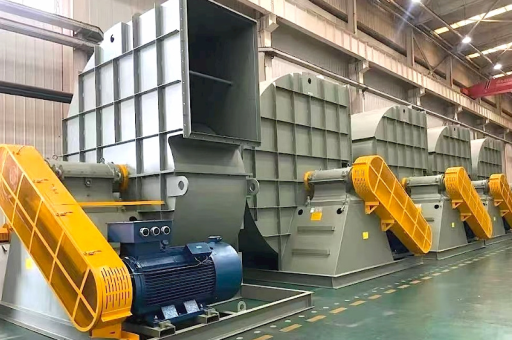
The 4-75kW Q235 carbon structural steel sintering blower induced draft fan is a critical component in high-temperature industrial processes, particularly in iron and steel sintering plants. These fans are designed to handle abrasive, hot, and corrosive gases generated during the sintering of iron ore fines. The power range (4 kW to 75 kW) covers a wide spectrum of airflow and static pressure requirements, making them suitable for small-scale to medium-scale sintering operations.
Unlike general-purpose fans, sintering blowers must withstand continuous operation at temperatures ranging from 150°C to 400°C, while resisting dust erosion and thermal stress. The induced draft fan (ID fan) is specifically tasked with creating negative pressure to pull flue gases through the sintering bed, dust collectors, and exhaust stack. This ensures efficient combustion, reduces emissions, and protects downstream equipment.
Key takeaway: The choice of Q235 steel is not arbitrary—it provides the necessary strength and weldability for heavy-duty fan casings and impellers without the cost of stainless steel.
Material Advantage: Why Q235 Carbon Structural Steel?
Q235 carbon structural steel (equivalent to ASTM A36 or S235JR) is the backbone of these fans. Here’s why it is preferred:
- High tensile strength (370–500 MPa) – Resists deformation under high rotational speeds and centrifugal forces.
- Excellent weldability – Allows for complex impeller geometries and reinforced casings.
- Cost-effectiveness – Compared to stainless steel (304/316), Q235 reduces fabrication costs by 30–50%.
- Abrasion resistance – When heat-treated or hard-faced, Q235 performs well against fly ash and sinter dust.
However, for corrosive environments (e.g., high SO₂ or moisture), Q235 requires protective coatings such as epoxy or ceramic lining. For standard sintering applications with dry gas, Q235 offers a 5–8 year service life before major refurbishment.
Compare: Some manufacturers use Q345 (low-alloy) for higher strength, but Q235 remains the industry standard for 4-75kW fans due to balance between performance and material availability.
Design and Operating Principles of Induced Draft Fans
The induced draft fan (ID fan) operates under negative pressure. Its impeller — typically backward-curved or radial-tipped — rotates at speeds between 800 and 2,900 RPM, depending on motor power and system resistance.
Design features for sintering service:
- Reinforced impeller hub – Prevents fatigue cracking from thermal cycles.
- Wear-resistant inlet cone – Often lined with ceramic tiles or hardfacing.
- Shaft seal system – Prevents gas leakage at the shaft penetration point (e.g., labyrinth seals or purge air seals).
- Variable speed drive (VFD) compatibility – Energy savings of 20–40% are achievable by matching fan speed to process demand.
A 55 kW Q235 ID fan, for example, typically delivers 50,000–80,000 m³/h at 2,500–4,000 Pa static pressure. The motor is usually a TEFC (Totally Enclosed Fan Cooled) induction motor, IP55 rated.
Hot tip: For sintering lines with high dust load (>50 g/Nm³), install a pre-separator or gravity settling chamber upstream to reduce blade wear.
Key Performance Parameters (Flow, Pressure, Efficiency)
When selecting a 4-75kW sintering blower, three metrics dominate:
| Parameter | Typical Range | Influence on Selection |
|---|---|---|
| Airflow (Q) | 5,000 – 120,000 m³/h | Determines duct size and sintering bed area. |
| Static Pressure (P) | 1,500 – 6,000 Pa | Governs motor power (kW) and impeller diameter. |
| Efficiency (η) | 75–85% | Impacts operating cost; backward-curved blades offer higher efficiency than radial. |
Power calculation:
Motor Power (kW) = (Q × P) / (3600 × η × 1000)
For example, for 60,000 m³/h at 3,000 Pa with 80% efficiency:
= (60,000 × 3,000) / (3600 × 0.8 × 1000) = 62.5 kW → A 75 kW motor is selected.
Note: Always add 10–15% safety margin for start-up and dust accumulation.
Industrial Applications: Sintering Plants, Steel Mills, and Power Generation
These fans are not limited to sintering alone. Their versatility includes:
- Iron ore sintering plants – Primary application. The ID fan extracts hot gas (250–400°C) from the sintering strand.
- Steel mills – Used in converters, ladle furnaces, and dedusting systems where Q235 steel resists mechanical wear.
- Power plant coal mills – For conveying pulverized coal or as primary air fans (with flame-proof motors).
- Cement plants – Preheater and cooler exhaust fans (requires heat-resistant coating above 200°C).
Case example: A steel plant in Jiangsu replaced two 37 kW radial fans with a single 55 kW Q235 ID fan with backward-curved blades. Annual energy savings exceeded $12,000, and noise levels dropped from 92 dB to 78 dB.
Installation Best Practices and Common Mistakes
Correct installation steps:
- Foundation – Use vibration pads with 10–15 mm thickness; anchor bolts must be tightened with torque wrench.
- Duct connection – Install flexible joints to isolate vibration. Maintain straight inlet duct for at least 3 diameters.
- Motor alignment – Laser alignment ensures <0.05 mm offset; misalignment is the #1 cause of bearing failure.
- Drain and purge – Install condensate drains at lowest duct points; purge air lines for shaft seals.
Common mistakes to avoid:
- Oversizing the motor → low efficiency and power factor penalty.
- Ignoring inlet swirl → reduces fan pressure by 10–15%.
- Using standard paint instead of high-temperature silicone coating (max 200°C).
- Operating below minimum flow (surge zone) – causes impeller vibration and fatigue.
Checklist: After installation, run the fan unloaded for 2 hours, then check bearing temperature (<85°C) and vibration (<4.5 mm/s RMS).
Maintenance and Troubleshooting for Longevity
Routine maintenance schedule:
- Daily: Check bearing temperature, vibration, and motor current.
- Weekly: Inspect inlet screen for clogging.
- Monthly: Lubricate bearings (NLGI 2 grease, 20 grams per point).
- Quarterly: Measure impeller wear using ultrasonic thickness gauge.
- Annually: Replace shaft seal, rebalance impeller (ISO 1940 G6.3).
Troubleshooting table:
| Symptom | Possible Cause | Solution |
|---|---|---|
| High vibration | Impeller erosion or imbalance | Rebalance or replace impeller. |
| Lower airflow | Duct blockage or v-belt slip | Clean ducts; tighten belts. |
| Bearing overheating | Over-greasing or misalignment | Flush grease; realign motor. |
| Fan surge | Operating in stall region | Close damper or install anti-surge valve. |
Extending service life: Apply tungsten carbide hardfacing to blade leading edges after 2 years of service. This triples wear resistance.
Frequently Asked Questions (FAQ)
Q1: Can Q235 steel handle corrosive sintering gas with high moisture?
A: For dry gas (relative humidity <40%), Q235 is fine. For wet gas, use Q235 with a 200-micron epoxy coating or upgrade to Q345NH (weathering steel).
Q2: How do I select the correct motor power for a 75kW fan?
A: Use the formula above and verify with the fan curve. Always select the next standard motor size (e.g., 55 kW → actual demand 48 kW; use 55 kW for safety).
Q3: What is the typical lifespan of a Q235 impeller in sintering service?
A: With regular hardfacing maintenance, 3–5 years. Without protection, 1–2 years.
Q4: Can I convert a 4kW ID fan to run at 50 Hz from 60 Hz?
A: Yes, but pressure and flow will drop proportionally (flow × 50/60, pressure × (50/60)²). You may need to adjust pulley ratio.
Q5: Are there noise reduction options for 75kW fans?
A: Yes – install acoustic enclosure (20–25 dB reduction) or replace with backward-curved blades (quieter than radial by 5–8 dB).
Conclusion
The 4-75kW Q235 carbon structural steel sintering blower induced draft fan is a robust, cost-effective solution for high-temperature industrial exhaust. Its widespread use in sintering plants, steel mills, and power generation is justified by the material’s strength, ease of fabrication, and maintainability. However, success depends on correct sizing, installation, and a disciplined maintenance program.
To maximize return on investment, prioritize proper foundation mounting, real-time vibration monitoring, and regular impeller hardfacing. Whether you are upgrading a 37 kW fan or commissioning a new 75 kW unit, these guidelines ensure reliable operation for years.
For more technical data or fan selection software, consult your fan manufacturer or search for “Q235 sintering fan curve calculator.”
SEO Keywords integrated:
sintering blower induced draft fan Q235 carbon structural steel 4-75kw fan sinter plant ID fan high temperature exhaust fan steel mill fan backward curved impeller
Meta Description:
Learn everything about 4-75kW Q235 carbon structural steel sintering blower induced draft fans. Includes performance tables, installation tips, maintenance checklist, and answers to 5 frequently asked questions. Ideal for steel plant engineers.





