
This article's table of contents introduction:
- Core Specification Breakdown
- Typical Engineering & Design Features
- Why is Abrasion Resistance the Key Spec?
- Potential Challenges & Considerations for Purchasing
- Summary Table
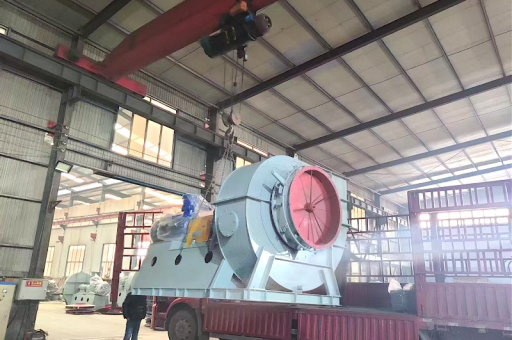
This is a specification for a high-powered, specialized industrial fan. Here is a detailed breakdown of what this specification means, the engineering challenges involved, and key considerations for procurement or application.
Core Specification Breakdown
- 200 kW (Kilowatts): This is the motor power. It indicates a very large, high-energy fan. For context, 200 kW is roughly equivalent to 268 horsepower. This fan is not a small ventilation unit; it is a primary piece of process equipment that will draw significant electrical current (potentially 300-400 Amps at 480V).
- Abrasion Resistant: This is the most critical material specification. The fan will handle gas streams containing particulate matter (fly ash, coal dust, sand, etc.) that will erode standard steel very quickly. It implies the use of:
- Hard-facing: Weld overlay of chromium carbide or tungsten carbide on leading edges of blades.
- Thicker Materials: Using AR400, AR500, or Hardox steel plate for the impeller and housing.
- Replaceable Liners: The housing is likely lined with bolt-on wear plates that can be swapped out during maintenance.
- Heavy Duty: This refers to the mechanical design and robustness. It implies:
- Robust Shaft & Bearings: Oversized shafts with heavy-duty spherical roller bearings (often with a separate cooling fan or oil lubrication system).
- Rigid Housing: Thick-walled, reinforced casing to withstand high static pressures and potential vibration.
- High Safety Factor: Designed for continuous 24/7 operation with minimal margin for failure.
- Induced Draft (ID) Fan: This defines the fan's location and function within the power plant cycle.
- Location: Located at the end of the flue gas path, after the dust collector (ESP or Baghouse), scrubber, and air preheater.
- Function: It pulls (induces) a negative pressure (vacuum) through the boiler, drawing flue gases out and up the stack.
- Challenge: It handles the hottest, dirtiest, and most corrosive gases in the plant.
- For Power Plants: This sets the context. The fan will operate under strict environmental regulations, contribute to overall plant efficiency (or be a major parasitic load), and must comply with safety codes relevant to high-temperature, explosive (dust), or rotating machinery.
Typical Engineering & Design Features
An ID fan meeting this spec will likely include:
-
Impeller Type:
- Radial (Paddle Wheel): Simple, rugged, excellent for abrasive media. Lower efficiency but high durability.
- Backward Inclined (Airfoil or Flat): More efficient (lower energy cost for a 200kW motor is significant), but more susceptible to abrasion and dust buildup. If used, they will have heavy gauge, hardened blades.
- High-Efficiency with Hard-Facing: A modern compromise is a backward-curved blade with thick leading edges and full hard-facing.
-
Peripheral Speed:
Very high (typically over 100 m/s or 330 ft/s). The kinetic energy of the particles hitting the blade at this speed is immense, requiring the abrasion resistance.
-
Variable Speed Control (Critical):
- A 200kW fixed-speed fan is very inefficient for variable load. It will almost certainly be driven by a Variable Frequency Drive (VFD) or have a Hydraulic Coupling for speed control to match boiler load and prevent over-drafting.
-
Bearing & Lubrication:
- Sleeve Bearings (Journal Bearings): More common for very heavy, high-speed shafts like this.
- Rolling Element Bearings: Used if a forced oil lubrication system is designed. A "Heavy Duty" spec will likely include a forced oil lubrication system with a pump, filter, cooler, and flow switches.
-
Sealing & Cooling:
- Shaft Seals: Mechanical seals or carbon ring seals to prevent hot, dusty gas from leaking out of the housing and into the bearing housing.
- Shaft Cooling: A fan (or separate cooling blower) on the shaft to cool the bearing housing and prevent heat migration from the hot gas.
Why is Abrasion Resistance the Key Spec?
The economic driver for an abrasion-resistant ID fan is Maintenance Cost and Downtime.
- Unprotected Fan: An unprotected impeller handling fly ash will have its blades eroded to paper-thin edges in 6-12 months. This destroys the fan's performance (lower pressure, lower flow) and leads to catastrophic failure (blade detachment, massive vibration, bearing failure).
- Protected Fan (Properly Designed): A hard-faced impeller can last 3-5 years or more, with only occasional liner replacement in the housing.
Potential Challenges & Considerations for Purchasing
- Cost: A 200kW abrasion-resistant fan is a major capital investment. Price will be heavily influenced by the material grade (AR400 vs. CrC overlay vs. full ceramic lining).
- Weight & Installation: The fan will be extremely heavy (likely 5-10 tons for the impeller alone, 15-30 tons for the entire assembly). Requires a heavy foundation, overhead crane access, and specialized rigging.
- Vibration Monitoring: A heavy-duty fan of this power must have dedicated vibration sensors (accelerometers) connected to a plant control system to trigger alarms and trips before catastrophic failure.
- Balance: The impeller must be dynamically balanced to a very high precision (e.g., ISO 1940 G2.5 or G1.0) due to the high rotational forces.
- Inlet & Outlet Connections: The ductwork to and from the fan must be properly designed to minimize turbulence, erosion, and pressure drop. An improper inlet box can destroy efficiency and cause premature failure.
- Corrosion: If burning high-sulfur coal, the flue gas may be acidic (sulfuric acid dew point). The fan may require corrosion-resistant coatings or special alloys (e.g., Corten steel, 316L SS, or even higher alloys) in addition to abrasion resistance.
Summary Table
| Feature | Implication for "200kW Abrasion Resistant ID Fan" |
|---|---|
| Size | Very large, heavy (multiple tons). |
| Material | Hardox, AR400/500, Chromium Carbide overlay, or Ceramic lining. |
| Drive | VFD or Fluid Coupling (Variable Speed). |
| Bearing | Heavy-duty, forced oil lubrication, with separate cooling. |
| Function | Creates negative pressure at the tail end of a boiler. Handles hot, dirty, corrosive gas. |
| Main Driver | Abrasion resistance (to reduce downtime). |
| Risk | High centrifugal forces (impeller explosion hazard if balance is lost). High maintenance cost if material spec is wrong. |
Conclusion: You are specifying a critical, high-maintenance, and high-capital piece of equipment. The success of this fan hinges entirely on the quality of its abrasion-resistant materials and the robustness of its bearing and shaft system. A cheap version of this fan will be a constant source of downtime and repair cost. A properly engineered one will be the workhorse of the power plant for over a decade.





