
This article's table of contents introduction:
- Core Function: The "Draft" System
- The Ideal Solution: Centrifugal Fans (The Workhorse)
- Critical Design Considerations for Boiler Exhaust Fans
- A Note on "Blowers"
- Summary: Choosing Your Fan
- Final Recommendation
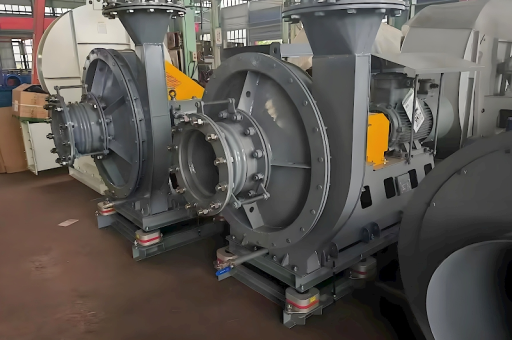
This is a very specific and important industrial application. Using the correct fan for steam boiler exhaust is critical for safety, efficiency, and compliance. Here is a detailed breakdown of the types of fans used for steam boiler exhaust, focusing on Centrifugal Fans and Blowers.
Core Function: The "Draft" System
In a steam boiler system, the fan's primary job is to manage the "draft" – the flow of combustion air into the boiler and the flow of flue gas (exhaust) out. There are three main configurations, but the first two are most relevant to your query:
- Induced Draft (ID) Fan: Located after the boiler. It pulls hot, dirty flue gases through the boiler, economizer, and pollution control equipment, creating a negative pressure in the furnace.
- Forced Draft (FD) Fan: Located before the boiler. It pushes ambient air into the burner for combustion. This is less common for exhaust but directly related.
- Balanced Draft: Uses both an FD fan (pushes air in) and an ID fan (pulls exhaust out) for precise pressure control.
For "Industrial Exhaust Fans For Steam Boilers," you are almost certainly referring to an Induced Draft (ID) Fan.
The Ideal Solution: Centrifugal Fans (The Workhorse)
Centrifugal fans are the standard for boiler exhaust because they are excellent at handling high temperatures, particulates, and variable flow rates against significant system resistance (static pressure).
Here are the specific types you will encounter:
Radial Blade Fans (Also known as "Paddle Wheel" or "Material Handling" Fans)
- Best For: Highly abrasive or particulate-laden flue gases (e.g., from coal or biomass boilers).
- Key Feature: A flat, radial paddle wheel design. It is robust, simple, and self-cleaning. It generates high pressure.
- Pro: Extremely durable, least likely to clog.
- Con: Lowest efficiency (can be noisy).
Backward Inclined (BI) / Backward Curved (BC) Fans
- Best For: Cleaner gas streams, higher efficiency applications (e.g., natural gas or oil-fired boilers).
- Key Feature: Blades curve away from the direction of rotation.
- Pro: High efficiency, non-overloading horsepower characteristic (power draw peaks and then drops, preventing motor burnout).
- Con: Less tolerant of dirty or sticky particulates. Blades can accumulate material.
Airfoil (AF) Fans
- Best For: Very large, clean, high-efficiency systems.
- Key Feature: Hollow, airfoil-shaped blades (like an airplane wing).
- Pro: Highest efficiency of all centrifugal fans.
- Con: Very sensitive to dust and erosion. The most expensive option.
Forward Curved (FC) Fans (Squirrel Cage)
- Best For: Low-pressure, high-volume applications (rarely used for primary boiler ID).
- Key Feature: Blades curve forward in the direction of rotation.
- Pro: Compact, relatively quiet.
- Con: Low structural strength, prone to clogging, has a "overloading" horsepower curve (can stall motor if ductwork is blocked). Not recommended for boiler exhaust.
Critical Design Considerations for Boiler Exhaust Fans
When selecting a fan for this application, these factors are non-negotiable:
Temperature
- Standard ID Fan: Typically rated for 200°C - 250°C (400°F - 480°F).
- High-Temperature ID Fan: Can handle 400°C+ (750°F+) using:
- Special Alloys: (e.g., Corten, 316L Stainless Steel) in the wheel and shaft.
- Water-Cooled Bearings: A jacket around the bearing housing circulates cooling water.
- Heat Slinger (or Fan Shroud): A disc on the shaft near the housing prevents hot gas from traveling to the bearings.
Material
- Carbon Steel: Standard for clean, low-temp applications.
- Corten Steel: "Weathering steel" is excellent for corrosion resistance in acidic flue gas environments.
- Stainless Steel (316L, 310S): Necessary for high temperatures and corrosive chemicals.
Corrosion & Erosion (The "Killers")
- Acid Dew Point: Flue gases contain sulfur. If the gas temperature drops below the acid dew point (~120°C / 250°F for natural gas), it forms sulfuric acid, which destroys a standard steel fan.
- Abrasion: Fly ash from solid fuel is like sandblasting the impeller. You need thick materials, replaceable wear liners, or hard-facing on the blades.
Vibration & Balance
- ID fans run at high RPMs. A small imbalance can damage bearings and the boiler stack.
- Required: Dynamic balancing (ISO 1940 G6.3 or G2.5 grade).
- Optional but recommended: Vibration monitoring sensors (accelerometers) with automatic alarms/shutdown.
Drive Type
- Direct Drive: Motor shaft is directly coupled to the fan shaft. Higher efficiency, but fan speed is fixed (unless using a VFD).
- Belt Drive: Uses pulleys and belts. Allows for speed changes (by changing pulley sizes) and isolates motor from fan vibration. Slightly less efficient but more flexible.
- Variable Frequency Drive (VFD): The gold standard. Allows you to modulate fan speed to precisely match boiler load, saving massive amounts of energy compared to using a damper.
Shaft & Seal
- Shaft Seal: Prevents hot flue gas from leaking out along the shaft. Common types: labyrinth seals, carbon ring seals, or purge air seals.
- Shaft Diameter: Must be large and strong enough to handle the torque without whipping.
A Note on "Blowers"
In industrial settings, the term "Blower" is often used interchangeably with "Fan," but there's a technical distinction:
- Fan: Low pressure rise (< 1 psi / 27.7" w.g.) - Typically used for boiler ID.
- Blower: Medium pressure rise (1-15 psi) - Used for FD fans on small boilers or for air sparging.
- Compressor: High pressure (>15 psi)
In the context of steam boilers, a Centrifugal Fan is nearly always the correct term for the exhaust (ID) application. "Blower" is sometimes used for the smaller Forced Draft (FD) unit that pushes air into the burner.
Summary: Choosing Your Fan
| Application | Boiler Fuel | Best Fan Type | Material | Critical Features |
|---|---|---|---|---|
| Induced Draft (Exhaust) | Natural Gas / Oil | Backward Inclined (BI) | Corten or Carbon Steel | VFD, Chemical Seal, Corrosion-resistant coating |
| Induced Draft (Exhaust) | Biomass / Wood Pellets | Radial Blade (Paddle Wheel) | Carbon Steel with wear liners | Heavy-duty shaft, replaceable liners, erosion protection |
| Induced Draft (Exhaust) | Coal (with baghouse/ESP) | Airfoil (AF) or Backward Inclined | Stainless or Corten | High efficiency, VFD, precise balancing |
| Forced Draft (Combustion Air) | ALL | Forward Curved or Backward Inclined | Carbon Steel | Simple design, low static pressure, VFD |
Final Recommendation
If you are specifying a fan for an exhaust system:
- Get the flue gas analysis: Provide the fan manufacturer with the exact temperature, chemical composition, and particulate loading (mass flow, particle size, and abrasiveness).
- Specify a Centrifugal Fan.
- For solid fuel (coal/biomass): Choose a Radial Blade (Paddle Wheel) fan.
- For gas/oil: A Backward Inclined (BI) fan is the standard choice.
- Always include a VFD for energy savings and process control.
- Demand high-temperature design (water-cooled bearings, heat slinger) even if your current process is "cool."
Caution: Do not use a standard HVAC "exhaust fan" or a forward-curved fan for boiler exhaust. They will fail prematurely, potentially causing a boiler shutdown or a dangerous backdraft of carbon monoxide into the facility.
Would you like me to help you calculate the required CFM and Static Pressure for your specific boiler?





