
This article's table of contents introduction:
- Understanding the "14000 Pa" Rating
- Where is a 14,000 Pa Centrifugal Fan Used?
- Key Technical Specifications to Check
- Important Considerations for Purchase
- Summary Checklist for Sourcing
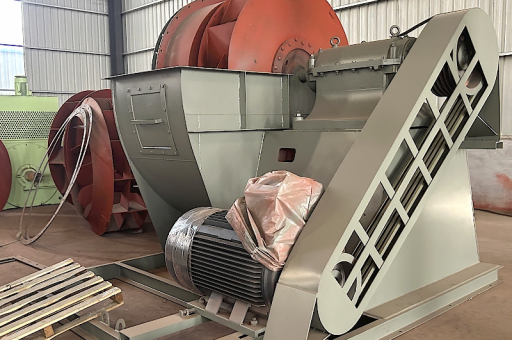
This is a specification for a centrifugal fan (also called a blower) with a static pressure rating of 14,000 Pascals (Pa) .
Here is a breakdown of what this specification means, where it is used, and key considerations.
Understanding the "14000 Pa" Rating
- What it is: Pressure (or "head"). In fan specifications, this usually refers to Static Pressure. It is the resistance the fan can overcome to move air.
- Scale: 14,000 Pa (14 kPa) is very high pressure.
- Comparison: A typical household bathroom fan is about 30-80 Pa.
- Comparison: A high-end industrial dust collector might be 2,000-4,000 Pa.
- Comparison: 14,000 Pa is roughly equal to 56 inches of water gauge (in. w.g.) or 2.0 PSI.
Where is a 14,000 Pa Centrifugal Fan Used?
This is an industrial-grade fan. It is not used for ventilation. It is used for material handling or high-resistance air systems. Common applications include:
- Pneumatic Conveying: Moving materials like plastic pellets, grains, powders, or wood chips through pipes over long distances or high vertical lifts. The high pressure is needed to overcome friction in the dense-phase conveying system.
- Industrial Dust Collection: For highly restrictive filters (e.g., HEPA, cartridge, or baghouse filters) that create very high pressure drops as they get dirty.
- Sintering / Furnace Air Supply: Forcing air through a deep bed of material (e.g., in a metal sintering plant or a combustion chamber).
- Aeration Systems: Deep water aeration in waste treatment plants where air must be forced down to the bottom of a deep tank through fine bubble diffusers.
- Vacuum Systems (High Vacuum): When run on the inlet side (suction), these fans can create strong suction for holding, lifting, or cleaning.
Key Technical Specifications to Check
When you see "14000 Pa," the fan must have other specific features. Do not buy one based on pressure alone.
- Airflow (m³/hr or CFM): This is the other critical number. A fan producing 14,000 Pa can move very little air (e.g., 500 m³/h) or a huge amount (e.g., 50,000 m³/h). You need the full performance curve.
- Motor Power (kW or HP): To push against 14,000 Pa, the motor must be powerful.
- Estimate: Power (kW) $\approx$ (Airflow m³/s $\times$ Pressure Pa) / 1000.
- For 1 m³/s (3600 m³/h) at 14,000 Pa, you need a 14 kW+ motor (which is substantial).
- Impeller Type:
- Backward Curved (BC): Most efficient for clean air at this pressure.
- Radial (Paddlewheel): For dirty air or sticky materials. It is less efficient but more robust.
- Forward Curved (FC): Usually not used for this pressure (they are for lower pressure, high volume). A 14,000 Pa fan will almost certainly have a Backward Curved or Radial impeller.
- Speed (RPM): This is a high-pressure fan. It will likely run at 3000 RPM (for 50Hz) or 3600 RPM (for 60Hz), or use a V-belt drive to run at very high speeds.
- Construction:
- Housing: Must be thick steel (or aluminum/cast iron) to withstand the pressure without bulging.
- Shaft: Large diameter, supported by heavy-duty bearings.
- Seals: May require shaft seals to prevent air leakage at the high pressure.
Important Considerations for Purchase
- Do you actually need 14,000 Pa? This is extremely high. If you mis-calculated your system resistance (e.g., you only have 2,000 Pa of friction), this fan will either overload the motor or be incredibly noisy and inefficient.
- Noise: A fan running at 14,000 Pa will be very loud (likely > 85-100 dBA). You will need a silencer (attenuator) for any occupied area.
- Cost: This is not a cheap "ventilation fan." Expect a heavy-duty industrial blower costing thousands of dollars, depending on the CFM.
- Drive Type:
- Direct Drive: Higher efficiency, lower maintenance.
- Belt Drive: Allows you to change speed (and thus pressure/flow) by changing pulleys. This is usually preferred for industrial applications to "tune" the system.
Summary Checklist for Sourcing
To get the correct fan, you need to tell the supplier:
"I need a centrifugal fan with a duty point of [X] m³/h at 14,000 Pa static pressure. The air is [clean / dusty / hot / corrosive]. I need a [Backward Curved / Radial] impeller in a [steel / stainless steel] housing, driven by a [Direct / Belt] drive with a [kW] motor at [RPM]."
Warning: Ensure the fan curve matches your system exactly. If your ducting or filter resistance is lower than 14,000 Pa, a fan designed for this pressure will push WAY more air than expected, which can overload the motor (burning it out quickly) unless it is on a VFD or damper.





