
This article's table of contents introduction:
- The Core Application: Boiler Draft Systems
- Why Centrifugal Fans? (Not Axial Fans)
- Specific Types of Centrifugal Fans for Boilers
- Critical Engineering Considerations
- Common Applications & Systems
- Standards & Manufacturers
- Summary: Which Fan for Your Boiler?
This is a highly specific and technical area of industrial ventilation. For steam boilers, the fans are not just for general exhaust; they are critical components of the combustion and flue gas handling system.
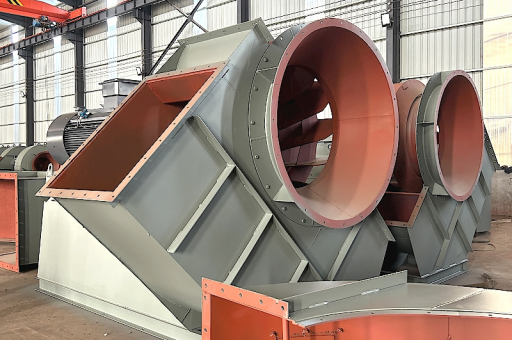
Here is a detailed breakdown of Industrial Exhaust Fans for Steam Boilers, specifically focusing on Centrifugal Fans and Blowers.
The Core Application: Boiler Draft Systems
In a steam boiler, fans create a pressure differential to move air and flue gases through the system. This is called draft. There are three main configurations:
- Forced Draft (FD) Fan: Pushes fresh air into the boiler furnace. It operates at ambient temperature but must overcome the pressure drop of the burner and air preheater.
- Fan Type: Centrifugal, often Forward-Curved or Radial.
- Induced Draft (ID) Fan: Pulls hot, dirty flue gases out of the boiler and through the pollution control equipment (baghouse, scrubber). It handles high temperatures and corrosive, abrasive gases.
- Fan Type: Centrifugal, almost always Backward-Inclined or Airfoil.
- Balanced Draft: Uses both an FD fan (pushing in) and an ID fan (pulling out) to maintain a slightly negative pressure in the furnace. This is the most common design for modern, large steam boilers.
Why Centrifugal Fans? (Not Axial Fans)
For steam boilers, centrifugal fans are preferred over axial fans (like a propeller fan) for several critical reasons:
| Feature | Centrifugal Fan | Axial Fan |
|---|---|---|
| Pressure | High pressure (500+ Pa to 20 kPa+) | Low to medium pressure |
| Efficiency | Higher over wide pressure range | High, but only at design point |
| Robustness | Handles particulates and heat better | Prone to damage from debris/heat |
| Flow Control | Excellent via dampers, VFDs, inlet vanes | Good, but less stable at low flow |
| Typical Use | FD, ID, Primary Air | General ventilation, cooling towers |
Key Takeaway: Boilers require high static pressure to overcome resistance in burners, tubes, heat exchangers, and pollution control. Centrifugal fans are the only reliable choice.
Specific Types of Centrifugal Fans for Boilers
You will encounter these specific wheel designs:
A. Backward-Inclined / Backward-Curved (Most Common for ID Fans)
- Design: Blades curve away from the direction of rotation.
- Pros: High efficiency (up to 85%), non-overloading power curve (motor won't burn up if system pressure drops), handles moderate dust loads.
- Cons: Requires higher speed for same pressure vs. forward-curved.
- Use Case: The standard for ID fans in medium-to-large boiler systems. Also used for FD fans with VFD control.
B. Radial / Paddle Wheel (Rugged & Simple)
- Design: Straight, flat blades radiating outwards.
- Pros: Extremely rugged, handles heavy dust, sticky materials, and temperatures up to 1000°F+ (special alloys).
- Cons: Lowest efficiency (50-60%), high noise level.
- Use Case: Biofuel boilers (wood chips, biomass), coal-fired boilers with high fly ash, applications where erosion/abrasion is severe.
C. Forward-Curved (Small, Low Speed)
- Design: Blades curve in the direction of rotation (like a squirrel cage).
- Pros: Compact, low-noise, good for low-pressure high-volume.
- Cons: Overloading power curve (motor can burn out if duct is blocked), normally aspirated (relies on inlet ambient pressure).
- Use Case: Residential/commercial small boilers (< 100 HP), FD fans for small package boilers.
D. Airfoil (Highest Efficiency)
- Design: Blades shaped like an airplane wing.
- Pros: Best efficiency (85-90%), quietest.
- Cons: Most expensive, blade is hollow (can trap dust/corrosion), requires clean air.
- Use Case: Large, high-efficiency power plant boilers (coal, gas, oil) where energy cost is the primary driver and air is filtered.
Critical Engineering Considerations
When selecting or maintaining these fans, specialists must evaluate:
A. Temperature
- ID Fans: Flue gas temperature is key. Standard mild steel fan shafts and housings can handle 200-300°F. For 400-600°F, you need special alloys (Corten, 316 SS) and shaft cooling (a small fan on the bearing bracket). Above 800°F, water-cooled bearings are mandatory.
- FD Fans: Usually ambient air, but if they pull from a hot space, they need heat slingers on the shaft.
B. Erosion & Corrosion
- Fly Ash: Silica particles in flue gas erode blades. Wear liners (ceramic tiles or hard-faced steel) are bolted or welded to the blade leading edges and housing.
- Condensation: If flue gas cools below the acid dew point (e.g., from sulfur in fuel), sulfuric acid forms. Corten steel (resists acid) or FRP coatings are used. Drain holes at the bottom of the fan housing are critical.
C. Vibration & Balance
- Critical Speed: The fan's rotational speed must not match its natural frequency (this is a structural analysis).
- Dynamic Balancing: Fans must be balanced to API/ISO standards (e.g., G2.5). Imbalance due to dust buildup (fouling) is a common cause of premature bearing failure.
- Monitoring: Accelerometers are installed on bearing housings for continuous vibration monitoring (connected to the boiler's DCS).
D. Drive Arrangement
- Direct Drive (Coupled): Motor shaft connected to fan shaft via a flexible coupling or directly. High reliability, no belts to slip.
- Belt Drive (V-Belts): Allows speed change by changing sheave diameters; motor can be placed remotely to avoid heat.
- Variable Frequency Drive (VFD): Modern standard. Allows precise control of fan speed (RPM) to match boiler load, saving 30-50% energy compared to inlet damper control.
Common Applications & Systems
| Application | Fan Type | Key Feature |
|---|---|---|
| Primary Air (PA) Fan | Radial or Backward-Inclined | High pressure (to push coal dust) |
| Overfire Air (OFA) Fan | Axial or Centrifugal | Low pressure, high volume (for NOx control) |
| Gas Recirculation (GRF) | Centrifugal (Backward) | Handles hot, dirty gas (recycling back to furnace) |
| Biomass/Industrial Boiler ID | Radial Paddle Wheel | Heavy-duty, abrasion resistant |
| Package Boiler FD | Forward-Curved | Compact, low cost |
Standards & Manufacturers
- Standards: Fans are tested to AMCA 210 for performance. Structural design follows ASME PTC 11.
- Major Global OEMs:
- Howden (UK) – A leader in boiler draft fans.
- New York Blower (NYB) (USA) – Very common in industrial boilers.
- Chicago Blower (USA) – High-efficiency, heavy-duty.
- Greenheck (USA) – Industrial centrifugal line.
- Ziehl-Abegg (Germany) – High-efficiency EC plugs.
- Soler & Palau (Spain) – Industrial range.
Summary: Which Fan for Your Boiler?
- Small Package Boiler (Gas/Oil, < 100 BHP): A Forward-Curved FD fan is fine.
- Medium Industrial Boiler (Gas/Oil/Biomass, 100-500 BHP): Use a Backward-Inclined fan for ID and FD with VFD control.
- Large Power Boiler (Coal/Biomass/Waste-to-Energy): Use Airfoil for FD, Backward-Inclined or Radial Paddle Wheel for ID, with heavy-duty wear liners and water-cooled bearings.
Final Note: Always consult a fan application engineer from a reputable manufacturer. They will perform a fan selection program (e.g., using NYB's FanSelect or Greenheck's CAPS) using your specific data:
- Flow (CFM or m³/s)
- Static Pressure (in. wg or Pa)
- Gas Temperature (°F/°C)
- Gas Density (affected by temp, barometric pressure, altitude)
- Fuel type (to predict dust load & corrosiveness)





