
This article's table of contents introduction:
- Critical Design Features (The "Must-Haves")
- Key Technical Specifications (Example Model)
- Sizing & Performance (What you need to calculate)
- Selection Checklist (Questions for the Supplier)
- Alternative for Extreme Cases
- Common Failure Modes to Avoid
- Summary Recommendation
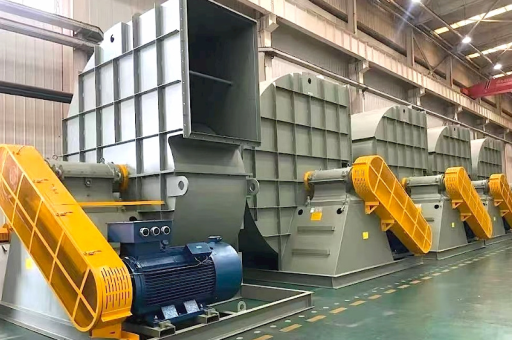
This is a specialized piece of industrial equipment. To move high-temperature clean gas (300°C) effectively and safely, a standard centrifugal fan will fail. You need a fan designed with specific materials and cooling mechanisms.
Here is a detailed breakdown of the specifications, design features, and considerations for a High-Temperature Resistant Centrifugal Fan suitable for your application.
Critical Design Features (The "Must-Haves")
A fan for 300°C gas is significantly different from a standard fan. The primary enemies are thermal expansion and bearing failure.
- Impeller Material: Q345R (High-Temp Steel) or Stainless Steel (304/316L). Standard carbon steel (Q235) will lose strength and warp at 300°C. Stainless steel offers better oxidation resistance at this temperature.
- Housing Material: Typically Q235B or Q345R with a thicker wall gauge to compensate for reduced material strength at high temperatures.
- Shaft & Bearing Assembly (The Most Critical Part):
- Overhung Design: The impeller should be mounted on a shaft that extends out from the bearing housing. This keeps the bearings away from direct heat radiation.
- Shaft Seal: A high-temperature labyrinth seal or carbon ring seal is needed to prevent hot gas from leaking along the shaft towards the bearings.
- Cooling System: Mandatory. The bearings themselves cannot operate at 300°C.
- Option A (Air Cooling): A dedicated cooling fan on the shaft behind the impeller blows ambient air over the bearing housing. Good for intermittent use or lower ambient temps.
- Option B (Water Cooling - Recommended): A water jacket around the bearing housing circulates cooling water (e.g., from a plant water loop). This is the most reliable method for continuous 300°C operation.
- Expansion Allowance:
- The shaft must be designed with a thermal expansion gap (e.g., using a floating bearing on the non-drive end).
- The impeller blades should have a stress-relief cut or flexible connection to the hub to allow for radial expansion without cracking.
Key Technical Specifications (Example Model)
Here is a typical specification you would request from a manufacturer (e.g., like Jiangsu Jinwang, Sanyuan, or similar industrial fan makers).
| Parameter | Specification / Requirement | Reason |
|---|---|---|
| Gas Type | Clean (Low Dust, Non-Corrosive) | No abrasive particles to wear down the special coatings. |
| Gas Temperature | 300°C (572°F) | Maximum continuous operating temperature. |
| Impeller Type | Backward-Curved or Radial Tip | Backward-curved for efficiency with clean gas; Radial tip for higher pressure. |
| Material (Impeller) | 16MnR (Q345R) or 304 Stainless | Strength and creep resistance at 300°C. |
| Shaft Material | 40Cr (Alloy Steel) or 2Cr13 (Stainless) | High strength and thermal stability. |
| Bearing Cooling | Water-Cooled Jacket (Required) | Keeps bearing temperature below 80°C. |
| Bearing Type | Spherical Roller Bearings | High load capacity and self-alignment for thermal expansion. |
| Shaft Seal | Graphite Ring Seal or Labyrinth | Prevents hot gas from reaching the bearings. |
| Max. Temp. Tolerance | 350°C (Short term) | Safety margin. |
| Vibration Limit | < 4.5 mm/s (ISO 2372) | Critical for high-speed, high-heat operation. |
Sizing & Performance (What you need to calculate)
Before you order, you must calculate these values:
- Required Flow (m³/h or CFM): How much gas needs to be moved. Important: Gas expands significantly with heat. Your volume flow rate at operating condition (300°C) will be much higher than at standard temperature. Design for the hot condition, not the cold condition.
- Required Pressure (Pa or mmH₂O): The system resistance at the hot operating condition. Cold gas is denser. If you design for cold pressure, the fan at 300°C will produce much less pressure.
- Motor Power (kW): Power required = (Flow × Pressure) / (Fan Efficiency × Drive Efficiency). Motors must be oversized (e.g., 20-30% safety factor) because the gas density at 300°C is low, but the motor will see higher current if the system resistance changes or when starting from cold.
Selection Checklist (Questions for the Supplier)
When contacting a manufacturer, ask these specific questions:
- "Is the impeller made of 16MnR or 304SS? Can you provide the material certificate?" (Standard Q235 will fail.)
- "Does the bearing housing have a water-cooling jacket? What is the required water flow rate (L/min) and inlet pressure (bar)?"
- "What type of shaft seal do you use to prevent 300°C gas from reaching the bearings?" (Look for "graphite ring" or "high-temp labyrinth seal.")
- "Is the fan designed with a thermal expansion allowance for the shaft and impeller?"
- "What is the maximum safe continuous operating temperature?" (It should be at least 320°C to have a safety margin.)
Alternative for Extreme Cases
- Air-Cooled Cantilever Fan: If you cannot supply cooling water, you will need a "cantilever" (or "overhung") fan with a long shaft and a dedicated cooling impeller (a small fan on the back end of the shaft) that blows outside air over the bearing bracket. This is less efficient but eliminates the need for water.
Common Failure Modes to Avoid
- Shaft Cooling Failure: The number one killer. If the water jacket fails or the cooling fan stops, the bearings seize in minutes.
- Thermal Lock: The impeller expands and rubs against the fan inlet cone. Ensure a generous radial clearance (e.g., > 5mm for a 1m diameter impeller at 300°C).
- Material Creep: Using standard steel (Q235) at 300°C causes the impeller blades to slowly deform (creep) until they fail.
- Imbalance: Dust or dirt baked on the hot impeller causes severe vibration. "Clean gas" is specified, but be sure.
Summary Recommendation
For 300°C clean gas, you need:
- Water-cooled bearing housing.
- Stainless steel (304) or high-temp alloy steel (Q345R) impeller.
- Backward-curved blades (for efficiency with clean gas).
- A motor with a 25-30% power safety margin.
- A thermal expansion gap in the design.
Do not use a standard off-the-shelf centrifugal fan. It will fail catastrophically. Find a manufacturer that specializes in "High-Temperature Fans" or "Process Fans" and specify the exact temperature (300°C) and gas composition (clean).





