
This article's table of contents introduction:
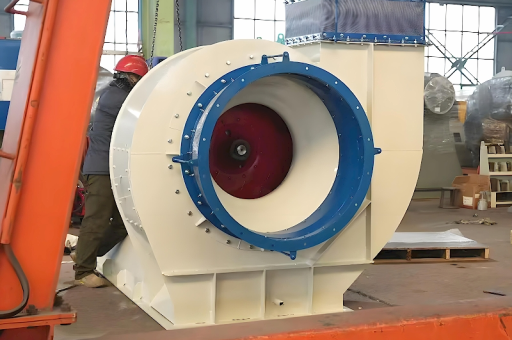
- What is an FD Fan?
- Voltage Specifications (415V / 440V / 660V)
- Typical Specifications for a Boiler FD Fan
- How to Choose / What to Look For
- Conclusion
It sounds like you are describing a Forced Draft (FD) Fan used in a boiler system, specifically a high-pressure centrifugal blower for industrial applications. Here is a breakdown of what you are referring to, including the voltage specifications:
What is an FD Fan?
- Purpose: In a boiler, the Forced Draft fan supplies the primary air needed for combustion. It pushes air through the air heaters and into the furnace (or burner).
- Type: These are typically high-pressure centrifugal fans because they need to overcome the resistance of the ductwork, air heaters, and windbox.
- Key Characteristics: High static pressure, high efficiency, and robust construction (often with heavy-duty bearings and reinforced impellers to handle the air density and temperature).
Voltage Specifications (415V / 440V / 660V)
These voltages represent the standard electrical supply for industrial motors in different regions or for specific motor designs:
| Voltage | Common Region / Standard | Notes |
|---|---|---|
| 415V | Standard in India, UK, Middle East, SE Asia (IEC standard for 3-phase). This is the most common for industrial blowers of this type. | |
| 440V | Common in older US/Canadian plants or specific power grids (e.g., 60 Hz systems). Often, motors are rated for 440V to account for voltage drop. | |
| 660V | Used in some heavy industries (e.g., steel, mining, petrochemical) to reduce current and cable size over long distances. Also common in 690V class systems. |
Key Point: A motor designed for one voltage cannot be directly connected to another without changing the motor windings (e.g., Star vs. Delta configuration) or using a transformer. A single motor might be dual-voltage (e.g., 415/660V or 440/660V) where it is wired in Star for 660V and Delta for 415V.
Typical Specifications for a Boiler FD Fan
If you are sourcing or specifying this fan, here are the typical parameters:
- Type: Centrifugal (Backward Curved or Forward Curved blades; Backward Curved is more efficient and typical for high-pressure applications).
- Flow: Measured in m³/s or CFM (e.g., 50,000 m³/h for a medium-sized industrial boiler).
- Pressure: High static pressure (e.g., 2000 Pa to 6000 Pa or more, depending on boiler resistance).
- Motor Power: Measured in kW (e.g., 45 kW, 110 kW, 250 kW).
- Speed: Direct driven (e.g., 1500 RPM or 3000 RPM for 50 Hz) or via pulley/belt.
- Standards: Usually manufactured per IS 6556 or API 673 (for heavy duty).
How to Choose / What to Look For
- Air Density: The fan performance is based on inlet air density (usually corrected for altitude and temperature).
- Impeller Material: Carbon steel (standard) or stainless steel (for corrosive gases / high temperatures).
- Motor: Are the windings rated for the specific voltage (415V, 440V, or 660V)? If you have a 660V supply, you need a 660V motor.
- Control: Variable Frequency Drive (VFD) compatibility is common for energy savings. Check if the motor is suitable for VFD operation.
- Protection: Vibration sensors, temperature sensors on bearings, and a proper damper or inlet vane control system.
Example Nameplate Data (Hypothetical):
- Model: HPC-225-2
- Type: Centrifugal, High Pressure
- Flow: 85,000 m³/h
- Pressure: 4500 Pa
- Voltage: 415V / 660V (Dual Winding)
- Power: 132 kW
- Speed: 1480 RPM
Conclusion
An FD Fan in a boiler is a critical piece of equipment. The voltage (415V, 440V, or 660V) simply refers to the motor supply. For a heavy-duty boiler application, you want a high-pressure centrifugal blower with a robust motor designed for continuous operation.
If you need a specific selection (power, flow, or supplier recommendations), please provide the required air flow (m³/h) and static pressure (Pa or mmWG).





