
This article's table of contents introduction:
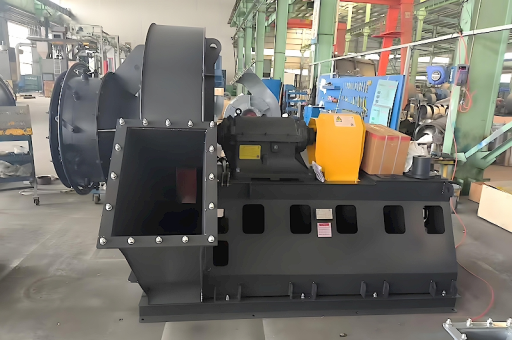
- Core Application: Induced Draft (ID) Fans in Chemical Boilers
- Why "Energy Saving" & "High Pressure" for 37kW?
- Key Technical Specifications (Typical for 37kW)
- Critical Design Features for Corrosion Resistance
- Energy Saving Features (How to achieve "Energy Saving" label)
- Potential Accessories & Safety Systems
- Important Selection Considerations
- Summary for Procurement
Based on your query, here is a detailed technical breakdown and specification analysis for a 37kW Energy Saving High Pressure Corrosion Resistant Centrifugal Fan designed specifically for Chemical Plant Boiler Induced Draft (ID) applications.
This type of fan is a critical component in a chemical plant's steam generation system. It must handle hot, often acidic, flue gases while maintaining high efficiency to reduce operational costs.
Core Application: Induced Draft (ID) Fans in Chemical Boilers
- Function: The fan is located at the outlet of the boiler (after the economizer, air preheater, and scrubbers). It pulls the flue gas through the boiler system, maintaining a slightly negative pressure (draft) in the furnace.
- Challenges:
- High Temperature: Gases usually at 140°C to 250°C (can peak higher during upsets).
- Corrosion: Flue gases contain sulfur oxides (SOx) and water vapor, forming corrosive sulfuric acid (H₂SO₄) at lower temperatures (acid dew point).
- Abrasion: Fly ash and particulate matter in the gas stream.
- Variable Flow: Boiler load changes constantly, requiring a fan with a wide operating range and efficient variable speed control.
Why "Energy Saving" & "High Pressure" for 37kW?
-
Energy Saving (High Efficiency):
- A standard centrifugal fan might operate at 70-75% efficiency. An "energy-saving" fan is designed for 85-90%+ static efficiency.
- Achieved via: Advanced aerodynamic impeller designs (like backward-curved or airfoil blades) and precision volute casing.
- Result: A 37kW motor on an efficient fan can move the same amount of gas as a 45kW motor on a standard fan, leading to significant annual power savings ($2,000 - $5,000+ USD per year depending on duty cycle).
-
High Pressure:
- "High pressure" in this context typically means long-term reliable operation at 2000–4500 Pa (8–18 in.w.g.) static pressure.
- This pressure is needed to overcome the resistance of the boiler tubes, heat exchangers, ducting, and pollution control equipment (baghouse, wet scrubber, or electrostatic precipitator).
Key Technical Specifications (Typical for 37kW)
| Parameter | Specification / Range | Notes for Chemical Boiler ID |
|---|---|---|
| Motor Power | 37 kW (50 HP, 50/60 Hz) | Typically 4-pole (1450/1750 RPM) or 6-pole (970/1160 RPM) for lower tip speed. |
| Motor Type | IE4 (Super Premium Efficiency), Inverter Duty | Must be rated for VFD operation with encoder feedback for precise control. |
| Drive Type | Direct Drive (preferred) or V-Belt | Direct drive is more reliable for high-temp, high-speed IDs. |
| Max. Flow Rate | ~30,000 – 60,000 m³/hr (17,000 – 35,000 CFM) | Dependent on system resistance curve. |
| Max. Static Pressure | 3000 – 5000 Pa | Must be tested at operating temperature (not cold). |
| Temperature Range | 150°C (standard) to 300°C (High-temp version) | Crucial: Fan must be designed for the minimum gas temperature (to avoid condensation) and the maximum (for material limits). |
| Noise Level | < 85 dB(A) @ 1m | Achieved via backward-curved blades and sound insulation. |
Critical Design Features for Corrosion Resistance
For a chemical plant, standard carbon steel fans will fail rapidly. The following materials and coatings are essential:
| Component | Standard Material | Corrosion-Resistant Upgrade | Reason |
|---|---|---|---|
| Impeller | Carbon Steel (IS 2062, A36) | Stainless Steel 316L or Duplex 2205 | Resists acid dew point corrosion and chloride stress cracking. |
| Shaft | EN8 / CS | SS 410 or SS 17-4 PH | High strength + excellent corrosion resistance. |
| Casing | Mild Steel | SS 316L or Rubber-lined CS (for wet IDs) or Glass Flake Epoxy Coated | Internal coating is critical. External paint is secondary. |
| Hub/Cone | Cast Iron | Cast Stainless Steel | Prevents pitting from acidic condensation running down the cone. |
| Inlet Box (if used) | MS | SS 316L with drain plug | Preventing water pooling is key. |
| Shaft Seal | Standard labyrinth | Packing gland with purge air or double mechanical seal | Prevents hot acidic gas from leaking out and damaging bearings. |
Energy Saving Features (How to achieve "Energy Saving" label)
- Backward-Curved Airfoil (BCA) Blades: Most efficient design (>90% peak efficiency). Has a non-overloading power curve (motor won't burn out if duct is blocked).
- Variable Frequency Drive (VFD): A 37kW fan is almost universally paired with a VFD. Even a 20% reduction in speed gives a 50% reduction in power (Fan Affinity Laws).
- Computational Fluid Dynamics (CFD) Optimization: The impeller and volute are designed using modern CFD to minimize turbulence, recirculation, and internal friction losses.
- AMCA 210 Certified: The fan should be certified by AMCA for air and sound performance to guarantee the "energy saving" claim.
Potential Accessories & Safety Systems
- Vibration Sensors: Essential for predictive maintenance. Alarm and trip at high vibration.
- Bearing Temperature RTDs (Pt100): Induced draft fans run hot. Bearing temps must be monitored.
- Drain Petcocks: Located at the lowest point of the casing to drain acid condensation.
- Expansion Joints: On the inlet and outlet to accommodate thermal expansion of the ducting.
- Louver / Inlet Damper: For manual isolation if VFD fails or for initial balancing.
- Base Frame: Heavy-duty I-beam base with vibration isolators (spring or rubber).
Important Selection Considerations
- Duty Point: The fan must be selected for flue gas density, not air density. A fan sized for cold air will be undersized for the actual hot, less dense gas. Require the vendor to provide performance curves at operating temperature (e.g., 180°C) .
- Critical Speed: The fan's operating speed should be well below (or above) its first natural frequency to avoid resonance.
- Startup Torque: ID fans start with a closed inlet damper or vane to reduce load. The VFD must provide sufficient breakaway torque.
- Acid Dew Point: Ensure the fan casing and ducting are insulated and possibly steam-traced to keep internal surface temperatures above the acid dew point (typically 115-130°C for heavy fuel oil / high sulfur coal gas).
Summary for Procurement
When asking a manufacturer (e.g., Howden, Flakt Woods, Twin City Fan, or a reputable Indian/Chinese manufacturer like Kruger Ventilation or Reitz India), give them this specification:
"Requirement: 37kW, 415V, 50Hz, IE4 Inverter Duty Motor. Application: Boiler Induced Draft for Chemical Plant. Gas temp: 180°C, Density: 0.75 kg/m³. Flow: 45,000 m³/hr @ 3,500 Pa Static Pressure. Material: Impeller & Casing in SS 316L. Shaft: SS 410. Design for VFD operation. Provide AMCA Certificate and Performance Curve at Operating Temperature."
Verdict: A properly designed 37kW "Energy Saving High Pressure Corrosion Resistant Centrifugal Fan" is a highly valuable investment for a chemical plant. It will pay back its premium cost through reduced energy bills, longer lifespan (10-15 years vs 2-3 years for a standard fan), and reduced maintenance downtime. Do not cut corners on the SS 316L material or VFD complexity.





