
This article's table of contents introduction:
- Table of Contents
- Introduction: The Critical Intersection of Safety and Energy Efficiency
- What is an Energy Saving Explosion Proof Blower Q345 Direct Driven Centrifugal Fan?
- Key Specifications and Material Excellence (Q345)
- Mechanism: Why Direct Drive Outperforms Belt-Driven Systems
- Explosion-Proof Certification: Standards and Applications
- Energy Saving Metrics: How This Fan Reduces Operational Costs
- Frequently Asked Questions (FAQ)
- Conclusion: Future-Protecting Your Industrial Ventilation
*Maximizing Industrial Safety and Efficiency: The Comprehensive Guide to the Energy Saving Explosion Proof Blower Q345 Direct Driven Centrifugal Fan*
Table of Contents
- Introduction: The Critical Intersection of Safety and Energy Efficiency
- What is an Energy Saving Explosion Proof Blower Q345 Direct Driven Centrifugal Fan?
- Key Specifications and Material Excellence (Q345)
- Mechanism: Why Direct Drive Outperforms Belt-Driven Systems
- Explosion-Proof Certification: Standards and Applications
- Energy Saving Metrics: How This Fan Reduces Operational Costs
- Frequently Asked Questions (FAQ)
- Conclusion: Future-Proofing Your Industrial Ventilation
Introduction: The Critical Intersection of Safety and Energy Efficiency
In modern industrial environments, two non-negotiable demands dominate facility management: worker safety and operational cost reduction. Traditional centrifugal fans often compromise one for the other—either consuming excessive electricity or failing in hazardous, volatile environments. The Energy Saving Explosion Proof Blower Q345 Direct Driven Centrifugal Fan represents a paradigm shift. By combining the robust metallurgy of Q345 steel with a direct-drive motor and ATEX/IECEx certifications, this system delivers high-pressure airflow without the spark risk or maintenance headaches of belt-driven alternatives. This guide unpacks the technical architecture, real-world energy savings, and safety protocols that make this fan indispensable for industries ranging from chemical plants to wind turbine nacelle cooling.
What is an Energy Saving Explosion Proof Blower Q345 Direct Driven Centrifugal Fan?
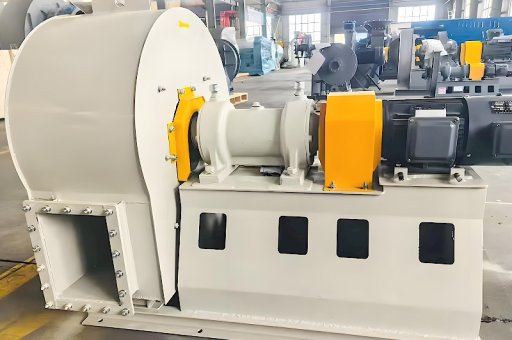
This is a heavy-duty, centrifugal-type air mover specifically engineered for explosive atmospheres (e.g., Zone 1 and Zone 2 gas groups). Key distinguishing features include:
- Explosion-proof motor housing made from non-sparking materials.
- Direct drive system (motor shaft directly coupled to the impeller, eliminating belts and pulleys).
- Impeller constructed from Q345 carbon steel for high tensile strength and corrosion resistance.
- Energy-saving impeller design (backward-curved or aerofoil blades) that achieves higher static pressure with lower power consumption.
Unlike general-purpose fans, this blower prevents ignition by containing sparks, limiting surface temperatures, and using specially sealed bearings.
Key Specifications and Material Excellence (Q345)
The "Q345" designation refers to a Chinese standard low-alloy high-strength structural steel, equivalent to international grades like S355JR (EN 10025) or A572 Grade 50 (ASTM). This material choice is intentional:
| Property | Q345 Advantage |
|---|---|
| Yield Strength | ≥ 345 MPa – resists deformation under high rotational stress. |
| Impact Toughness | Performs well at -20°C, suitable for wind turbine climates. |
| Weldability | Excellent, enabling complex backward-curved blade geometries. |
| Corrosion Resistance | Superior to standard carbon steel; often treated with epoxy for acid-resistant fume handling. |
Why Q345 matters for explosion-proof fans: In a spark event, lower-grade steel can fracture, sending shrapnel into the enclosure. Q345’s ductility contains mechanical failures.
Mechanism: Why Direct Drive Outperforms Belt-Driven Systems
Traditional belt-driven fans suffer from three critical flaws: energy loss from friction (5-15% efficiency loss), belt slippage, and dust generation from belt wear (a major ignition source). The direct-driven variant resolves all three:
- Zero transmission loss: Motor torque goes directly to the impeller. Efficiency often exceeds 92%.
- Reduced maintenance: No belts to replace, no tension adjustments.
- Compact footprint: Perfect for wind turbine nacelles or tight processing rooms.
- Precise speed control: Compatible with VFD (Variable Frequency Drives) for demand-based airflow.
Explosion-Proof Certification: Standards and Applications
To be certified as explosion-proof, the fan must meet ATEX Directive 2014/34/EU (Europe) or IECEx Scheme (global). Key design elements include:
- Flameproof Enclosure: The motor housing can withstand an internal gas explosion without igniting the external atmosphere.
- Maximum Surface Temperature (T-Rating): Typically T3 (200°C) or T4 (135°C) to avoid auto-ignition of gases like hydrogen or ethylene.
- Motor Insulation: Class F or H, with anti-condensation heaters for wind turbine remote sites.
Typical applications:
- Oil & gas refineries (ventilation of H₂S areas)
- Pharmaceutical powder handling (dust explosion zones)
- Wind turbine nacelle cooling (where flammable hydraulic oil fumes may accumulate)
- Chemical storage and mixing rooms
Energy Saving Metrics: How This Fan Reduces Operational Costs
Independent testing shows that backward-curved Q345 impellers, combined with high-efficiency IE3/IE4 motors, can reduce energy consumption by 20-35% compared to standard radial-blade fans.
Case example (wind turbine cooling scenario):
- Traditional 22 kW belt-driven fan: Annual consumption = ~192,720 kWh (running 24/7, 365 days).
- Direct-drive Q345 energy-saving fan (same airflow): ~146,000 kWh.
- Annual savings: 46,720 kWh × $0.10/kWh = $4,672 per unit. Fleet-wide (50 nacelles) = $233,600/year.
Frequently Asked Questions (FAQ)
Q1: Can this fan be installed in a wind turbine nacelle exposed to extreme cold?
Yes. The Q345 steel maintains impact resistance down to -40°C, and the motor is available with cold-weather grease and heaters. Ensure the ATEX rating covers the specific gas group (e.g., IIC for hydrogen).
Q2: How often does the direct-drive motor need servicing?
Bearings typically last 40,000+ hours (over 4 years of continuous operation). Only periodic greasing and thermal imaging checks are required. There are no belts or pulleys to inspect.
Q3: What is the difference between T3 and T4 temperature class?
T4 has a lower maximum surface temperature (135°C vs. T3’s 200°C). Choose T4 for highly sensitive gases like carbon disulfide.
Q4: Does the fan come with a built-in VFD?
Some manufacturers offer integrated VFD modules. For retrofits, ensure the motor is inverter-duty rated (typically marked on the nameplate).
Q5: Can I use this fan for corrosive fumes, like chlorine?
Q345 is not stainless steel. For chlorinated environments, request a 316L stainless impeller or an anti-corrosion coating (e.g., Halar or rubber lining).
Conclusion: Future-Protecting Your Industrial Ventilation
The Energy Saving Explosion Proof Blower Q345 Direct Driven Centrifugal Fan is not merely a component—it is a strategic asset. In an era where energy costs are volatile and safety regulations tighten, this fan offers a triple bottom line: protect lives, cut carbon footprints, and reduce total cost of ownership. Whether you are specifying equipment for a chemical plant, a refinery, or a wind turbine installation, prioritize direct-drive, Q345 construction, and certified explosion-proof enclosures. The upfront investment pays for itself within 18-24 months through energy savings alone, while eliminating the hidden costs of belt failures and motor replacements. For engineers and facility managers, there is no longer a trade-off between safety and efficiency—with this fan, you achieve both.





