
This article's table of contents introduction:
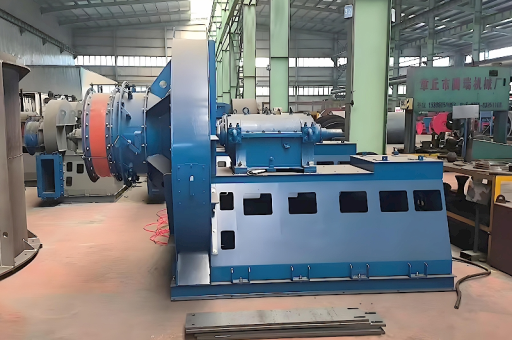
- Material: Q235 (Carbon Steel)
- Type: Centrifugal Flow Fan
- The "High Temperature" Aspect (Key Engineering Changes)
- Typical Application (Q235 High-Temp Fan)
- Standard Specification Table (Example)
- Important Warning: Corrosion + Heat
- Summary Recommendation
It appears you are looking for information or a specification for a Q235 centrifugal flow fan designed for high-temperature applications.
Here is a breakdown of what that description means, the typical specifications, and important considerations for such a fan.
Material: Q235 (Carbon Steel)
- What it is: Q235 is a Chinese standard (GB/T 700) grade of plain carbon structural steel. It is equivalent to ASTM A36 or S235JR (EN 10025).
- Pros: It is strong, weldable, and very cost-effective for general industrial use.
- Cons for High-Temp: This is the critical point. Q235 steel experiences a significant reduction in strength and begins to creep at temperatures above 300°C (572°F) . Its maximum recommended continuous service temperature is typically around 350°C (662°F) , but it will oxidize (rust) rapidly at those temperatures.
- Implication: If you are moving air above 300°C, a Q235 fan is not suitable unless the gas is corrosive only and heat is a secondary factor. For true high-heat (e.g., >400°C), you need stainless steel (SS304/SS316) or alloy steel (Q345R, 16Mn) .
Type: Centrifugal Flow Fan
- How it works: Air enters the impeller axially and is expelled radially (centrifugally) at 90 degrees.
- Why for High Temp?
- High Pressure: Centrifugal fans are excellent for overcoming the resistance of ductwork, heat exchangers, or long stacks.
- Stability: They handle fluctuating system pressures (e.g., from a furnace cycling) better than axial fans.
- Construction: The impeller (blades) is typically backward-curved or forward-curved. For high-temp, backward-curved (high efficiency) or radial/blade impellers (sturdy, dirt resistant) are common.
The "High Temperature" Aspect (Key Engineering Changes)
For a fan to handle high temperatures, the standard design must be modified:
- Shaft Cooling: The shaft must be longer (a "pedestal" or "shaft extension") to keep the bearings away from the heat. Bearing temperatures must stay below ~80°C.
- Shaft Cooling Disc (Radiation Fan): A small auxiliary fan fin mounted on the main shaft inside the bearing housing to pull cool air over the shaft and prevent heat transfer.
- Bearing Type: Grease-lubricated bearings (for lower temps <250°C) or high-temp grease. For very high temps, experienced bearing houses or forced oil lubrication.
- Gaskets & Seals: Standard rubber or neoprene gaskets will melt. High-temp silicone, PTFE (Teflon) , or ceramic fiber gaskets (e.g., Enerwrap) are required.
- Thermal Expansion: The housing must be designed to expand without binding the impeller. This often means a thrust bearing on the drive end and a floating bearing on the non-drive end.
Typical Application (Q235 High-Temp Fan)
- Forced Draft / Induced Draft for Boilers: (Up to 250°C - Q235 is acceptable here)
- Fume Extraction: (Non-corrosive, hot fumes from heat treatment)
- Drying Systems: (Textile, food, or sand drying)
- Cement & Kiln Air Supply: (Cooler side)
Standard Specification Table (Example)
| Parameter | Typical Value (for a Q235 High-Temp Centrifugal Fan) |
|---|---|
| Material | Q235 (Housing & Impeller) |
| Max Continuous Temp | 250°C - 300°C (482°F - 572°F) |
| Max Intermittent Temp | 350°C (662°F) for short periods |
| Airflow | 5,000 m³/h to 200,000 m³/h (or more) |
| Static Pressure | 1,000 Pa to 8,000 Pa (4" - 32" w.g.) |
| Impeller Type | Backward-curved (efficient) or Radial (rugged) |
| Drive Type | Direct Drive (for simple, high-speed) or Belt Drive (for speed control & heat isolation) |
| Bearing Cooling | Standard shaft cooling disc + extended shaft |
| Max Power | Up to 250 kW (depending on size) |
Important Warning: Corrosion + Heat
- Hot Air: Q235 is fine for hot dry air up to 250-300°C.
- Hot Flue Gas: If the gas contains sulfur (SOx), chlorine, or moisture, the Q235 will corrode rapidly (acid dew point corrosion). In this case, you must use stainless steel (SS316L) or apply a high-temperature anti-corrosion coating (e.g., silicone-based or ceramic coating like Belzona).
Summary Recommendation
- If your temperature is below 250°C and air is clean/dry: A Q235 centrifugal fan is a cost-effective solution.
- If your temperature is between 250°C and 400°C: You need alloy steel (16Mn, Q345R, Corten) or Stainless Steel 304.
- If your temperature is above 400°C: You need Stainless Steel 310S (25/20), Inconel, or Refractory-lined construction.
Do you have a specific temperature and gas composition (e.g., "exhaust gas from a 200°C drying oven" or "hot air from a 150°C heat exchanger")? That would allow me to give a more precise specification.





