
This article's table of contents introduction:
- What It Is
- Why "Coupling Driven" is Important in Metallurgy
- Key Components in a Metallurgical Coupling-Driven Fan
- Applications in Metallurgy
- Selection Criteria for a Metallurgical Fan
- The Trade-Off
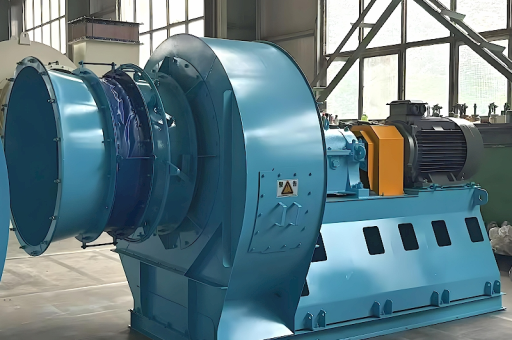
The term "Coupling Driven High Temperature Centrifugal Fan for Metallurgical" refers to a specific type of industrial fan system designed to handle extreme heat in demanding environments like steel mills, smelters, and foundries.
Here is a detailed breakdown of what this means, its components, applications, and why this specific configuration is chosen.
What It Is
- Centrifugal Fan: This is the core technology. It uses a rotating impeller to increase the velocity of air (or gas) and a scroll housing to convert that velocity into pressure. It is ideal for handling large volumes of gas against moderate to high resistance (pressure).
- High Temperature: These fans are engineered to handle gas temperatures ranging from 250°C (482°F) up to 600°C (1112°F) or even higher with special alloys and cooling systems.
- Coupling Driven: The fan wheel is not directly mounted on the motor shaft. Instead, a coupling (often a flexible coupling) connects the fan shaft to a motor shaft, or more commonly, to a gearbox. This is a critical differentiator.
- For Metallurgical: The construction materials, design, and safety features are tailored for the harsh conditions of metallurgy: slag dust, corrosive fumes, thermal shock, and continuous operation.
Why "Coupling Driven" is Important in Metallurgy
This is the most critical design specification. In standard high-temperature fans, the motor is directly connected (direct drive). However, metallurgy often demands a coupling-driven (or belt-driven) system for these key reasons:
- Heat Isolation (The Primary Reason): The motor is placed further from the hot gas source. A direct-drive motor must withstand the radiant heat conducted down the shaft. With a coupling, you can use a shaft cooling disc or a longer shaft between the fan housing and the bearing housing. This protects the motor bearings from seizing due to heat.
- Speed Control & High Pressure: Metallurgical processes often require high pressure (e.g., for combustion air in furnaces or for dust extraction in sinter plants). Direct-drive motors often run at standard speeds (e.g., 1500 or 3000 rpm). A coupling-driven system (often via a gearbox) allows the fan to run at high speeds (e.g., 3000-5000 rpm) to generate the necessary pressure, while the motor runs at a standard, efficient speed.
- Maintenance & Safety: If the fan wheel fails or seizes (due to heat distortion), the coupling acts as a mechanical fuse. It will shear or damage the coupling, protecting the expensive motor and gearbox. Replacing a coupling is far cheaper and faster than replacing a motor.
- Material Handling: Some metallurgical fans handle gas with heavy particulate (dust, scale). A coupling-driven fan allows for a stiffer shaft and larger bearings to handle the imbalance caused by uneven dust build-up on the impeller blades.
Key Components in a Metallurgical Coupling-Driven Fan
-
Impeller (Wheel):
- Material: High-strength steel (e.g., Q345R) for ~200°C. For higher temperatures (400-600°C), stainless steel (e.g., 310S or 316L) or Inconel is used to prevent creep (slow deformation under heat and stress).
- Design: Airfoil or backward-curved blades for efficiency. Special reinforced blades to prevent flutter and fatigue from high-speed rotation.
- Cooling: Some impellers have a hollow shaft with a cooling fan or a cooling disc (a metal disc welded to the shaft between the housing and bearing) to radiate heat away.
-
Housing (Scroll):
- Material: Carbon steel with high-temperature lining or stainless steel.
- Features: Heavy-duty reinforced to handle pressure. Access doors for cleaning and inspection. Expansion joints to accommodate thermal growth.
-
Shaft & Bearings:
- Shaft: Large diameter, turned from forged steel.
- Bearing Assembly: Typically a pedestal bearing housing mounted on a separate base. Bearings are often water-cooled or have high-temperature grease purge systems.
- Cooling: The area between the fan housing and the bearing is critical. Shaft cooling fins or a fan-on-shaft design blows ambient air over the shaft.
-
Drive Mechanism:
- Coupling: Flexible (gear, grid, or elastomeric) to handle misalignment and thermal expansion.
- Gearbox: Often required to step up speed. The gearbox will have its own oil cooling system.
-
Vibration & Thermal Monitoring:
- Thermocouples on the bearing housing and housing shell.
- Vibration sensors (accelerometers) for real-time condition monitoring.
Applications in Metallurgy
- Sinter Plant: For Induced Draft (ID) fans that pull hot, abrasive, SO2-laden gases through the sintering bed.
- Blast Furnace: For hot blast stoves (heating combustion air) and for gas cleaning.
- Steel Melting (EAF): For furnace fume extraction (direct evacuation system). Gases are very hot (up to 600°C) and contain heavy dust.
- Ladle Furnace / AOD: For exhausting fumes during refining.
- Casting & Rolling Mills: For cooling sections, and for collecting scale and steam.
Selection Criteria for a Metallurgical Fan
If you are sourcing a fan (e.g., for a specification or quote request), you need to provide:
- Gas Temperature: Normal operating temp and maximum peak temp (e.g., 350°C normal, 450°C peak for 10 minutes).
- Gas Composition: Is it clean air, or does it contain dust, sulfur, moisture, or chlorine? This dictates material selection.
- Flow Rate (m³/h or CFM): Actual volume at operating temperature (ACFM) is different from standard volume (SCFM).
- Pressure (mmWG, inWG, or kPa): Static pressure required.
- Driver Type: Motor + Gearbox? VFD (Variable Frequency Drive) ready?
- Installation Location: Indoors vs. outdoors, ambient temperature around the motor.
The Trade-Off
- Coupling Driven: Higher initial cost (more components, baseplate, bearings). Higher maintenance (bearings, alignment, coupling). But it handles heat better and protects the motor.
- Direct Drive: Lower initial cost, simpler. But severely limited by the motor's heat tolerance (usually max ~80°C ambient). Rarely used for metallurgical hot gas fans.
In summary: For any serious metallurgical application where gas temperatures exceed 200°C and reliability is critical, the coupling-driven high-temperature centrifugal fan is the industry standard.





