
This article's table of contents introduction:
- What is an Induced Draft (ID) Fan?
- Key Characteristics of a High-Pressure Centrifugal ID Fan
- How It Works in a System
- Common Applications
- Important Operational & Design Specifications
- Comparison: ID Fan vs. FD Fan vs. PA Fan
- Potential Issues & Maintenance
- Final Summary
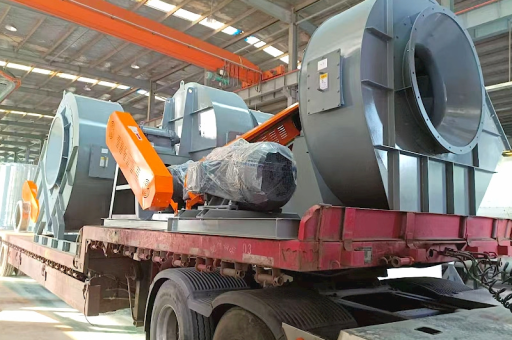
This is a highly specific and technical query. It appears you are looking for information about an Induced Draft (ID) Fan, specifically a High-Pressure Centrifugal Blower.
Here is a detailed breakdown of what this equipment is, its function, key design features, and common applications.
What is an Induced Draft (ID) Fan?
An Induced Draft Fan is located at the outlet or exhaust side of a system (like a boiler, furnace, or kiln). Its primary job is to pull flue gases (combustion byproducts) out of the system and create a negative pressure (vacuum) inside the combustion chamber. This is in contrast to a Forced Draft (FD) Fan, which pushes air into the system.
When we combine this with High Pressure and Centrifugal design, we get a very robust, heavy-duty machine designed for harsh environments.
Key Characteristics of a High-Pressure Centrifugal ID Fan
-
High Static Pressure: This is not just a ventilation fan. It must overcome significant resistance from:
- The boiler/furnace itself.
- Long ductwork.
- Air pollution control equipment (baghouses, electrostatic precipitators).
- The chimney/stack draft.
-
Centrifugal Design: The air is drawn into the center of a rotating impeller and flung outwards by centrifugal force. This design is inherently better at generating high pressure than an axial fan.
-
Radial or Backward-Inclined Blades: For high pressure and handling particulate-laden air, the impeller blades are typically:
- Radial Blades (Paddle Wheel): Extremely rugged. Best for handling dirty, abrasive gases (fly ash). Less efficient but very durable.
- Backward-Inclined Blades: More efficient for clean or slightly dirty gas streams. Generates high pressure with lower noise.
-
Robust Construction: Because it handles hot, corrosive, and abrasive gases:
- Material: Often made from Corten steel or stainless steel for corrosion resistance.
- Shaft Seals: High-quality mechanical seals or gland packing to prevent gas leakage.
- Bearings: Heavy-duty roller bearings with cooling systems (often water-cooled or with heat slingers).
- Wear Liners: Replaceable liners inside the casing to protect against erosion from fly ash.
How It Works in a System
- Fuel burns in the boiler, creating hot flue gases (CO2, H2O, SOx, NOx, ash).
- FD Fan pushes fresh air into the burner to support combustion.
- The ID Fan creates a negative pressure at the exit, pulling the hot gases through:
- The boiler passes (heat exchanger).
- The economizer (pre-heats feed water).
- The air heater (pre-heats combustion air).
- The pollution control system (baghouse or scrubber).
- The cleaned gases are then expelled through the stack/chimney.
Common Applications
This specific fan type is critical in heavy industries:
- Thermal Power Plants: Coal, oil, or gas-fired boilers.
- Cement Plants: Kilns and preheaters.
- Steel Mills: Sinter plants, blast furnaces, converters.
- Chemical & Petrochemical: Process heaters and incinerators.
- Waste-to-Energy Plants: Incinerators.
- Paper & Pulp: Recovery boilers.
Important Operational & Design Specifications
When specifying or troubleshooting a High-Pressure Centrifugal ID Fan, you need to know:
| Parameter | Typical Range / Requirement | Why it matters |
|---|---|---|
| Air Volume (Flow) | Measured in m³/hr or CFM | Matches the combustion output of the furnace. |
| Static Pressure | Measured in mmWC, Pa, or PSI | Must overcome the total system resistance. |
| Gas Temperature | 150°C to 400°C (can be higher) | Determines material and cooling requirements. |
| Gas Composition | High CO2, H2O, SOx, Fly Ash | Affects corrosion and erosion resistance. |
| Speed (RPM) | Typically 900 - 1500 RPM | Balances pressure generation with wear. |
| Power (Motor) | Measured in kW | High power consumption (can be 1000s of kW). |
| Duct Connection | Inlet: Axial or Radial; Outlet: Scroll | Affects installation and system efficiency. |
Comparison: ID Fan vs. FD Fan vs. PA Fan
| Feature | ID Fan (Induced Draft) | FD Fan (Forced Draft) | PA Fan (Primary Air) |
|---|---|---|---|
| Location | Outlet (after boiler) | Inlet (before boiler) | To the coal mill/burner |
| Media | Hot, dirty flue gas | Ambient air | Air to carry coal |
| Pressure | Negative (vacuum) | Positive | Positive |
| Duty | Harsh (hot, corrosive) | Moderate (clean air) | Moderate (dry air) |
| Blade Type | Radial (preferred) | Backward Inclined | Axial or Centrifugal |
Potential Issues & Maintenance
- Erosion: Fly ash erodes blades and casing. Solution: Wear liners, hard-facing on blades.
- Corrosion: Acid condensation (sulfuric acid from SOx) at low temperatures. Solution: Keep gas temperature above the acid dew point.
- Fan Stall/Surge: Operating the fan outside its stable performance curve. Solution: Proper system design and variable speed drives (VFD).
- Vibration: Imbalance due to uneven dust buildup or erosion. Solution: Regular cleaning and dynamic balancing.
- Bearing Overheating: High temperature from the gas. Solution: Proper cooling system.
Final Summary
An Induced Draft (ID) Fan that is a High-Pressure Centrifugal Blower is a workhorse in heavy industry. It is specifically designed to pull hot, dirty, and corrosive gases from a combustion process, overcoming high system resistance. Its key distinguishing features are its radial blade impeller for handling particulate matter, robust construction for high temperatures and erosion, and its role in creating a negative pressure for safe boiler operation.
If you have a specific application in mind, or need help with a specific performance curve, vibration analysis, or material selection, please provide more details.





