
This article's table of contents introduction:
- Why CFB Boilers Need This Specific Fan
- Material Specification: Q345 Steel (Now Q355B)
- Electrical Specification: 415V / 3-Phase
- Mechanical Design: Single Inlet Centrifugal
- Key Engineering Considerations for CFB Service
- Performance Parameters (You Must Define)
- Where to Source (Recommendations)
- Summary Checklist for your Purchase Order (PO):
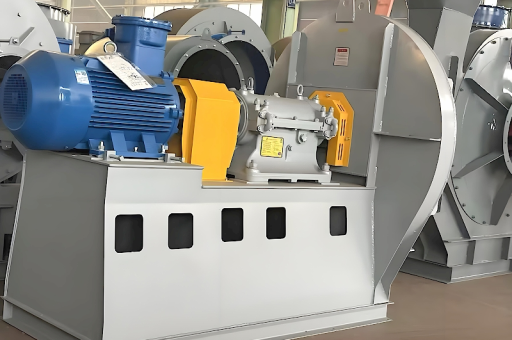
This is a highly specific industrial equipment request. You are looking for a 415V, Q345 steel, single inlet centrifugal blower intended for Circulating Fluidized Bed (CFB) Boiler systems.
Below is a detailed breakdown of what this specification means, the engineering challenges involved, and what you should look for when sourcing or specifying this fan.
Why CFB Boilers Need This Specific Fan
CFB boilers are not like standard coal-fired furnaces. They operate with a bed of fuel and limestone particles fluidized by air. This creates unique demands on the blowers (usually Primary Air Fans, Secondary Air Fans, or Fluidizing Air Fans):
- High Static Pressure: The fan must overcome pressure drop of the bed material (typically 600–1400 mmH₂O or more).
- Abrasive Environment: Unburnt fuel and ash particles are abrasive. Erosion resistance is critical.
- Temperature Tolerance: While the CFB bed is hot (850-900°C), the air entering the fan is ambient, but the fan must handle potential backflow of hot gas or duct heating.
- Variable Airflow: CFB needs precise air staging control, usually via Inlet Guide Vanes (IGV) or Variable Frequency Drives (VFD).
Material Specification: Q345 Steel (Now Q355B)
- What it is: Q345 (new standard: Q355B) is a low-alloy high-strength structural steel (equivalent to ASTM A572 Grade 50 or EN S355JR).
- Why for a Blower?
- Higher yield strength (~345 MPa) than standard Q235 carbon steel. This allows for thinner impeller blades and housing, reducing rotational mass and stress.
- Better weldability and toughness at low temperatures vs. simple carbon steel.
- Critical: It provides better resistance to erosion than standard mild steel, which is necessary for the dusty air in CFB systems. (Note: For highly abrasive ash, you may still need a wear liner like ceramic tiles or hard-facing on the leading edges.)
Electrical Specification: 415V / 3-Phase
- Standard: This is the standard industrial voltage in India, UK, Middle East, and parts of Southeast Asia.
- Motor Compatibility: 415V usually implies a 50Hz motor. The fan will be rated for a specific speed (e.g., 1480 RPM or 2960 RPM actual) depending on the pressure required.
- Power Range: For a CFB boiler fan, power is significant. A small fluidizing blower might be 37-75 kW, while a Primary Air Fan (PA Fan) could be 200 kW to 1.5 MW. 415V is common up to about 315 kW; above that, you would step up to 3.3kV or 6.6kV.
Mechanical Design: Single Inlet Centrifugal
The Single Inlet design (overhung impeller) is preferred for CFB systems over double inlet for these reasons:
- Simplicity & Reliability: Fewer bearings, simpler bearing housing (usually one pillow block on the drive side and one on the shaft).
- Maintenance: Easier access to the impeller for inspection and repair of erosion damage.
- Shaft Seal: Easier to design an effective shaft seal to prevent ash leakage into the bearing housing.
- Performance: Usually the fan curve is steeper, which is good for handling the variable resistance of a fluidized bed.
Key Engineering Considerations for CFB Service
When specifying this fan, you must prioritize erosion resistance and reliability over peak efficiency.
| Component | Standard Industrial Fan | CFB Boiler Fan (Your Spec) |
|---|---|---|
| Impeller Blades | Q235 Steel | Q345 (Q355B) Steel or thicker plate. Backward curved (BC) blades are best. |
| Housing | Standard gauge | Reinforced Q345 with replaceable wear plates (hardox or ceramic tiles) at the volute tongue and outlet. |
| Shaft & Hub | Standard steel | Forged steel, polished to prevent dust adhesion. |
| Bearings | Standard duty | Heavy-duty spherical roller bearings with ash-tight labyrinth seals and oil bath lubrication (not grease, which can trap dust). |
| Seal | Standard felt | Double mechanical seal or ventilated labyrinth seal with a blower to purge ash. |
Performance Parameters (You Must Define)
To get a proper quotation, you cannot just say "for CFB boiler." You need:
| Parameter | Typical CFB Value | Your Requirement |
|---|---|---|
| Airflow (m³/hr or m³/s) | Depends on boiler size (e.g., 40,000 to 500,000 m³/h) | [Specify] |
| Static Pressure (mmH₂O or kPa) | 800 – 1600 mmH₂O (8 – 16 kPa) | [Specify] |
| Air Temperature | Ambient (40-50°C) | [Specify] |
| Dust Load | High (5-20 g/Nm³) | [Confirms need for erosion protection] |
| Control Method | VFD or IGV | [VFD is best for energy savings] |
Where to Source (Recommendations)
Look for manufacturers specializing in Power Plant or Ash Handling fans, not standard HVAC suppliers.
- India: Kirloskar Brothers, Howden India, Flakt Woods, Alphair Ventilating Systems, Maico.
- China: Shandong Huadong Blower, Shenyang Blower Works (SBW).
- Global: Howden, TLT-Turbo, Robinson Fans.
Crucial Warning: Do not buy a cheap, standard centrifugal blower from a general supplier for a CFB boiler. It will fail within 6-12 months due to erosion and heat stress. You need a heavy-duty, engineered fan.
Summary Checklist for your Purchase Order (PO):
- Material: Housing and Impeller = Q345R (or Q355B).
- Voltage: 415V / 3Ph / 50Hz.
- Duty: Continuous (24/7).
- Wear Protection: Replaceable liners at volute tongue and impeller leading edges (Hardox 500 or equivalent).
- Accessories:
- Inlet box with Inlet Guide Vanes (IGV) for manual or auto control.
- Expansion joint (flexible connector) on inlet and outlet to isolate vibration.
- Vibration sensor (accelerometer) on bearing housing and motor.
- Balance: Impeller must be dynamically balanced to ISO 1940 G2.5 or better.





