
This article's table of contents introduction:
- Core Specifications (Typical for a 200 kW Unit)
- Key Components & Construction
- Primary Applications (Where you'll find this fan)
- Auxiliary Requirements & Protections
- Typical Challenges & Solutions
- Example Product Sizing (Estimation)
- Key Selection Criteria for a Buyer/Engineer
- Summary
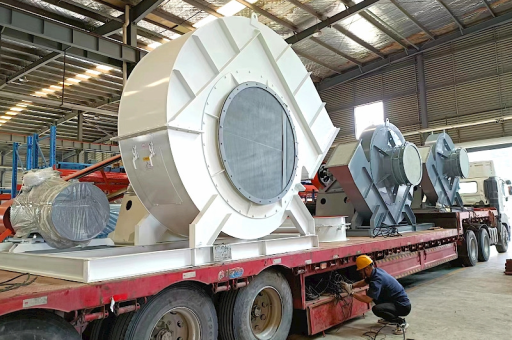
This is a specific request for a 200 kW Dust Removal Centrifugal Induced Draft Fan. Here is a detailed breakdown of the specifications, typical applications, key components, and considerations for such a fan.
This type of fan is a heavy-duty, high-power industrial fan designed to move large volumes of dusty, hot, or corrosive air by creating negative pressure (suction) in a system.
Core Specifications (Typical for a 200 kW Unit)
- Power: 200 kW (approximately 270 HP).
- Type: Centrifugal, Induced Draft (ID).
- Design: Usually Backward-Inclined (BI) or Airfoil (AF) blades for high efficiency and non-clogging characteristics in dusty environments. For very abrasive dust, Radial Tip or Paddle Wheel designs might be used, though they are less efficient.
- Airflow (Volume): High. Typically in the range of 150,000 to 350,000 m³/hr (88,000 to 206,000 CFM), depending on the system pressure.
- Pressure: Medium to High. Typical static pressure: 2,000 to 6,000 Pa (8 to 24 inches w.g.).
- Speed: Direct drive at 1,500 RPM (for 50 Hz) or 1,800 RPM (for 60 Hz). Could also use belt drive for speed adjustment.
- Temperature: Designed for hot gases, typically 80°C to 250°C (176°F to 482°F), with special construction for higher.
- Material: Heavy-gauge steel (e.g., Q235 or Corten for corrosion), with optional abrasion-resistant liners (e.g., AR400, ceramic tiles, or basalt lining) on the impeller and casing.
Key Components & Construction
- Housing: Spiral (volute) casing made from robust steel plate. It will have a large access door for cleaning and inspection, and drains for condensation.
- Impeller: The most critical part.
- Material: Typically Q345 (High Tensile Steel) or 16MnR. For corrosive gases, stainless steel (SS304/SS316).
- Wear Protection: The leading edges of the blades and the backplate are often hard-faced with weld overlay or fitted with sacrificial wear plates.
- Balance: Dynamically balanced to ISO G6.3 or better to handle the high mass and prevent vibration.
- Shaft & Bearings:
- Shaft: Large-diameter, precision-ground alloy steel (e.g., 40Cr or 42CrMo).
- Bearings: Heavy-duty spherical roller bearings, often in a pillow block or flanged cartridge housing. They will have a temperature monitoring port (for PT100 sensors).
- Drive Arrangement:
- Arrangement 3 (Direct Drive): Most common for this size. The fan wheel is mounted directly on the motor shaft. Saves space and reduces maintenance.
- Arrangement 4 (Direct Drive with separate bearing pedestal): The motor is not on the fan. The fan has two bearings. Often used for very high temperatures to keep the motor cool.
- Belt Drive: Less common for 200 kW due to power transmission losses, but possible if speed variability is needed without a VFD.
Primary Applications (Where you'll find this fan)
- Cement Plants: Main baghouse fan for raw mill, kiln, and clinker cooler dust collection.
- Steel Mills: Sinter plant, blast furnace gas cleaning, EAF (Electric Arc Furnace) fume extraction.
- Power Plants: Flue gas desulfurization (FGD) systems, coal mill exhaust.
- Chemical & Fertilizer: Fluidized bed dryers, pneumatic conveying of powders.
- Mining & Minerals: Underground ventilation, crusher dust extraction, mineral processing.
- Waste-to-Energy: Induced draft fan for the combustion chamber and flue gas treatment.
Auxiliary Requirements & Protections
A 200 kW fan is a critical asset. It requires:
- Motor: A 200 kW, 3-phase induction motor (e.g., IE3/IE4 efficiency). For VFD control, a 400-690V motor is typical. It must be rated for the fan's starting torque (high inertia).
- Inlet/Outlet Dampers:
- Inlet Box Damper: To control air volume (and thus fan power).
- Outlet or Discharge Damper: For isolation or additional control.
- Variable Frequency Drive (VFD): Highly recommended for a 200 kW fan. It saves significant energy (25-40% vs. dampers), reduces starting current (soft start), and allows precise process control. A 200 kW drive is a major component.
- Monitoring & Safety:
- Vibration Sensors: Two per bearing (horizontal and vertical), connected to a protective relay for alarm/trip.
- Bearing Temperature Sensors: PT100 RTDs wired to the automation system.
- Motor Protection: Overload, short circuit, earth fault, phase failure.
- Differential Pressure Switch: To detect dirty filters or a blocked system.
Typical Challenges & Solutions
| Challenge | Solution |
|---|---|
| Abrasive dust (e.g., cement, sand) | Use of wear liners (ceramic, AR400 steel) on impeller and casing. Hard-faced blades. |
| Sticky dust (e.g., wet scrubber mist) | Large access doors for cleaning. Anti-stick coatings (e.g., PTFE or epoxy). Welds ground smooth. |
| Imbalance due to erosion | Use of thicker blades. Regular vibration monitoring. Predictive maintenance. |
| High starting current | Must use a Soft Starter or VFD. A direct-on-line start for a 200kW motor will cause massive voltage dips. |
| Corrosion (acidic gases) | Stainless steel (SS316L), FRP (Fiberglass Reinforced Plastic) housing, or rubber lining. |
Example Product Sizing (Estimation)
Note: These are rough estimates for a medium-pressure, high-volume fan.
- Power: 200 kW (270 HP)
- Airflow: 200,000 m³/hr (at 20°C, standard density)
- Static Pressure: 3,000 Pa
- Efficiency: ~82% (Backward Curved)
- Motor Speed: 1,500 RPM
- Impeller Diameter: Approx. 1,500 mm (59 inches)
- Inlet Diameter: Approx. 1,200 mm (47 inches)
- Outlet Dimensions: Approx. 1,400 mm x 1,000 mm (55" x 39")
Key Selection Criteria for a Buyer/Engineer
- Is the system design for "clean gas" or "dirty gas"? This dictates impeller design (clean gas = airfoil; dirty = backward incline or radial).
- What is the gas temperature? Requires a specific material stress analysis.
- What is the particulate concentration (g/Nm³) and particle size? Dictates wear protection.
- Will the fan run continuously or with a VFD? VFD is almost mandatory for energy savings.
- Does the fan need to run at "critical speed"? For large, high-speed fans, a rotordynamics analysis is essential to avoid resonance.
- What are the local codes (ISO, API, ASME)? ISO 13349, ISO 14694, API 610 (for some heavy-duty applications).
Summary
A 200 kW dust removal centrifugal induced draft fan is a large, engineered piece of equipment. It requires a robust design tailored to the gas conditions (temperature, dustiness, corrosivity). The most cost-effective choice typically involves:
- A Backward Inclined impeller with wear protection.
- A direct-drive arrangement (Arr. 3 or 4).
- Supply with a Variable Frequency Drive (VFD) .
- Comprehensive vibration and temperature monitoring.
To get a precise quotation or design, you need to provide the fan manufacturer with the gas composition, temperature, humidity, dust concentration, required flow, and static pressure. Reputable global suppliers include Greenheck, New York Blower, Systemair, Howden, Clarage, or local heavy engineering companies specializing in industrial ventilation.





