This article's table of contents introduction:
- The Core Problem: 316 SS at 700°C
- What Material Do You Actually Need? (The 700°C Solution)
- Critical Design & Engineering Considerations
- Summary Table: Material vs. Temperature
- Final Recommendation
This is a topic that requires careful technical clarification. Standard 316/316L stainless steel is NOT suitable for continuous use at 700°C (1292°F).
Here is the detailed breakdown of why, and what you actually need for a fan operating at that temperature.
The Core Problem: 316 SS at 700°C
- Loss of Corrosion Resistance: The primary alloying element in 316 is Molybdenum (Mo), which gives it superior corrosion resistance. At temperatures above 500-600°C (932-1112°F) , the Molybdenum and Chromium carbides begin to precipitate at the grain boundaries (sensitization). This permanently destroys its corrosion resistance, making it brittle.
- Creep Strength Failure: At 700°C, standard 316 has very poor creep strength. "Creep" is the tendency of a solid material to slowly deform permanently under mechanical stress (like the centrifugal forces on a spinning fan blade). A 316 fan at 700°C would likely warp, sag, or fail catastrophically (blades flying off) within a short time.
- Oxidation "Scaling": While 316 forms an oxide layer, at 700°C this layer becomes non-protective and will flake off (scale), leading to rapid metal thinning.
Verdict: A standard 316 stainless steel fan will fail quickly at 700°C. Most suppliers who list a "316 fan" will have a maximum operating temperature of 500°C (932°F) or less.
What Material Do You Actually Need? (The 700°C Solution)
For a fan operating continuously at 700°C, you need a High-Temperature Nickel-Based Superalloy or a Specialized High-Temperature Stainless Steel. Common grades include:
- RA330 (UNS N08330): The most common choice for high-temp fans (up to ~1000°C). Excellent creep strength, oxidation resistance, and mechanical stability at 700°C.
- Inconel® 600 or 601 (UNS N06600/N06601): Superior to RA330. Offers high strength, excellent resistance to oxidation and carburization at 700°C+. 601 is specifically formulated for high-temperature oxidation resistance.
- 310S Stainless Steel (UNS S31008): A possible low-cost alternative. 310S (the "S" is critical) is an austenitic stainless with much higher chromium and nickel than 316. It can handle up to 1000°C in continuous service (intermittent to 1050°C). Do not confuse with regular 310 (which lacks low-carbon properties). This is the minimum you should consider.
- Hastelloy® X (UNS N06002): Used in aerospace and industrial furnace fans. Extremely high creep-rupture strength at 700°C+.
Critical Design & Engineering Considerations
Regardless of material, a 700°C fan is a precision engineered component. You cannot simply "upgrade" a standard fan.
- Expansion Clearance: The fan housing and shaft must be designed to accommodate significant thermal expansion. The impeller will grow larger at 700°C. Tight tolerances from a cold start will cause the fan to seize.
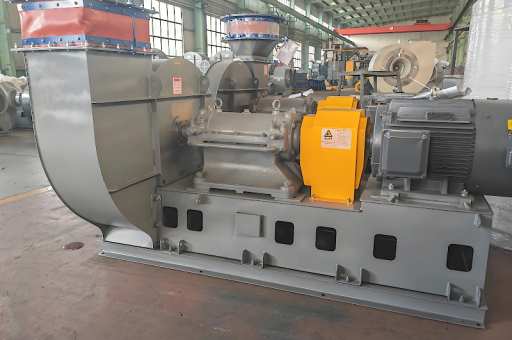
- Shaft Cooling: The motor is far from the impeller. The shaft must be long enough, and often includes a heat slinger or cooling disc to prevent heat traveling down the shaft and damaging the motor bearings.
- Bearing Selection: Standard grease-packed bearings will fail. You need:
- High-temperature grease (complex lithium or polyurea).
- Pillow block bearings with extended inner rings to run cooler.
- Water-cooled bearing housings (common for fans above 600°C).
- Hub Design: The hub (where blades meet the shaft) is the most stressed part. It must be thick and rigid to handle the thermal stress and centrifugal force.
- Welds: All welds must be done with matching high-temp filler metal and stress-relieved after fabrication. A standard 316 weld at 700°C will crack immediately under load.
Summary Table: Material vs. Temperature
| Material | Max Continuous Temp | Max Intermittent Temp | Suitable for 700°C? | Cost Level | Notes |
|---|---|---|---|---|---|
| 316/316L | 500°C (932°F) | 600°C (1112°F) | NO | Low | Will scale, warp, & fail quickly. |
| 310S SS | 1000°C (1832°F) | 1050°C (1922°F) | YES (Marginal) | Medium | Minimum viable choice. Good strength at 700°C. |
| RA330 | 1100°C (2012°F) | 1150°C (2102°F) | YES (Excellent) | High | Industry standard for furnace fans. |
| Inconel 601 | 1150°C (2102°F) | 1200°C (2192°F) | YES (Best) | Very High | Superior oxidation & creep resistance. |
Final Recommendation
Do not use a standard 316 stainless steel fan for a 700°C application.
- Minimum acceptable specification: A fan explicitly rated for 700°C+ made from 310S Stainless Steel.
- Best practice: A fan made from RA330 or Inconel 601 with an air-cooled or water-cooled shaft and high-temperature bearing system.
Contact a specialized high-temperature fan manufacturer (e.g., New York Blower, Howden, or Robinson Fans) and ask for a "700°C continuous duty impeller." They will require:
- Exact gas composition (oxidizing, reducing, sulfidizing).
- RPM and impeller diameter.
- Ambient temperature for motor cooling.
Safety Note: A fan blade failure at 700°C is catastrophic. Over-specifying the material is far cheaper than replacing an entire furnace or injuring personnel.