
This article's table of contents introduction:
- What is it?
- Function (Forced Ventilating)
- Key Features of a "Heavy Duty" Carbon Steel ID Fan
- Why is it "Heavy Duty"? (Applications)
- Key Performance Parameters
- Operational Considerations
- Summary Table
- Final Note
It appears you are looking for information related to a Heavy Duty Induced Draft (ID) Fan made of Carbon Steel, used for boiler forced ventilating.
This is a specific type of industrial fan used in thermal power plants, large boilers (coal, biomass, or oil-fired), and industrial furnaces.
Here is a detailed breakdown of what this equipment is, its function, key features, and considerations.
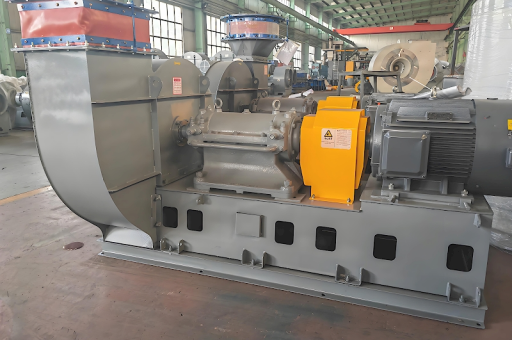
What is it?
An Induced Draft (ID) Fan is located at the outlet of the boiler system (between the dust collector/ESP and the chimney). Its job is to pull the hot flue gas (exhaust) through the boiler, economizer, air heater, and pollution control equipment, creating a slight negative pressure inside the furnace.
The term "Heavy Duty" and "Carbon Steel" specify the construction. Carbon steel is used for its strength, durability, and cost-effectiveness for handling high-temperature, abrasive, and corrosive gases (though it has temperature limits).
Function (Forced Ventilating)
- Creates Draft: It pulls the flue gases from the boiler, ensuring the furnace operates under a slight negative pressure. This is critical for safety (preventing hot gas leaks) and efficient combustion.
- Overcomes System Resistance: It provides the pressure needed to suck the gas through the boiler tubes, air preheaters, dust collectors (ESP or baghouse), and ductwork.
- Maintains Flow: It ensures a consistent flow of exhaust gases, essential for the boiler's thermal efficiency.
Key Features of a "Heavy Duty" Carbon Steel ID Fan
- Material: Carbon Steel (typically ASTM A36, A516 Gr. 70, or similar). This is the standard for high-temperature strength.
- Limitation: Carbon steel has a maximum operating temperature limit (typically 400-450°C or 750-850°F). Beyond this, creep and oxidation become problematic. For very high temperatures, alloy steels are used.
- Blade Design: Heavy duty implies robust, often radial or backward-curved blades, designed to handle the erosive nature of fly ash and high-temperature gas.
- Shaft & Bearings: Heavy-duty, oversized shaft and corrosion-resistant bearings with cooling systems (shaft cooling fans or water cooling) to handle the heat.
- Housing: A robust, welded steel casing designed to handle structural loads and thermal expansion. Often includes a wear lining (e.g., Stellite or ceramic tiles) on the impeller and casing to resist fly ash erosion.
- Vibration Monitoring: Typically includes provisions for vibration sensors (accelerometers) to detect imbalance or bearing failure.
- Drive System: Usually direct-driven by a powerful electric motor (often with a VFD for speed control) or via a belt/coupling. A hydraulic coupling or VFD is common for heavy duty ID fans to control airflow precisely.
Why is it "Heavy Duty"? (Applications)
- Power Plants: Coal-fired, biomass, or waste-to-energy boilers.
- Cement Industry: Kiln and preheater exhaust.
- Steel Industry: Blast furnace gas exhaust.
- Chemical/Petrochemical: Process heaters and boilers.
Key Performance Parameters
When specifying or selecting this fan, you need to know:
- Volume Flow Rate (CFM or m³/h): How much gas needs to be moved.
- Static Pressure (in. w.g. or Pa): The resistance of the system (boiler, filter, duct).
- Gas Temperature (max and normal): Critical for material selection (Carbon Steel max ~400°C).
- Gas Composition: Is it corrosive (SOx, NOx), wet (high humidity), or laden with abrasive particles (fly ash)?
- Density: The fan's performance varies with gas density (affected by temperature).
- Speed/RPM: Determined by the required pressure and flow.
Operational Considerations
- Erosion: Fly ash is abrasive. A heavy duty ID fan with wear-resistant coatings (hardfacing, ceramic tiles) is essential.
- Corrosion: If the boiler runs at low load or with high sulfur fuel, condensation of sulfuric acid can occur, quickly destroying the fan. Cold-end corrosion is a major cause of failure.
- Imbalance: Dust deposition on the impeller blades causes imbalance and vibration. Regular cleaning (or online cleaning with water/sonic horns) is needed.
- Temperature Limits: Never exceed the material's temperature rating. Overheating can cause the impeller to warp or the shaft to creep.
- Noise: These fans are very loud. Heavy duty sound attenuation (silencers) is required.
Summary Table
| Feature | Specification |
|---|---|
| Type | Induced Draft (ID) |
| Function | Pulls flue gas from boiler, creates negative pressure |
| Material | Carbon Steel (e.g., ASTM A36, A516) |
| Max Temp (approx) | 400-450°C (750-850°F) |
| Key Threats | Fly ash erosion, acid corrosion, heat, imbalance |
| Typical Drive | Large motor + VFD or hydraulic coupling |
| Applications | Power plants, large industrial boilers, cement kilns |
Final Note
If you are sourcing a quote or designing a system, you must provide the specific operating conditions (flow, pressure, temperature, gas composition, altitude) to the fan manufacturer. A generic "carbon steel ID fan" will not work reliably; it must be engineered for the specific duty.
Would you like more details on:
- Specific manufacturers (e.g., Howden, AirEng, TLT-Babcock, Robinson Fans)?
- How to size an ID fan for a given boiler pressure drop?
- Comparison between ID and FD (Forced Draft) fans?





