
This article's table of contents introduction:
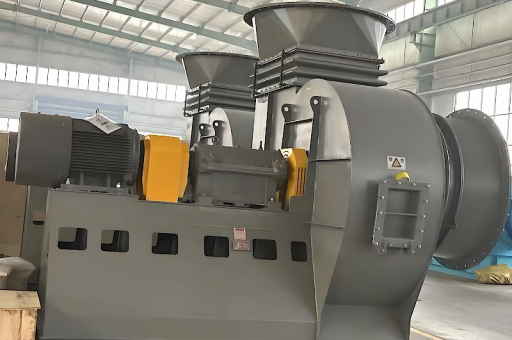
- What is a Forced Draught (FD) Fan?
- Why "Industrial Kilns" and "Power Plants" are Specific Use Cases
- Key Design Features of a "Kiln-Grade" Centrifugal Blower
- Typical Performance Parameters (Example Sizing)
- Common Problems & Solutions in Kilns/Power Plants
- How to Order / Specification Checklist
- Summary Recommendation
It appears you are looking for a Centrifugal Blower (Fan) specifically designed for Forced Draught (FD) application in an Industrial Kiln or Power Plant setting.
Here is a detailed breakdown of what this equipment is, its critical features, and how to specify one correctly.
What is a Forced Draught (FD) Fan?
In a kiln or boiler system, the Forced Draught Fan is located at the beginning of the air path. Its primary job is to push ambient air into the system (e.g., through an air heater and into the burner grate or furnace).
- Function: Supplies the primary combustion air.
- Location: Upstream of the heat source (cold side).
- Pressure: Handles higher static pressure to overcome resistance from air ducts, air preheaters, and windboxes.
- Design: Typically uses a centrifugal impeller.
Why "Industrial Kilns" and "Power Plants" are Specific Use Cases
These applications demand heavy-duty construction due to:
- High Air Volume: Large kilns (cement, lime) or boiler furnaces require massive CFM/m³/s.
- Abrasive Air: In cement kilns or coal-fired power plants, the incoming air (even ambient) is often laden with dust or ash. High wear resistance is mandatory.
- High Temperature: While the fan is on the cold side (Forced Draught), it handles air heated by the Air Preheater. Temperature can range from 20°C (ambient) up to 120-200°C.
- Continuous Operation: Must run 24/7 with zero downtime for months (up to 8000 hours/year).
Key Design Features of a "Kiln-Grade" Centrifugal Blower
If you are sourcing this fan, look for the following engineering specifications:
| Feature | Specification for Heavy Duty | Why it matters |
|---|---|---|
| Impeller Type | Backward Inclined (BI) or Backward Curved (BC) | High efficiency, non-overloading power curve (critical for motor safety), handles dust better than forward curved. |
| Blade Profile | Airfoil (hollow) or Flat Plate (solid) | Airfoil is more efficient. Flat plate is stronger for high abrasion. |
| Construction | Housings: Heavy gauge steel (6mm - 12mm) with stiffeners. Shaft: Forged steel, oversized. Bearings: Self-aligning spherical roller bearings (SKF/FAG equivalent) with cooling fins. | Prevents vibration and fatigue failure. |
| Wear Protection | Option 1: Thickened plate at impeller wear zones. Option 2: Ceramic tiles or Hardox steel liners on the volute tongue and impeller. |
Extends fan life by 2-3x in dusty environments (cement/power plants). |
| Drive System | Direct Drive (Coupling) preferred for reliability. Belt Drive used only for variable speed with fixed speed motors. | Direct drive eliminates belt maintenance and slippage. |
| Variable Speed | VFD (Variable Frequency Drive) or Inlet Guide Vanes (IGVs). | Essential for process control in modern kilns. VFD is most energy efficient. |
Typical Performance Parameters (Example Sizing)
To give you a concrete idea, here are the specs for a Medium-Sized Power Plant FD Fan:
- Air Volume: $150,000 \text{ m}^3/h$ (approx 88,000 CFM)
- Static Pressure: $3500 \text{ Pa}$ (14 inch w.g.)
- Power: $250 \text{ kW}$ at 990 RPM
- Temperature: $80^\circ C$ (Standard design) or $150^\circ C$ (for hot air).
- Material: Impeller: Corten steel or SS304 for corrosion resistance.
Common Problems & Solutions in Kilns/Power Plants
If you are troubleshooting an existing blower, these are the three most common failures:
-
Erosion (Wear)
- Symptom: Vibration, imbalance, efficiency loss.
- Fix: Install wear pads (ceramic/epoxy) on the impeller leading edges and the cut-off (scroll) plate.
-
Overheating of Bearings
- Symptom: Grease melting, bearing noise.
- Fix: Ensure cooling vents are clear. For high-temp models, use water-cooled bearing housings. Use high-temp grease (e.g., Mobilith SHC 100).
-
Vibration
- Symptom: Structural failure, bearing damage.
- Fix: Balance the impeller to ISO 1940 G6.3 (or better G2.5). Check for foundation resonance.
How to Order / Specification Checklist
To get the correct price and quote from a manufacturer (e.g., Howden, Flakt Woods, TLT-Babcock, or a regional custom manufacturer), provide this data:
- Application: (e.g., Coal Power Plant, Cement Kiln, Lime Kiln)
- Air Flow Rate: (m³/h or CFM)
- Static Pressure: (Pa or inch w.g.)
- Inlet Air Temperature: (°C)
- Dust Load: (mg/Nm³) – Critical for wear protection
- Altitude: (For air density correction)
- Control Type: (Damper / Inlet Vanes / VFD)
- Material of Construction: (Carbon Steel, Corten, Stainless Steel)
Summary Recommendation
For an Industrial Kiln Power Plant, a Heavy-Duty Centrifugal FD Fan with Backward Inclined Blades, direct drive, VFD control, and protective wear coatings (hardfacing or ceramic) is the standard.
Do not use standard HVAC blowers (forward curved) for this application; they will fail quickly due to abrasion and overheating.
Need a specific quote or drawing? You must provide the model, capacity, and kiln type (e.g., "Cement Kiln 3000 tpd").





