
This article's table of contents introduction:
- Critical Application Parameters (You Must Define)
- Why "Direct Drive" is a Key Specification
- Why "Forced Draught" (FD) vs. Induced Draught (ID)
- Key Customization Options for This Fan Type
- Recommended Next Steps (How to Proceed with Customization)
- Important Safety & Compliance Note
- Summary for your Request:
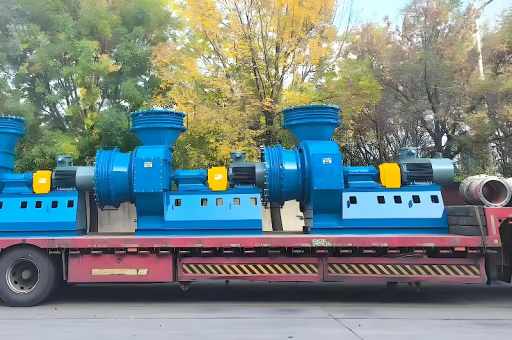
It sounds like you are looking for a customized, direct-drive, forced draft centrifugal fan designed specifically for flue gas applications. This is a very specific piece of industrial equipment, often used in power plants, incinerators, industrial boilers, or chemical processing where hot, corrosive, or particulate-laden gases need to be moved.
Because you specified "Customized," there is no single "off-the-shelf" product. However, I can provide you with the critical engineering specifications you need to define for a manufacturer, along with the key design considerations.
Here is the expert breakdown for specifying this fan.
Critical Application Parameters (You Must Define)
To get a proper quotation and design, you need to provide these values:
| Parameter | Why it's critical for a Flue Gas Fan |
|---|---|
| Gas Temperature | Most important. Affects material selection (e.g., Carbon Steel vs. Stainless Steel), thermal expansion, and shaft cooling needs. |
| Gas Composition | Determines corrosion resistance (e.g., sulfur, chlorides, acids). |
| Particulate Load | Determines if an erosion-resistant coating or radial-tipped blades are needed. |
| Flow Rate (m³/hr or CFM) | The volume of gas to be moved (note: volume changes drastically with temperature). |
| Static / Total Pressure (Pa or in.wg) | The resistance the fan must overcome (ductwork, scrubber, stack). |
| Density / Specific Gravity | Affects motor power calculation. Flue gas is lighter than air. |
| Altitude | Affects air density and motor cooling. |
Why "Direct Drive" is a Key Specification
You have specified Direct Drive (as opposed to belt drive). This means:
- Motor Shaft is directly coupled to the fan impeller.
- No belts, bearings, or pulleys on the fan side.
- Pros: Zero slip, higher efficiency, lower maintenance, better for high RPM, compact footprint.
- Cons: Motor must run at the exact fan speed (often requires a VFD), motor bearings must handle the fan's axial/radial loads.
- Application: Often used with high-speed, high-efficiency impellers (e.g., backward-curved) or when space is limited.
Why "Forced Draught" (FD) vs. Induced Draught (ID)
This is the most critical distinction for customization:
- FD Fan: Pushes ambient air into the furnace/boiler. The fan is on the clean, cold side.
- Customization focus: High pressure, clean air, standard materials (carbon steel is often fine).
- ID Fan: Pulls hot flue gas out of the furnace, through the pollution control system, and up the stack. The fan is on the hot, dirty side.
- Customization focus: High temperature, erosion resistance, acid dew point protection, heavy-duty shaft seals.
- Your phrase "Flue Gas Fan" implies an ID Fan or a specialized Overfire Air Fan. Please confirm. If it's truly for flue gas (downstream of the furnace), it's an ID fan.
Key Customization Options for This Fan Type
| Feature | Standard | Customized (For Flue Gas) |
|---|---|---|
| Impeller Type | Forward Curved (low noise, low pressure) | Backward Curved / Radial Tip (Radial) for high efficiency & erosion resistance. |
| Material | Mild Steel (MS) | Corten Steel, Stainless Steel 316L, or Hastelloy (for corrosion). |
| Shaft Seal | Standard lip seal | Mechanical seals, labyrinth seals, or purge air seals (to prevent gas leakage). |
| Casing | Standard gauge | Reinforced, with access doors for cleaning, lined with erosion-resistant wear plates. |
| Motor | Standard ODP | TEFC (Totally Enclosed Fan Cooled) or TEAAC, high-temperature bearings, with VFD bypass for startup. |
| Cooling | None | Shaft cooling fins or water-cooled bearings if gas > 100°C. |
| Vibration Monitoring | Optional | Mandatory accelerometers (4-20mA output) for predictive maintenance. |
Recommended Next Steps (How to Proceed with Customization)
- Contact Industrial Fan Manufacturers who specialize in heavy-duty process fans. Good examples include:
- New York Blower (NYB)
- Chicago Blower
- Greenheck (Industrial division)
- Robinson Fans
- Twin City Fan (Industrial process group)
- Soler & Palau (S&P) (Industrial division)
- Local/regional industrial fan fabricators.
- Provide a Technical Inquiry (Use the parameters from section 1).
- Ask for a "Performance Curve" – This is critical. It shows the fan's operating range. You want to be near the peak efficiency point for the "Direct Drive" speed.
- Request a "Duty Point" analysis – Confirm that the fan's BHP (Brake Horsepower) does not exceed the motor's rated power at the required volume.
- Specify "Overspeed" capability – For safety, the impeller should be designed for 110-115% of the maximum RPM.
- Request a "Thermal Expansion" calculation – For hot flue gas, the shaft will expand. This affects bearing placement and seal clearance.
Important Safety & Compliance Note
- ATEX / IECEx: If the flue gas contains unburned hydrocarbons or is in a potentially explosive atmosphere, the fan must be ATEX-certified (for Europe) or NEC 500/505 compliant (for USA). This dictates spark-resistant construction (e.g., aluminum impeller or non-metallic lining).
- Eurovent / AMCA: Look for fans certified by AMCA (Air Movement and Control Association) for performance and sound.
Summary for your Request:
Since you are requesting a customized, direct-drive, forced-draught flue gas centrifugal fan, you are essentially building a high-pressure, high-temperature, corrosion-resistant workhorse.
The most important first step is to clarify: Is this for the clean air side (FD) or the hot gas side (ID)? The difference determines if you use standard carbon steel (FD) or exotic alloys with heavy-duty seals (ID).
If you provide the Gas Temperature and Gas Composition, I can give you a more specific material and impeller recommendation.





