
This article's table of contents introduction:
- Table of Contents
- Introduction: The Unsung Hero of Cement Production
- What Is a Heavy Duty Low Pressure Cement Fan?
- The Critical Role of Rotary Kiln Exhaust in Cement Plants
- Design Features That Define Heavy Duty Low Pressure Fans
- Key Performance Metrics: Flow, Pressure, and Efficiency
- Common Operational Challenges and Solutions
- Maintenance Best Practices for Long Service Life
- FAQs: Heavy Duty Low Pressure Cement Fan in Rotary Kiln Exhaust
- Conclusion: Optimizing Exhaust for Higher Productivity
** Mastering Heavy Duty Low Pressure Cement Fan Performance: Critical Insights for Rotary Kiln Exhaust Systems
Table of Contents
- Introduction: The Unsung Hero of Cement Production
- What Is a Heavy Duty Low Pressure Cement Fan?
- The Critical Role of Rotary Kiln Exhaust in Cement Plants
- Design Features That Define Heavy Duty Low Pressure Fans
- Key Performance Metrics: Flow, Pressure, and Efficiency
- Common Operational Challenges and Solutions
- Maintenance Best Practices for Long Service Life
- FAQs: Heavy Duty Low Pressure Cement Fan in Rotary Kiln Exhaust
- Conclusion: Optimizing Exhaust for Higher Productivity
Introduction: The Unsung Hero of Cement Production
In any modern cement plant, the rotary kiln stands as the epicenter of thermal processing. Yet, behind its fiery operation lies a critical piece of mechanical equipment often overlooked: the heavy duty low pressure cement fan. This fan is specifically designed to handle rotary kiln exhaust gases—hot, dust-laden, and chemically aggressive. Without it, the kiln cannot maintain negative draft, combustion efficiency drops, and environmental compliance becomes impossible.
This article dives deep into the technical nuances of these fans, blending industry knowledge with practical answers to common questions. We will examine how design, operation, and maintenance of heavy duty low pressure cement fans directly impact kiln performance, energy consumption, and plant profitability.
What Is a Heavy Duty Low Pressure Cement Fan?
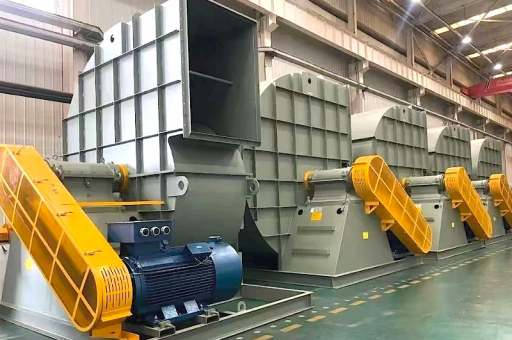
A heavy duty low pressure cement fan is a high-volume, low-static-pressure fan engineered to move large quantities of exhaust gas from the rotary kiln through the gas cleaning system (such as baghouses or electrostatic precipitators) before discharge to the stack.
Key characteristics include:
- Volume flow capacity: Typically ranging from 200,000 to over 1,000,000 m³/h depending on kiln size.
- Low static pressure: Usually between 1,500 and 3,500 Pa (6 to 14 inches w.g.), suitable for overcoming friction in ductwork and minor pressure losses.
- Robust construction: Steel alloys, reinforced impellers, and abrasion-resistant linings to withstand high temperatures (up to 350°C or more) and particulate erosion.
Unlike high-pressure fans used in pneumatic conveying, these units prioritize volumetric flow over pressure rise. They are mounted directly after the kiln or after the air quenching cooler, often referred to as kiln exhaust fans or kiln ID fans (induced draft fans).
The Critical Role of Rotary Kiln Exhaust in Cement Plants
The rotary kiln exhaust system is responsible for:
- Maintaining negative pressure inside the kiln to prevent backflow of hot gases into upstream equipment (preheaters and precalciners).
- Transporting combustion gases (including CO₂, SO₂, NOₓ, and water vapor) and fine cement dust through the pollution control equipment.
- Regulating combustion air balance by controlling the amount of airflow through the kiln, which directly affects clinker quality and energy efficiency.
A poorly performing heavy duty low pressure cement fan can cause:
- Increased specific heat consumption due to leakage or reduced draft.
- Higher emissions due to incomplete combustion or poor dust capture.
- Mechanical failures from excessive vibration, bearing wear, or impeller erosion.
Design Features That Define Heavy Duty Low Pressure Fans
To survive the harsh environment of rotary kiln exhaust, manufacturers incorporate several unique design elements:
A. Impeller Geometry
- Backward-curved or radial blades to handle dust without clogging.
- Reinforced heavy gauge steel or high-strength aluminum alloys.
- Balance quality per ISO 1940 G6.3 or better to minimize vibration.
B. Casing and Inlet
- Welded steel casing with bolted access doors for inspection.
- Inlet cone or inlet box designed for uniform flow distribution.
- Abrasion-resistant coatings or ceramic tile lining on wear zones.
C. Shaft and Bearings
- Oversized shaft to minimize deflection at high speeds.
- Heavy-duty anti-friction bearings with temperature sensors.
- Grease or oil lubrication systems with continuous monitoring.
D. Drive System
- Direct-coupled or belt-driven arrangement depending on speed requirements.
- Variable frequency drive (VFD) for fine tuning airflow with energy savings.
E. Isolation Systems
- Expansion joints to absorb thermal expansion.
- Inlet and outlet silencers to reduce noise levels.
- Isolation dampers for maintenance without kiln shutdown.
Key Performance Metrics: Flow, Pressure, and Efficiency
Understanding fan performance curves is essential for system optimization.
- Volume flow (Q): Measured in m³/h or CFM. Fixed by plant capacity.
- Static pressure (SP): Required to overcome system resistance. Over-sizing leads to wasted energy; under-sizing causes insufficient draft.
- Fan efficiency (η): The ratio of air power to input shaft power. Modern heavy duty low pressure cement fans achieve 75–85% efficiency at design point.
- System resistance curve: A parabolic relationship between flow and pressure drop. The fan operating point is the intersection of fan curve and system curve.
Tip: Using a VFD to match fan speed to actual demand can reduce energy consumption by 20–40% compared to throttling dampers.
Common Operational Challenges and Solutions
| Challenge | Cause | Solution |
|---|---|---|
| Vibration | Unbalanced impeller due to dust buildup or erosion | Regular cleaning, rebalancing, and installation of vibration transmitters |
| High temperature | Incomplete cooling or shutdowns | Install temperature probes with alarms; use cooling air ducting |
| Abrasion | High dust loading with sharp particles | Apply ceramic linings; replace impeller material to AR500 or better |
| Corrosion | Acid condensation from SO₃/HCl | Maintain gas temperature above dew point; use stainless steel or FRP for casings |
| Bearing failure | Overheating or misalignment | Use thermal grease, realign shafts, and monitor bearing temperature trends |
Maintenance Best Practices for Long Service Life
Predictive and preventive maintenance are vital:
- Daily checks: Monitor amperage, vibration amplitude, and bearing temperature. Listen for unusual noise.
- Weekly checks: Inspect inlet and outlet dampers. Grease bearings per manufacturer schedule.
- Monthly checks: Examine impeller and casing for wear or dust accumulation. Clean as needed.
- Annual overhaul: Disassemble, clean, inspect, and balance the impeller. Replace bearings and seals. Check and calibrate VFD parameters.
A well-maintained heavy duty low pressure cement fan can last 15–20 years in continuous service.
FAQs: Heavy Duty Low Pressure Cement Fan in Rotary Kiln Exhaust
Q1: What is the typical speed range for a heavy duty low pressure cement fan?
A: Depending on size and drive arrangement, speeds range from 600 to 1200 RPM for large fans and up to 1800 RPM for smaller units. Direct drive with a motor running at 1000 or 1500 RPM (4-pole or 6-pole) is common.
Q2: Can I use a standard industrial fan for rotary kiln exhaust?
A: Not recommended. Standard fans lack the abrasion resistance, temperature tolerance, and structural rigidity needed. A heavy duty low pressure cement fan is purposely designed for these conditions.
Q3: How does the fan affect kiln fuel consumption?
A: Directly. If the fan provides insufficient draft, the kiln may require more fuel to maintain burner flame. Conversely, too high draft pulls cold air into the system, increasing heat loss.
Q4: What is the difference between an ID fan and a heavy duty low pressure fan?
A: In cement plants, the terms are often used interchangeably. However, an ID fan specifically refers to the induced draft fan placed after the baghouse or scrubber. The heavy duty low pressure cement fan can be the kiln exhaust fan located before the dust collector.
Q5: How do I calculate the required fan power?
A: Power (kW) = (Volume (m³/s) × Static Pressure (Pa)) / (1000 × Efficiency). Always add a safety margin of 10–15% for system aging.
Q6: What materials are best for impeller manufacturing?
A: For high-temperature, dusty environments, use abrasion-resistant steel like Hardox 400 or 500, or stainless steel 310S for corrosion resistance. For the casing, a combination of carbon steel with internal ceramic lining is typical.
Q7: Can I retrofit an existing fan with a VFD?
A: Yes, as long as the motor and fan can operate at variable speeds without exceeding critical speed limits. VFD retrofits typically pay back within 1–3 years via energy savings.
Q8: How often should I balance the fan rotor?
A: After any repair or replacement, and at least once every 12 months during annual overhaul. Also, rebalance immediately if vibration exceeds ISO 1940 limits.
Conclusion: Optimizing Exhaust for Higher Productivity
The heavy duty low pressure cement fan may not command the spotlight, but its role in rotary kiln exhaust is indispensable. Selecting the right fan, maintaining it diligently, and operating it within its design envelope directly correlates to lower energy costs, reduced downtime, and cleaner emissions.
In the competitive cement industry, every percentage point of efficiency matters. By understanding the principles laid out in this guide, plant engineers and operators can ensure their kiln exhaust fans perform at peak levels year after year.
For more information on industrial fan solutions, visit the official website of leading fan manufacturers or consult your plant’s mechanical engineering team.





