
This article's table of contents introduction:
- Table of Contents
- Introduction: Why the Dust Collector Blower Fan Matters
- Understanding the Forced Draft System in Rotary Kilns
- The Anatomy of a Dust Collector Blower Fan
- Performance Parameters: Airflow, Static Pressure, and Temperature Tolerance
- Common Operational Challenges and Maintenance Best Practices
- Frequently Asked Questions (FAQ)
- Conclusion: Integrating the Fan for Optimal Kiln Efficiency
Table of Contents
- Introduction: Why the Dust Collector Blower Fan Matters
- Understanding the Forced Draft System in Rotary Kilns
- The Anatomy of a Dust Collector Blower Fan
- Performance Parameters: Airflow, Static Pressure, and Temperature Tolerance
- Common Operational Challenges and Maintenance Best Practices
- Frequently Asked Questions (FAQ)
- Conclusion: Integrating the Fan for Optimal Kiln Efficiency
Introduction: Why the Dust Collector Blower Fan Matters
In the demanding environment of industrial rotary kilns—whether used for cement production, lime calcination, or waste incineration—the dust collector blower fan stands as a silent yet indispensable component. This fan is the mechanical heart of the forced draft system, responsible for maintaining negative pressure inside the kiln, extracting hot, dust-laden gases, and ensuring emission compliance. Without a properly designed and maintained fan, the entire kiln operation risks reduced thermal efficiency, increased particulate emissions, and premature equipment failure.
This article delves into the engineering nuances of the dust collector blower fan within the forced draft architecture. By the end, you will understand how to select, operate, and troubleshoot this critical fan to maximize kiln uptime and meet environmental standards.
Understanding the Forced Draft System in Rotary Kilns
To appreciate the role of the dust collector blower fan, we must first grasp the forced draft concept. In a rotary kiln, air must be precisely controlled to sustain combustion and heat transfer. The forced draft system typically uses a fan to push air into the kiln’s burner, while an induced draft (ID) fan pulls gases out. However, the dust collector blower fan is often part of the dust collection system that lies downstream of the main kiln exhaust.
Here is how the system flows:
- Primary and Secondary Air: Fans supply combustion air at the burner end.
- Kiln Exhaust: Hot gases, volatile compounds, and fine dust exit the kiln.
- Cooling and Conditioning: Gases pass through a cooler or conditioning tower.
- Dust Collection: The dust collector blower fan draws these gases through baghouses or electrostatic precipitators (ESP), ensuring clean discharge.
The dust collector blower fan in this context is specifically a forced draft fan for the dust collector itself. It must overcome the resistance of filter media (e.g., fabric bags) and ductwork to maintain a consistent negative pressure. This pressure difference is what captures airborne particulates before they escape to the atmosphere.
Key Insight: The fan must handle not only the volume of gas but also its high temperature (often 120°C–260°C) and the abrasiveness of suspended dust. Therefore, fan materials and blade design are chosen for durability and thermal stability.
The Anatomy of a Dust Collector Blower Fan
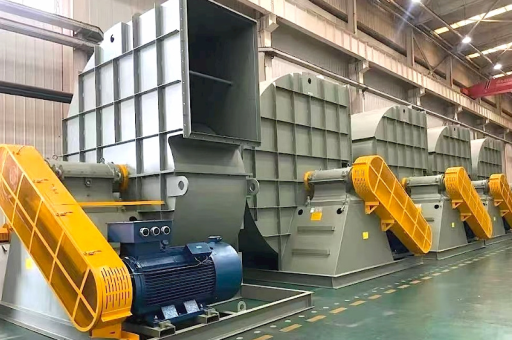
A typical dust collector blower fan used in kiln forced draft applications consists of the following core components:
- Impeller (Blades): Most often backward-inclined or radial-tip designs. Backward-inclined blades are efficient and handle particulate matter better than forward-curved designs. Radial-tip blades are preferred for highly abrasive dust.
- Housing: Made from heavy-gauge steel with replaceable wear liners. The housing must be airtight to prevent fugitive emissions.
- Shaft and Bearings: The fan shaft is supported by heavy-duty bearings, often with cooling fins or oil lubrication to cope with radiant heat from the kiln.
- Drive System: Typically belt-driven or direct-coupled. Belt drives allow speed adjustments to fine-tune airflow, while direct drives offer higher reliability.
- Variable Frequency Drive (VFD): Modern installations use VFDs to modulate fan speed, providing precise control over draft and reducing energy consumption.
Why forced draft? Unlike natural draft, which relies on chimney buoyancy, forced draft using a fan provides reliable, controllable pressure. This ensures the dust collector captures particles even during kiln startup, shutdown, or fluctuating loads.
Performance Parameters: Airflow, Static Pressure, and Temperature Tolerance
Selecting the right dust collector blower fan for a rotary kiln forced draft system requires careful analysis of three key parameters:
Airflow (CFM or m³/h)
The fan must move a specific volumetric flow of gas. Too little flow and the dust collector fails; too much flow can cause baghouse over-pressurization and filter damage. Engineers calculate this based on:
- Kiln production rate (tons per hour)
- Excess oxygen requirements
- Dust loading (g/m³)
Static Pressure (in. w.g. or Pa)
The fan must overcome resistance from:
- Duct friction losses
- Inlet dampers and turning vanes
- Filter media (clean vs. dirty bags)
- Pressure drop across the kiln itself
A typical dust collector fan for a cement kiln may require 20–35 in. w.g. (5000–8700 Pa) total static pressure.
Temperature Tolerance
Gas temperature at the fan inlet can range from 120°C (after conditioning) up to 260°C or more in preheater systems. Fans are classified by temperature rating:
- Standard: up to 120°C
- High-temperature: up to 260°C with special alloys (e.g., Corten or 316L stainless steel)
- Extreme: >400°C with ceramic coatings or internal cooling
Real-world Tip: Always derate fan performance at higher temperatures. Hot air is less dense, so the fan moves more volume but generates less mass flow. Use manufacturer’s curves for selection.
Common Operational Challenges and Maintenance Best Practices
Despite robust design, dust collector blower fans in kiln forced draft systems face several challenges:
Challenge 1: Abrasive Wear
Dust particles—especially from raw meal or clinker—erode fan blades over time. This reduces efficiency and can unbalance the rotor.
Solution: Apply hard-facing (e.g., chromium carbide overlay) on blade leading edges. Schedule biannual inspection of blade thickness.
Challenge 2: Imbalance & Vibration
Dust buildup (cake) on the impeller causes imbalance, leading to bearing failure.
Solution: Install a dust purge system (e.g., compressed air nozzles) that cleans the impeller at intervals. Use vibration sensors to alert before imbalance becomes critical.
Challenge 3: High Temperature Excursions
If the conditioning tower fails or kiln bypass is active, the fan may face gas temperatures exceeding design limits, causing thermal distortion.
Solution: Use a temperature safety interlock that slows the fan or trips it if inlet temperature exceeds 280°C. Install a cold air bleed damper to temper incoming gas.
Maintenance Checklist:
- Monthly bearing grease replenishment (high-temperature grease)
- Quarterly belt tension check (if belt-driven)
- Semi-annual fan shaft alignment
- Annual impeller dynamic balancing
Frequently Asked Questions (FAQ)
Q1: Can I use the same dust collector blower fan for both induced and forced draft? No. Forced draft fans push air into a system (positive pressure), while induced draft fans pull air out (negative pressure). Their impeller and housing designs differ. A forced draft fan in an induced draft position would operate poorly and risk cavitation or overheating.
Q2: What happens if the forced draft fan fails during kiln operation? The dust collector immediately loses vacuum and pressure. Particulate emissions will spike, and the kiln may need to be idled or tripped to avoid regulatory non-compliance. This is why many plants install a standby fan with an automatic switchover.
Q3: How do I choose between belt-drive and direct-drive for a dust collector fan? Belt drives allow easy speed changes and absorb some motor vibration; they are common when VFD is not used. Direct drives are more compact, have higher efficiency (no belt slip), and require less maintenance but may need VFD for speed control.
Q4: What is the typical lifespan of a dust collector blower fan in a cement rotary kiln? With proper maintenance (wear liners, balancing, and dust control), the fan housing lasts 10–15 years. The impeller may need replacement every 3–5 years depending on dust abrasiveness.
Q5: Can a dust collector blower fan be retrofitted for energy savings? Yes. Replacing an old standard-efficiency fan with a VFD-controlled high-efficiency backward-inclined fan often reduces energy consumption by 20–35%. Also consider aerodynamic inlet cones to reduce turbulence.
Conclusion: Integrating the Fan for Optimal Kiln Efficiency
The dust collector blower fan is not an accessory—it is a mission-critical component in the forced draft system of industrial rotary kilns. Its role in maintaining negative pressure, capturing particulate, and enabling compliance with environmental regulations cannot be overstated.
For engineers and plant managers, the path to success includes:
- Selecting a fan with the correct airflow, pressure, and temperature ratings.
- Ensuring robust materials (hardened steel or alloys) to handle dust erosion.
- Implementing predictive maintenance (vibration analysis, thermal imaging, and regular balancing).
- Using variable speed drives to match fan output to kiln load, reducing energy waste.
By treating the dust collector blower fan as a key part of the kiln system—rather than an afterthought—you extend equipment life, protect the environment, and maintain smooth production. Forced draft technology, when paired with a properly designed fan, makes rotary kiln operations cleaner, safer, and more efficient.
This article is written exclusively for professionals seeking deep technical insight into industrial fan systems. For specific fan sizing or selection assistance, always consult with original equipment manufacturers.





