
This article's table of contents introduction:
- Table of Contents
- Introduction: Why Air Filtration Demands High-Strength Blowers
- Core Design: Understanding the Backward Curved Centrifugal Fan
- Material & Durability: The “High Strength” Advantage
- Integration into Filtration Systems: Key Components and Workflow
- Performance Metrics: Efficiency, Pressure, and Energy Savings
- Application Areas: From HVAC to Heavy Industry
- Frequently Asked Questions (FAQ)
- Conclusion: Future Trends and Selection Criteria
Optimizing Industrial Air Quality: The Engineering Power of High Strength Backward Curved Centrifugal Blower Air Filtration Systems**
Table of Contents
- Introduction: Why Air Filtration Demands High-Strength Blowers
- Core Design: Understanding the Backward Curved Centrifugal Fan
- Material & Durability: The “High Strength” Advantage
- Integration into Filtration Systems: Key Components and Workflow
- Performance Metrics: Efficiency, Pressure, and Energy Savings
- Application Areas: From HVAC to Heavy Industry
- Frequently Asked Questions (FAQ)
- Conclusion: Future Trends and Selection Criteria
Introduction: Why Air Filtration Demands High-Strength Blowers
Modern industrial environments generate airborne contaminants—particulates, fumes, chemical vapors, and biological agents—that require robust filtration. At the heart of any effective air filtration system lies the blower. Among various fan types, the High Strength Backward Curved Centrifugal Blower has emerged as a preferred choice for demanding filtration tasks. This article will dissect its engineering principles, performance advantages, and real-world integration, answering critical questions for engineers, facility managers, and procurement specialists.
Core Design: Understanding the Backward Curved Centrifugal Fan
A centrifugal blower uses a rotating impeller to accelerate air radially outward. In a backward curved design, the blades are inclined opposite to the direction of rotation. This creates a crucial aerodynamic benefit:
- Lower turbulence: Air exits smoothly, reducing noise and vibration.
- Higher static pressure efficiency: The fan can overcome high resistance from dense filter media.
- Non-overloading power characteristic: Unlike forward curved fans, power draw peaks and then stabilizes—preventing motor burnout even if ductwork is blocked.
The “backward curved” geometry is particularly suited to filtration because it maintains stable airflow across varying system resistance, which is common as filters load with dust.
Material & Durability: The “High Strength” Advantage
The term “High Strength” refers not only to the motor power but fundamentally to the material construction:
- Impeller: Typically fabricated from heavy-gauge steel or aluminum alloys (e.g., 5052-H32 or 6061-T6) with welded or riveted blade attachments. Some designs incorporate stainless steel for corrosive or high-temperature environments.
- Housing: Reinforced sheet metal or cast iron, engineered to withstand static pressures up to 20 kPa or more without deformation.
- Bearings and shaft: Oversized, sealed ball bearings capable of continuous operation under high radial loads. The shaft is often heat-treated and ground for minimal runout.
This robust construction ensures the blower can handle not only clean air but also particulate-laden streams without blade erosion or imbalance—a common failure point in lower-grade fans.
Integration into Filtration Systems: Key Components and Workflow
A typical air filtration system incorporating a high-strength backward curved centrifugal blower includes:
- Pre-filter or inertial separator – Removes large debris to protect the fan.
- Secondary filtration – HEPA, bag filters, or activated carbon cartridges.
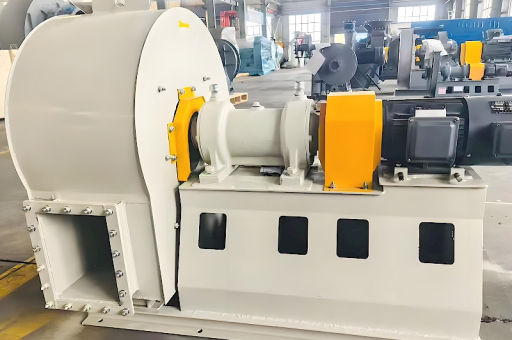
- Blower unit – Draws air through filters and discharges clean air.
- Ductwork & silencers – Manages airflow and reduces noise.
- Control system – VFD (Variable Frequency Drive) for modulating fan speed based on pressure differential.
The backward curved fan is typically placed after the filters (pull-through configuration) to enhance efficiency. Because it generates high static pressure, it compensates for the pressure drop across dense filter media, ensuring consistent airflow even as filters become partially loaded.
Performance Metrics: Efficiency, Pressure, and Energy Savings
Key performance parameters that make this blower optimal for filtration:
- Static Efficiency: Often exceeds 75% at peak, compared to 60–65% for forward curved fans. This translates directly to lower electricity consumption.
- Pressure Capability: Reliable at 1,500 Pa to over 5,000 Pa (6–20 in WG). Some heavy-duty models can reach 10 kPa.
- Airflow Range: Typically 500 to 50,000 CFM, depending on impeller diameter and RPM.
- Sound Levels: Properly designed backward curved fans operate at lower blade-pass frequencies, reducing annoying tonal noise. Silencers can further attenuate sound below 75 dBA.
Energy savings example: A facility switching from a forward curved fan to a high-strength backward curved fan for a 10 kW system can save 15–20% on energy annually, with payback within 12–18 months.
Application Areas: From HVAC to Heavy Industry
These blowers are deployed where reliability and air quality are non-negotiable:
- Pharmaceutical cleanrooms: Maintaining ISO Class 5 + environments.
- Chemical fume hoods: Handling corrosive acids and solvents.
- Welding fume extraction: High particulate loads without clogging.
- Cement and mining: Abrasive dust handling with erosion-resistant coatings.
- HVAC systems for hospitals: High-static pressure for terminal HEPA filters.
In each case, the system’s ability to maintain constant airflow as filters load is critical for regulatory compliance and worker safety.
Frequently Asked Questions (FAQ)
Q1: Why is a backward curved fan better than a forward curved fan for filtration?
A: It delivers higher static pressure efficiency and has a non-overloading power curve. This means it can maintain airflow as filters load without risk of motor overload.
Q2: Do I need a Variable Frequency Drive (VFD) with this blower?
A: Highly recommended. A VFD allows precise control of airflow to match changing filter resistance, reducing energy waste and extending filter life.
Q3: Can the impeller handle abrasive particles?
A: Yes, if specified with hardened steel or coated blades. Some models offer replaceable wear plates and inlet coatings for high-dust applications.
Q4: How often should I balance the impeller?
A: Factory-balanced impellers require rebalancing only after significant wear or repair. Annual inspection for vibration is standard.
Q5: Is the high strength version louder than standard ones?
A: Not necessarily. High-strength construction often reduces vibration transmission. However, noise levels depend on blade design and housing insulation—consult manufacturer data for specific models.
Conclusion: Future Trends and Selection Criteria
The High Strength Backward Curved Centrifugal Blower Air Filtration System represents a marriage of aerodynamic efficiency and metallurgical durability. As industries tighten emission standards and energy costs rise, demand for such systems will grow.
When selecting a unit, consider:
- airflow and static pressure requirements at end-of-life filter resistance
- material compatibility with the filtered air stream
- drive configuration (direct vs. belt) for maintenance ease
- availability of on-site testing reports (AMCA or ISO certified)
For tailored specifications, consult with fan manufacturers that specialize in filtration—visit fan (our dedicated domain) for detailed product databases and engineering calculators.
By investing in high-strength backward curved technology, facility operators can achieve cleaner air, lower operating costs, and long-term system reliability—a win for both business and the environment.





