
This article's table of contents introduction:
- The Core Function
- Why Biomass Boilers are Different (The "Why")
- Types of Fans for Biomass Boiler Dust Extraction
- Critical Engineering Specifications (You MUST check)
- Common Problems & Solutions
- Installation Best Practices
- Summary Recommendation
This is a very specific industrial equipment inquiry. You are asking about the fan component of a Dust Collection System for a Biomass Boiler.
These three terms (Biomass Boiler, Dust Collector, Fan) are interconnected. Here is a breakdown of what you need to know, the specific types of fans used, and critical engineering considerations.
The Core Function
The fan (often called the Induced Draft Fan or ID Fan in this context) does two things:
- Creates Negative Pressure: It pulls dust-laden exhaust gas from the boiler through the ductwork.
- Overcomes Resistance: It forces the gas through the filter bags, cartridges, or cyclones of the dust collector and then out the stack.
Why Biomass Boilers are Different (The "Why")
Biomass (wood chips, pellets, agricultural waste) creates a uniquely difficult filtration environment compared to coal or natural gas:
- High Moisture: Can cause clumping and corrosion.
- Sticky Ash: Contains potassium and sodium that melts into a sticky, corrosive "ash slag."
- High Temperature: Exhaust gases can be 180°C – 250°C (356°F – 482°F).
- Emissions Control: Often requires injection of lime or activated carbon, which adds abrasive dust.
Therefore, you cannot use a standard HVAC fan. You need a heavy-duty industrial fan.
Types of Fans for Biomass Boiler Dust Extraction
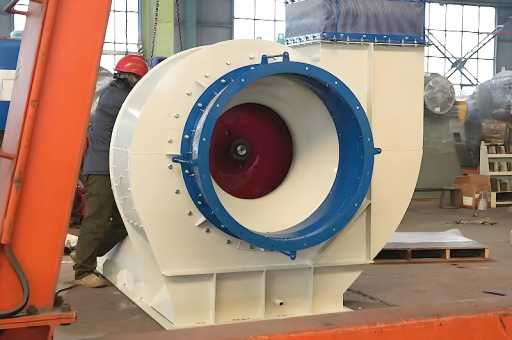
The most common fan design for this application is the Backward Inclined (BI) or Airfoil (AF) centrifugal fan. Sometimes a Radial Blade fan is used for highly abrasive dust.
| Fan Type | Best For | Pros | Cons |
|---|---|---|---|
| Backward Inclined (BI) | Most biomass dust collectors | High efficiency, non-clogging design, stable pressure curve. | Not for extremely sticky/tarry dust. |
| Airfoil (AF) | Cleaner biomass (pellets) | Highest efficiency (saves electricity). | Blades are hollow; if they wear through or get sticky, balance is lost quickly. |
| Radial / Paddle Wheel | High abrasion (sand, char), sticky fly ash | Very rugged, simple blades. Handles heavy dust loads. | Low efficiency (costs more to run), noisier. |
Critical Engineering Specifications (You MUST check)
When selecting or ordering this fan, provide the following information to the manufacturer:
- Gas Temperature: This determines the fan material.
- Standard: Carbon steel (up to ~250°F / 120°C).
- Hot Gas: Corten steel or Stainless Steel 304/316 (for high temp up to 450°F / 230°C).
- Very Hot: Requires a shaft cooling fan, heat slinger, and high-temp bearings.
- Dust Content (Particulate Loading):
- Pre-filtered (after baghouse): Low abrasive wear.
- Before the filter (directly from boiler): High abrasive wear (requires wear plates, hard-facing).
- Moisture/Sticky Ash:
- If the dust is heavy with potassium/sodium, the fan may need a water wash port or Teflon coating on the wheel to prevent ash buildup (which causes vibration and imbalance).
- Spark Potential:
- Biomass creates embers. The fan may require explosion-proof construction (non-sparking wheel, TEFC motor). NFPA 664 (Wood Processing) often applies.
Common Problems & Solutions
- Problem: Fan wheel imbalance (vibration).
- Cause: Ash buildup on blades (common with biomass).
- Solution: Request a clean-out door on the housing; schedule weekly cleaning using compressed air.
- Problem: Bearing failure.
- Cause: Heat radiating from the housing.
- Solution: Use an air-cooled shaft (heat slinger) and remote grease lines.
- Problem: Blade erosion (holes in the wheel).
- Cause: Abrasive fly ash (silica).
- Solution: Specify Hardox or AR400 wear plates on the blades, or a Radial fan with thicker material.
Installation Best Practices
- Vibration Isolation: Mount the fan on heavy inertia bases (concrete filled) with spring isolators.
- Variable Frequency Drive (VFD): Mandatory. You must be able to vary the speed to match the boiler load and filter cleaning cycle.
- Ductwork: Use thick gauge steel (10 ga or thicker). Never use flexible duct in the hot zone.
- Outlet Damper: Install a manual or automatic damper on the discharge to isolate the fan during maintenance.
Summary Recommendation
For a Biomass Boiler Dust Collector Fan:
Select a Backward Inclined centrifugal fan with a heat slinger and oversized bearings. The construction material should be Carbon Steel with a high-temp paint for standard conditions, or Corten/Stainless if the gas temperature exceeds 250°F. Always use a VFD. Budget for an explosion-proof motor and non-sparking wheel if the fuel is dry wood dust.
If you have a specific spec:
- Flow rate (CFM)?
- Static Pressure (inches w.g.)?
- Gas Temperature?
- Dust type (sawdust vs. ash vs. husk)?
I can give a more precise calculation or recommendation.





