
This article's table of contents introduction:
- Understanding the Components
- What "Free Standing" Means
- Key Design Considerations
- Typical Layout (Free Standing)
- Common Problems & Solutions for Free Standing Fans
- Sizing Recommendation
- Summary
Here is a breakdown of the terminology and considerations for an Industrial Boiler Secondary Air Fan and a Dust Extraction Fan configured as Free Standing units.
Understanding the Components
A. Industrial Boiler Secondary Air Fan
- Purpose: In a boiler, combustion air is split into Primary Air (carries fuel) and Secondary Air.
- Function of this fan: It injects air above or around the fuel bed to ensure complete combustion of unburnt gases (CO, H₂) and soot particles.
- Why it is critical: Improves boiler efficiency (reduces carbon loss) and reduces emissions (NOx control).
- Mounting: Often large, heavy, and prone to high temperatures. Free-standing (on a concrete base or heavy steel frame) is standard to isolate vibration.
B. Dust Extraction Fan (Induced Draft/Exhaust Fan)
- Purpose: To pull flue gas (which contains fly ash, soot, and unburnt particles) from the boiler, through the dust collector (baghouse, ESP, cyclone), and out the stack.
- Function: Creates negative pressure in the furnace (draft) to ensure safe operation and captures particulate matter before release.
- Why it is critical: Environmental compliance (PM limits) and preventing ash buildup in ductwork.
- Mounting: Free-standing is common for large industrial fans, but must be heavy-duty due to particulate erosion and potential for high temperatures.
What "Free Standing" Means
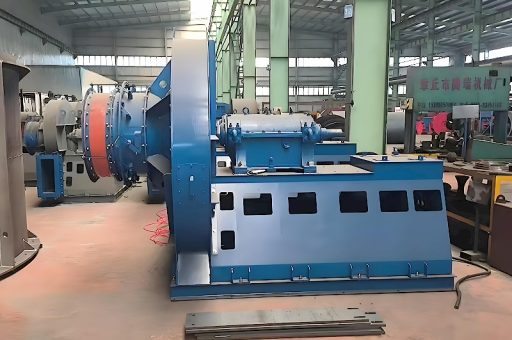
A Free Standing Fan is a complete unit mounted on a structural steel skid or concrete foundation rather than being suspended, wall-mounted, or flanged directly into a duct.
- Pros: Easy maintenance (access to bearings, belts, and impeller), lower vibration transfer to building structure.
- Cons: Requires significant floor space; foundation must be level and isolated.
- Typical Configuration: Motor mounted on same skid (V-belt drive for speed control) or direct-coupled.
Key Design Considerations
For the Secondary Air Fan
- Flow & Pressure: High volume, moderate pressure (typically 10–40 inches w.g. or 2500–10000 Pa).
- Temperature: Ambient air (cold) – typically no special heat treatment.
- Construction: Standard carbon steel impeller and housing.
- Noise: Can be high; may require an inlet silencer or acoustic enclosure.
For the Dust Extraction Fan
- Erosion Protection: This is the biggest challenge. Fly ash is abrasive.
- Material: Hard-faced impeller wear plates (e.g., AR400 steel), ceramic coating, or liners on the housing inlet.
- Design: Radial or backward-inclined blade design (less prone to clogging).
- Temperature: Flue gas can be 150°C–250°C (or higher). Requires high-temperature shaft seals, grease/lubrication systems, and expansion joints in the ductwork.
- Moisture & Corrosion: If sulfur is in fuel, acidic condensation can form. May need stainless steel or FRP components.
Typical Layout (Free Standing)
[Boiler Furnace] --> [Ductwork] --> [Dust Collector (Baghouse/ESP)]
                                       ↑
                               [Dust Extraction Fan]
                                (Free Standing Skid)
                                       ↓
                                  [Stack]
         [Ambient Air] --> [Secondary Air Fan]
                           (Free Standing Skid)
                                → [Boiler Windbox]
Common Problems & Solutions for Free Standing Fans
| Problem | Cause | Solution |
|---|---|---|
| Vibration | Unbalance from ash buildup, bearing wear, loose foundation bolts. | Regular cleaning schedule, vibration monitoring, spring isolators under base. |
| Erosion (Dust Fan) | High velocity fly ash hitting the blades. | Replaceable wear liners (tungsten carbide tiles or ceramic). |
| Belt Slippage | High torque startup, worn belts. | Use notched V-belts, automatic tensioners, or switch to direct drive. |
| Motor Overheating | High ambient temp from radiated heat, poor ventilation. | Install a separate ventilation hood or move motor outside the hot zone. |
Sizing Recommendation
If you are looking to specify or replace:
- For Secondary Air Fan: Calculate stoichiometric air for your fuel rate, add 15–25% excess air. Ensure pressure is enough to overcome windbox & grate resistance.
- For Dust Extraction Fan: Handle 100–120% of the flue gas volume at the highest expected temperature. The pressure requirement must overcome resistance of the ductwork + baghouse (often 15–30 inches w.g. or 3750–7500 Pa).
Summary
- Secondary Air Fan: Clean air, medium pressure, standard materials, free-standing for vibration control.
- Dust Extraction Fan: Dirty, hot, abrasive gas; requires wear-resistant materials and high-temperature seals; free-standing is necessary for access and maintenance.
Would you like me to provide a sample technical data sheet checklist for either of these fans?





