
This article's table of contents introduction:
- The Terminology Breakdown
- The Challenge: Balancing Carbon Steel with Abrasion & Heat
- Typical Applications & Example Specifications
- Critical Questions for Selection
- Summary
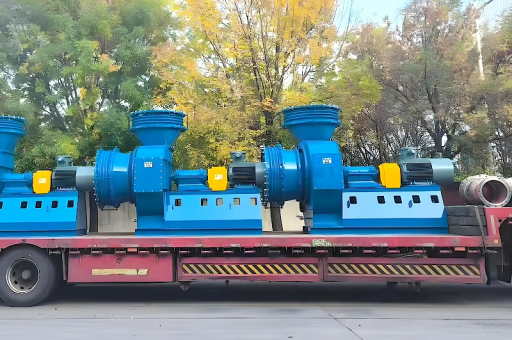
It appears you are listing key specifications, benefits, or requirements for a heavy-duty industrial fan, likely used in a boiler system (such as an ID Fan, FD Fan, or PA Fan).
Here is a breakdown of what that combination of terms means, why these features are critical, and how they relate to each other in an industrial context.
The Terminology Breakdown
- Long Life: Indicates a design focus on durability. In boiler fans, this is achieved through robust bearings, balanced rotors, and materials resistant to fatigue.
- Carbon Steel: The primary construction material. Carbon steel is strong and cost-effective, but it is not inherently corrosion or abrasion resistant unless treated or built thick. In this context, it likely refers to a high-strength low-alloy (HSLA) steel or a specific grade (e.g., Q235, Q345, or ASTM A36) that is chosen for its fatigue resistance.
- Boiler Fan: This is the application. Refers to Induced Draft (ID), Forced Draft (FD), or Primary Air (PA) fans. These handle hot, often dusty, and corrosive flue gases or combustion air.
- Heat Dissipation: The fan's ability to handle high temperatures. For boiler fans, the impeller and shaft must be designed to prevent thermal expansion, bearing failure, or structural weakening. Carbon steel can handle up to approximately 350°C - 400°C (662°F - 752°F) before it begins to lose strength significantly.
- Abrasion Proof: Resistance to wear from particulate matter (fly ash, coal dust, sand). This is the most critical challenge for boiler fans, especially ID fans on coal-fired boilers.
The Challenge: Balancing Carbon Steel with Abrasion & Heat
Carbon steel is a baseline material. It provides the structural strength, but by itself, it is not "abrasion proof" at high temperatures. Therefore, a "Long Life Carbon Steel Boiler Fan" that is "Abrasion Proof" achieves these goals through specific design and protection techniques:
A. How to make Carbon Steel "Abrasion Proof"
- Liner Plates: The fan casing and impeller blades are fitted with replaceable, hardened wear liners.
- Material: Often high-chromium iron (e.g., Cr27, Cr30) or hardox steel. These are bolted or welded onto the carbon steel structure.
- Wear Pads & Hardfacing: The leading edges of the blades and the areas of highest impact are coated with a layer of hardfacing weld (e.g., Stellite, Tungsten Carbide).
- Thicker Gauge: The fan is built with a heavier carbon steel gauge (e.g., 10mm vs 6mm) to allow for sacrificial wear over time.
B. How to manage Heat Dissipation in Carbon Steel
- Shaft Cooling: The bearing system is isolated from the hot gas path. A fan shaft is extended (shaft cooler) to allow heat to radiate away before reaching the bearings. A cooling fan (on the shaft) or water-cooled bearings are common.
- Expansion Joints: The fan casing and ductwork are fitted with bellows or expansion joints to prevent stress on the carbon steel structure as it expands.
Typical Applications & Example Specifications
You might be looking for a fan like this for:
- Coal-Fired Power Plants: ID Fan handling fly ash at 140°C - 180°C.
- Biomass Boilers: Handling dusty, fibrous ash.
- Cement Plants: Kiln exhaust fans.
- Steel Mills: Sinter plant fans.
Example Product Spec (You might see on a datasheet):
| Feature | Specification |
|---|---|
| Type | Centrifugal, Radial Blade (or Backward Inclined) |
| Material | Carbon Steel (Q345B) |
| Abrasion Protection | 12mm thick High-Chrome (Cr27) wear liners on casing; Tungsten Carbide hardfacing on blade leading edges. |
| Heat Dissipation | Water-cooled bearing housing; Shaft cooling fan; 400°C maximum continuous gas temperature. |
| Life Expectancy | 50,000 - 80,000 hours (before major impeller rebuild) |
Critical Questions for Selection
If you are sourcing or evaluating this fan, you must clarify:
- Gas Temperature: Is it truly under 400°C? If it spikes above that, carbon steel is dangerous (loss of yield strength).
- Dust Loading (g/Nm³): How much abrasive particulate is in the gas? This determines the thickness of the necessary wear protection.
- Gas Chemistry: Is there any corrosive element (Sulfur, Chlorine)? Carbon steel will rust rapidly in acidic condensing conditions. You may need a stainless steel or Corten steel fan instead.
- Maintenance: Is the "abrasion proof" feature a replaceable liner system? If so, fully replacing the fan is not needed; you just replace the liners.
Summary
A "Long Life Carbon Steel Boiler Fan Heat Dissipation Abrasion Proof" is a high-performance, heavy-duty industrial fan. It relies on carbon steel for its structural integrity and heat tolerance (up to ~400°C) and achieves abrasion resistance through sacrificial hard coatings or replaceable liners, not from the base metal itself.
Verdict: This is a practical, cost-effective solution for moderate-temperature, high-dust environments (like coal boilers), provided the temperature is stable and the wear protection is specified correctly. For extreme heat or high corrosion, stainless steel or specialty alloys would be required.





