
This article's table of contents introduction:
- What is a Stokerfeed Boiler?
- Role of the Centrifugal Fan in this System
- Key Design Features for Stokerfeed Boiler Service
- Specific Challenges & Solutions for Stokerfeed Boilers
- Typical Specifications for a Single Inlet Stokerfeed ID Fan
- Manufacturers
- Summary
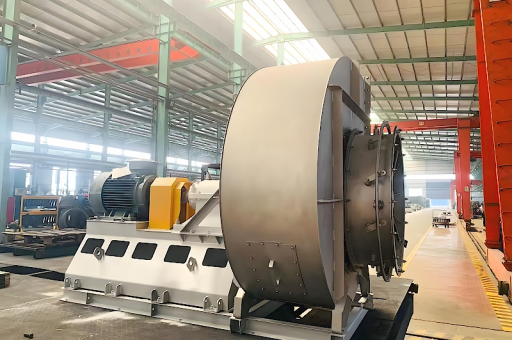
Here is a detailed breakdown of Single Inlet Stokerfeed Boiler Industrial Centrifugal Fans, covering their design, function, and specific application in stoker-fired boilers.
What is a Stokerfeed Boiler?
First, let's understand the application. A stokerfeed boiler is a type of solid fuel boiler (typically coal, biomass, or waste wood) where fuel is mechanically fed onto a moving grate (the stoker) from a hopper. Air is forced up through the grate to burn the fuel. This creates two primary gas streams that require fan power:
- Underfire Air (Primary Air): Blown up through the fuel bed on the grate.
- Overfire Air (Secondary Air): Blown above the fuel bed to complete combustion of volatile gases.
- Induced Draft (ID): Suction on the exhaust side to pull flue gases through the boiler, economizer, and particulate control equipment.
Role of the Centrifugal Fan in this System
The Single Inlet Centrifugal Fan is the workhorse of this system. It is most commonly used as an Induced Draft (ID) Fan on the outlet of the boiler, but can also be used as a Forced Draft (FD) Fan.
Why "Single Inlet"?
- The fan housing has a single, ducted air intake on one side of the impeller.
- This is standard for most industrial applications where the fan connects to a single duct system.
- Double inlet fans are used in larger, high-volume applications to reduce the wheel width and balance forces.
Key Design Features for Stokerfeed Boiler Service
Stokerfeed boiler fans face harsh conditions: high temperatures, abrasive fly ash, and potential for corrosive gases. Standard industrial fans will fail quickly. Here are the critical design features:
Impeller Design (The Rotating Wheel)
- Radial or Paddle Wheel: The most common type for this application. Blades curve outward radially. This design is:
- Self-cleaning: The flat blades do not trap ash or material buildup as easily as backward-curved blades.
- High Wear Resistance: The simple blade shape allows for thick, replaceable wear liners (often made of AR400 steel or hardfacing).
- Backward-Inclined (BI) Blades: Used when high efficiency is paramount and the gas stream is cleaner (e.g., on the FD Fan side). They are less tolerant of abrasive dust.
- Material: Typically constructed from Corten steel or Stainless Steel (304/316) for corrosion resistance from sulfur in the fuel.
Housing (Scroll Casing)
- Thick, Reinforced Walls: To withstand high operating pressures (15-30 in. wg for ID fans) and abrasion.
- Wear Liners: Replaceable steel plates on the inner cut-off (scroll tongue) and base of the housing where ash settles.
- Access Doors: Large, gasketed doors for cleaning and inspection of ash buildup.
- Shaft Seal: Labyrinth or carbon ring seals at the shaft penetration to prevent hot flue gas leakage.
Shaft & Bearings
- Oversized Shaft: To minimize deflection under heavy loads and high temperatures.
- Water-Cooled Bearings: Critical for ID fans handling gases above 300°F. A water jacket circulates cooling water around the bearing housing to protect the grease and bearing steel.
- Outboard Bearings: Often mounted on a pedestal separate from the fan housing to isolate them from heat and vibration.
Variable Inlet Dampers (Vanes)
- Instead of a variable frequency drive (VFD), many stoker boiler fans use inlet box dampers (lowered or radial vane controls).
- These are placed at the fan's suction inlet. By rotating the vanes, they "pre-swirl" the air entering the impeller, effectively changing the fan's capacity and reducing power consumption.
- Why? Vane dampers are more robust for dirty gas streams than a VFD motor system is cost-effective for constant-speed AC motors.
Drive System
- Direct Drive: Shaft-mounted motor. Most common for high-speed, clean applications.
- V-Belt Drive: Allows for speed adjustment (by changing sheaves) and provides some mechanical shock absorption. Often used for smaller fans.
Specific Challenges & Solutions for Stokerfeed Boilers
| Challenge | Cause | Fan Design Solution |
|---|---|---|
| Erosion (Abrasion) | Fly ash in flue gas at high velocity. | Thick impeller blades, replaceable wear liners (AR400, chrome carbide), hardened shafts. |
| High Temperature | Flue gas temperature (300-450°F standard, up to 700°F after air heater bypass). | Water-cooled bearings, high-temperature shaft seals, cooling fan on shaft. Use of 4140 or 316SS shafts. |
| Corrosion | Sulfur in fuel + water vapor = sulfuric acid (acid dew point). | Corrosion-resistant materials (Corten, SS 316L), keeping metal temperatures above the acid dew point. |
| Ash Buildup | Wet or sticky fly ash accumulating on rotating impeller. | Radial blade design (self-cleaning), "bumpers" or "clean-out" holes on blades, scheduled water washing. |
| Vibration | Out-of-balance condition due to uneven ash buildup on the impeller. | Access doors for cleaning, continuous vibration monitoring (4-20 mA output), automatic cleaning ports. |
Typical Specifications for a Single Inlet Stokerfeed ID Fan
- Type: Single Width, Single Inlet (SWSI) Centrifugal.
- Blade Type: Radial (Paddlewheel) or Backward-Inclined (BI).
- Duty: Heavy duty for continuous operation (24/7/365).
- Max Gas Temperature: 450°F (Standard), up to 700°F (Optional).
- Capacity: 10,000 CFM to 200,000+ CFM.
- Static Pressure: 10" w.g. to 40" w.g.
- Bearing Type: Water-cooled, spherical roller bearings.
Manufacturers
Reputable manufacturers for this specific type of industrial fan include:
- New York Blower (NYB)
- Robinson Fans
- TLT-Babcock
- Howden
- Greenheck (Industrial Series)
- Air Control Industries (ACI)
- Cincinnati Fan (Industrial)
Summary
A Single Inlet Stokerfeed Boiler Industrial Centrifugal Fan is a purpose-built, heavy-duty machine designed to handle the hot, dirty, and abrasive gas stream from a solid fuel boiler. Its key differentiators are a robust radial impeller for self-cleaning and abrasion resistance, water-cooled bearings for reliability, and a thick-walled housing with wear liners to maximize service life under 24/7 operation. It is most commonly used as an Induced Draft (ID) fan to pull combustion gases through the boiler and pollution control equipment.





