
This article's table of contents introduction:
- Table of Contents
- Introduction: The Critical Intersection of AC Motors and Material Handling Blowers
- Why AC Motor Long Life Matters in Harsh Industrial Environments
- Key Factors Affecting AC Motor Longevity in Centrifugal Fan Applications
- Optimizing Centrifugal Fan Design for Materials Drying
- Best Practices for Extending AC Motor Life in Blower Systems
- Common FAQ: AC Motor Long Life and Centrifugal Fan Performance
- Conclusion: Integrated Strategies for Reliable Drying Operations
Table of Contents
- Introduction: The Critical Intersection of AC Motors and Material Handling Blowers
- Why AC Motor Long Life Matters in Harsh Industrial Environments
- Key Factors Affecting AC Motor Longevity in Centrifugal Fan Applications
- Optimizing Centrifugal Fan Design for Materials Drying
- Best Practices for Extending AC Motor Life in Blower Systems
- Common FAQ: AC Motor Long Life and Centrifugal Fan Performance
- Conclusion: Integrated Strategies for Reliable Drying Operations
Introduction: The Critical Intersection of AC Motors and Material Handling Blowers
In modern industrial processing, material handling blower systems are essential for transporting bulk solids, powders, or granular materials through pneumatic conveying lines, especially during materials drying stages. At the heart of these systems lies the centrifugal fan driven by an AC motor. Achieving AC motor long life is not merely a maintenance goal—it is a strategic objective that directly impacts production uptime, energy efficiency, and total cost of ownership.
This article synthesizes the latest industry insights (including best practices from leading engineering resources) to provide a comprehensive guide on selecting, operating, and maintaining AC motor-driven centrifugal fans for drying applications. We address the most pressing questions engineers face: How do you prevent premature motor failure? What fan design best supports drying consistency? How do environmental contaminants affect component lifespan?
Why AC Motor Long Life Matters in Harsh Industrial Environments
AC motors in centrifugal fans for materials drying operate under severe conditions: high ambient temperatures (often 40°C–60°C), airborne dust, moisture from drying processes, and continuous variable loads. According to industry studies, unplanned motor failure in material handling blowers can cost a facility 5–10 times the motor's initial price due to lost production and emergency repairs.
AC motor long life in this context means achieving 50,000–100,000 operating hours before major service. Key threats to longevity include:
- Thermal stress: Overheating accelerates insulation breakdown.
- Vibration: Imbalanced centrifugal fan impellers degrade bearings.
- Contaminant ingress: Dust and moisture cause winding corrosion or bearing seizing.
Proactive design and maintenance can mitigate these risks. For instance, IP55 or IP56 enclosure ratings, sealed bearings, and Class F or H insulation are minimum standards for drying systems.
Key Factors Affecting AC Motor Longevity in Centrifugal Fan Applications
To ensure AC motor long life in material handling blower systems, engineers must evaluate three interconnected domains:
A. Load Characteristics of Centrifugal Fans
Centrifugal fans for materials drying present a quadratic torque-speed curve —torque increases with speed squared. Motors must be sized to handle peak pressure at full conveying capacity without overcurrent. Using variable frequency drives (VFDs) reduces inrush current and allows soft-start, significantly extending motor winding and bearing life.
B. Environmental Protection
Drying processes release hot, humid air mixed with fine particulate. The centrifugal fan's intake must be equipped with a pre-filter or cyclonic separator to prevent abrasion. For the AC motor, consider a separate ventilation or a TEFC (Totally Enclosed Fan Cooled) frame with oversized fins.
C. Lubrication and Bearing Care
Over 60% of motor failures in blowers originate from bearing issues. Relubrication intervals must be shortened in high-temperature drying environments. High-temperature grease (e.g., lithium-based with NLGI 2 grade) should be used, and bearing housings should have drain plugs to vent excess grease.
Optimizing Centrifugal Fan Design for Materials Drying
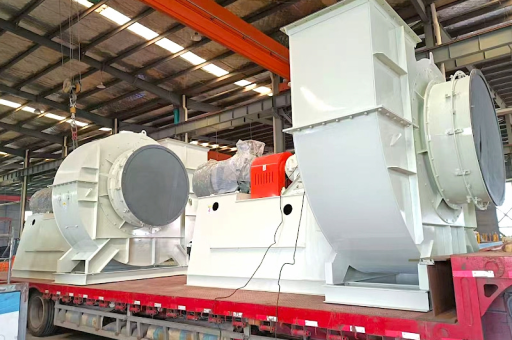
The centrifugal fan itself determines the effective air volume (CFM) and static pressure needed for drying. For materials drying, backward-curved impellers are preferred because:
- They reduce dust accumulation on blades.
- They provide higher efficiency (up to 85%) at design point.
- They allow higher operating speeds, aligning with AC motor efficiency peaks.
Material handling blower design must also include:
- Wear liners on the volute casing (e.g., ceramic or hardened steel) to resist erosion.
- Shaft seals (labyrinth or contact seals) to block moisture and dust migration toward motor brackets.
- Inlet guide vanes for modulating airflow without reducing motor speed, preserving AC motor long life.
Practical Example: A cement drying facility switched from a forward-curved fan to a backward-curved centrifugal fan with a 30 hp AC motor. The new fan reduced motor load by 15% and extended bearing life from 12 months to over 30 months.
Best Practices for Extending AC Motor Life in Blower Systems
Here are actionable strategies compiled from industry experts:
- VFD Integration: Run motors at 50–90% of rated speed during partial loads. Avoid operating at fixed full speed because drying demand fluctuates.
- Frequent Insulation Testing: Perform megohm testing quarterly. Values below 5 MΩ indicate imminent winding failure.
- Temperature Monitoring: Install RTD sensors in motor windings. If temperature exceeds 130°C (Class F limit), reduce load or improve cooling.
- Structural Support: Use a rigid base frame to minimize vibration transmitted from the centrifugal fan.
- Scheduled Cleaning: Remove dust from motor cooling fins and fan blades weekly. Dust buildup can raise motor temperature by 10°C–15°C.
Common FAQ: AC Motor Long Life and Centrifugal Fan Performance
Q1: Can I use a standard AC motor for a material handling blower in a drying application?
A: No. Standard motors often lack sealed bearings and high-temperature insulation. For AC motor long life, specify a TEFC motor with IP55 rating and Class H insulation. Additionally, use a non-sparking design if conveying combustible dust.
Q2: How often should I replace bearings in a centrifugal fan motor?
A: Under typical drying conditions (40°C ambient), regrease every 1,000 operating hours. Replace bearings every 2–3 years or if vibration exceeds 4 mm/s (RMS). Use sealed or shielded bearings to prevent contamination.
Q3: Does using a VFD affect AC motor long life?
A: Yes, positively—if properly applied. VFDs reduce starting torque stress, but ensure the motor is rated for inverter duty (NEMA MG1 Part 31) to handle voltage spikes. Use a load reactor to prevent reflected wave damage.
Q4: What is the ideal speed range for a centrifugal fan in materials drying?
A: Most centrifugal fans achieve peak efficiency at 1,200–1,800 RPM for large impellers and 2,400–3,600 RPM for smaller impellers. Operate within ±20% of the best efficiency point (BEP) to minimize fan wear and motor overheating.
Q5: How do I select between a belt-driven and direct-drive centrifugal fan?
A: Direct-drive removes belt losses (improving efficiency by 3–5%) and reduces maintenance, but belt-drive allows speed changes without replacing motor or fan components. For AC motor long life, direct-drive is recommended because it eliminates bearing misalignment from belt tension.
Conclusion: Integrated Strategies for Reliable Drying Operations
Achieving AC motor long life in a material handling blower system dedicated to materials drying requires a holistic approach: selecting the right centrifugal fan design, applying proper motor protection, and implementing rigorous maintenance practices. The data shows that a well-engineered system—featuring a backward-curved centrifugal fan, inverter-duty AC motor with TEFC design, and proactive condition monitoring—can operate reliably for over 10 years with minimal unscheduled downtime.
By following the principles outlined in this guide, industrial operators can reduce energy costs, improve drying consistency, and maximize return on their blower system investment. Always consult with fan and motor manufacturers to tailor specifications to your specific material properties and process parameters.
For more technical resources on AC motor selection, fan performance curves, or drying system design, search for “Material Handling Blower Optimization” on engineering databases or industry forums.





