
This article's table of contents introduction:
- Table of Contents
- Introduction: The Critical Role of Industrial Dust Extraction
- What is a Coupling Driven High Temperature Backward Curved Dust Collector Fan?
- Key Design Specifications & Material Considerations
- How Does It Compare to Belt-Driven or Direct-Drive Systems?
- Performance Benefits in High-Temperature and Dust-Laden Environments
- Installation, Maintenance & Safety Considerations
- Frequently Asked Questions (FAQ)
- Conclusion: Choosing the Right Fan for Your Facility
*The Ultimate Guide to Coupling Driven High Temperature Backward Curved Dust Collector Fan: Design, Efficiency, and Application*
Table of Contents
- Introduction: The Critical Role of Industrial Dust Extraction
- What is a Coupling Driven High Temperature Backward Curved Dust Collector Fan?
- Key Design Specifications & Material Considerations
- How Does It Compare to Belt-Driven or Direct-Drive Systems?
- Performance Benefits in High-Temperature and Dust-Laden Environments
- Installation, Maintenance & Safety Considerations
- Frequently Asked Questions (FAQ)
- Conclusion: Choosing the Right Fan for Your Facility
Introduction: The Critical Role of Industrial Dust Extraction
In modern industrial facilities—from cement plants and woodworking shops to chemical processing units—controlling airborne particulate is not just about cleanliness: it is about worker safety, equipment longevity, and regulatory compliance. A dust collection system’s heart is its fan, and when temperatures soar and dust loads are heavy, the Coupling Driven High Temperature Backward Curved Dust Collector Fan emerges as the most robust solution.
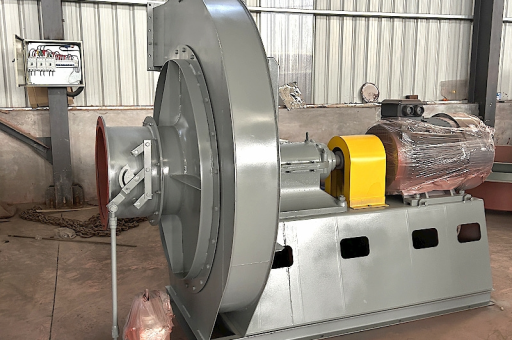
This fan type is engineered specifically for environments where standard forward-curved or axial fans would fail. It combines a backward curved impeller (high efficiency, self-cleaning properties) with a coupling-driven mechanism (reliable torque transfer, reduced motor stress) and high-temperature construction (alloy steel or 310S stainless steel). The result is a fan that moves large volumes of hot, abrasive air with minimal energy consumption and long service life.
What is a Coupling Driven High Temperature Backward Curved Dust Collector Fan?
Let’s break down the name:
- Coupling Driven: The fan wheel is connected to the motor via a flexible or rigid coupling, rather than belts or direct shaft mounting. This design allows the motor to be placed outside the hot air stream, protecting it from thermal damage and dust ingress. Couplings also absorb minor misalignment and vibration.
- High Temperature: Built to withstand continuous operation at 200°C to 450°C (400°F to 850°F), with special models rated up to 600°C. Components include heat-treated shafts, high-temp bearings, and expansion joints.
- Backward Curved Blades: The impeller blades curve away from the direction of rotation. This design produces a steep pressure curve, non-overloading power characteristics, and minimal dust build-up on blades.
- Dust Collector Fan: Designed for negative pressure systems, handling particulate-laden air without clogging or excessive wear.
How it works: The coupling transmits torque from a standard electric motor (often mounted on a separate base outside the ductwork) to the fan shaft. The backward curved impeller draws air axially into the fan, then accelerates it radially outward. Due to the blade curvature, air exits at high velocity and pressure, overcoming system resistance from filters, ducts, and cyclones.
Key Design Specifications & Material Considerations
To operate reliably in high-temperature, dust-laden environments, these fans incorporate specialized materials and features:
| Component | Material / Feature | Reason |
|---|---|---|
| Impeller | Carbon steel (coated), 304SS, 310S, or Inconel | Thermal stability, corrosion & abrasion resistance |
| Shaft | 4140 alloy steel, heat-treated | High torsional strength, reduced thermal expansion |
| Casing | Heavy-gauge carbon steel with expansion joints | Accommodates thermal growth without distortion |
| Bearings | Spherical roller, high-temp grease, cooling discs | Handles radial & axial loads at elevated temperatures |
| Coupling | Tire-type, grid, or disc (flexible or rigid) | Absorbs shock, compensates thermal misalignment |
| Seal | Labyrinth or carbon ring | Prevents dust leakage into bearing housing |
Backward curved blade geometry:
- Blade exit angle: 35°–45° (backward)
- High static efficiency: 75%–85%
- Non-overloading power: if system resistance drops, motor amp draw stays within safe limits
Performance data (example 30″ fan):
- Airflow: 10,000–30,000 CFM
- Static pressure: 8–30 in.w.g.
- Max. temperature: 450°F continuous / 600°F intermittent
- Speed: 1,200–1,800 RPM (via coupling)
How Does It Compare to Belt-Driven or Direct-Drive Systems?
A common question: why choose coupling-driven over belt-driven or direct-drive? Here is a side-by-side analysis:
| Aspect | Coupling-Driven | Belt-Driven | Direct-Drive (shaft-mounted) |
|---|---|---|---|
| Motor location | Separate, outside air stream | Separate, outside air stream | Inside or attached to fan housing |
| Thermal protection | Excellent – motor shielded from heat | Good – motor distant, but belts degrade | Poor – motor exposed to heat & dust |
| Efficiency | 95–97% transmission | 85–90% (belt slip & friction loss) | 100% (no transmission loss) |
| Maintenance | Minimal – coupling every 1–2 years | Frequent – belt tension & replacement | Simple but motor at risk |
| Speed control | Fixed by motor RPM + sheave | Adjustable (pulley change) | Fixed (must use VFD) |
| Dust resistance | High – sealed coupling | Moderate – belts shed dust | Low – motor windings exposed |
| Space requirement | Larger footprint (motor offset) | Compact (motor near fan) | Most compact |
Winner for high-temp dust: Coupling driven because it protects the motor from thermal damage and dust, while maintaining high transmission efficiency and low maintenance. Belt-driven fans are cheaper upfront but suffer from belt wear and heat degradation. Direct-drive fans are simple but cannot handle high temperatures without a special (expensive) high-temp motor.
Performance Benefits in High-Temperature and Dust-Laden Environments
A. Self-Cleaning Impeller
Backward curved blades naturally shed dust due to centrifugal force. Unlike forward-curved blades (which trap debris inside the wheel), the backward design minimizes build-up. This reduces imbalance, vibration, and the need for manual cleaning.
B. Non-Overloading Power Curve
If a filter becomes clogged and system resistance increases, a forward-curved fan’s motor current would rise dangerously. A backward curved fan’s power consumption peaks near the best efficiency point (BEP) and actually decreases at higher pressures. This protects motors and breakers.
C. High Static Pressure Capability
Dust collection systems often require 15–25 in.w.g. of static pressure to overcome filter bags, cyclones, and long duct runs. Backward curved impellers are specifically designed to produce high pressure at moderate flow rates.
D. Temperature Handling
- Standard fans: limited to 180°F
- High-temp backward curved fans: up to 600°F with reinforced shaft, high-temp bearings, and expansion joints
- Example: A power plant using a coupling-driven backward curved fan to extract flue gas at 450°F without cooling dilution.
E. Energy Savings
Because backward curved impellers achieve 75–85% static efficiency (vs. 55–65% for forward curved), a 25,000 CFM fan can save $3,000–$7,000 annually in electricity (based on $0.10/kWh, 24/7 operation).
Installation, Maintenance & Safety Considerations
Installation Tips
- Foundation: Ensure rigid, vibration-absorbing concrete base. Use inertia bases if roof-mounted.
- Alignment: Coupling alignment is critical. Use a dial indicator; misalignment causes coupling wear and bearing failure.
- Ductwork: Include a flexible connector at the fan inlet and outlet to prevent thermal expansion stress.
- Drain or purge: For dust-laden gas, install a bottom drain for moisture or heavy particulate.
Maintenance Schedule
| Interval | Task |
|---|---|
| Weekly | Inspect coupling rubber element for cracks; listen for vibration |
| Monthly | Check bearing temperature (max 190°F); re-grease per manufacturer spec |
| Quarterly | Clean impeller through access door; inspect for erosion |
| Annually | Replace coupling element; perform vibration analysis; test motor insulation |
Safety
- High surface temperatures: Casing can exceed 400°F. Insulate barriers or install warning signs.
- Spark-resistant construction: For combustible dust (wood, carbon, sulfur), use non-sparking impeller (aluminum or monel) and housing.
- Emergency cut-off: Ensure coupling guard is interlocked with motor starter.
Frequently Asked Questions (FAQ)
Q1: Can this fan handle sticky or moist dust?
A: The backward curved design resists build-up, but if dust is sticky (e.g., paint overspray, food powder), consider adding an air purge or coating (epoxy, Teflon). Coupling-driven design keeps the motor away from moisture.
Q2: What is the typical lifespan of a coupling-driven high-temperature fan?
A: With proper alignment and maintenance: 10–15 years for the fan, 3–5 years for coupling element replacements. Bearing life is typically 15,000–25,000 hours depending on temperature.
Q3: How do I determine the right fan size for my dust collection system?
A: You need three parameters: required airflow (CFM), system static pressure (in.w.g.), and gas temperature. Fan manufacturers provide performance curves. For high-temp applications, derate the pressure based on air density correction (pressure increases with temperature decrease).
Q4: Can I retrofit a belt-driven dust collector fan with a coupling-driven system?
A: Yes, but it requires a new motor base, coupling alignment, and possibly a taller shaft. Most manufacturers offer retrofit kits. Cost is often justified by energy savings and reduced downtime from belt changes.
Q5: What is the difference between backward curved and backward inclined blades?
A: Backward curved blades have a curved profile (airfoil or plate), while backward inclined blades are flat. Curved blades are slightly more efficient and quieter; inclined blades are simpler to manufacture. Both are non-overloading.
Conclusion: Choosing the Right Fan for Your Facility
The Coupling Driven High Temperature Backward Curved Dust Collector Fan is not just a component—it is a strategic investment in operational reliability and energy efficiency. Its unique design addresses the three most common failure points in industrial dust extraction: motor overheating, impeller clogging, and power overload.
When selecting a fan:
- Evaluate temperature – If continuous above 250°F, choose high-temp alloy construction.
- Determine particulate type – For abrasive dust (sand, metal), use hardened impeller and replaceable wear liners.
- Compare lifecycle cost – Coupling-driven fans have higher first cost than belt-driven, but lower energy and maintenance costs over 5+ years.
- Consider future variability – Backward curved impellers handle flow changes with little efficiency drop.
In a world demanding stricter air quality standards and lower carbon footprints, this fan technology offers a compelling solution. Whether you’re upgrading an existing system or designing a new facility, the coupling-driven high-temperature backward curved fan will provide decades of reliable, efficient service.





