
This article's table of contents introduction:
- Breakdown of the Specification
- Critical Design & Engineering Considerations
- Why This Fan Setup is Best for Lime Kilns
- Summary of a Proper Specification
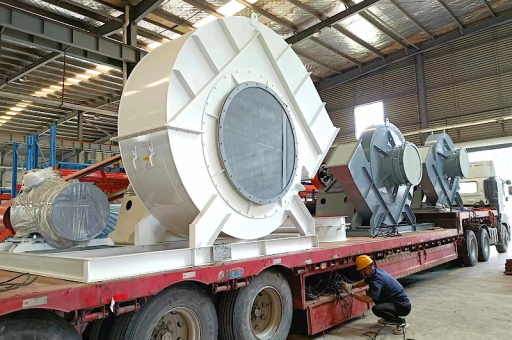
It sounds like you are specifying a centrifugal fan designed for a very specific and demanding industrial application.
Let's break down the specifications you provided (Single Suction, 16Mn, Backward Curved, Lime Kiln Flue Gas) and explain what each part means, along with the critical engineering considerations for this fan.
Breakdown of the Specification
- Single Suction: This refers to the fan's air intake design. Air enters the impeller from one side only (as opposed to a double-suction fan where air enters from both sides). This is typical for medium to high-pressure applications.
- 16Mn (Material): This is a High-strength Low-alloy (HSLA) steel. In Chinese and international standards (e.g., Q345B, ASTM A572 Grade 50), 16Mn offers higher tensile strength and wear resistance than standard carbon steel (Q235). Crucial for this application because lime kiln flue gas contains abrasive dust particles.
- Backward Curved (Blades): The blades curve away from the direction of rotation. This design is characterized by:
- High Efficiency (best efficiency of the standard fan types).
- Non-Overloading Power Curve (motor won't burn out if ductwork is unblocked).
- High Pressure capability.
- Self-limiting power.
- Lime Kiln Flue Gas: This defines the operating environment. The gas is:
- Hot: Typically ranging from 150°C to 350°C (depending on if it's pre-heater or before a baghouse/scrubber).
- Dusty: Contains CaO (quicklime) and CaCO₃ (limestone) fines. This is highly abrasive.
- Corrosive: Contains CO₂, and potentially SO₂ and NOx. If below the dew point, it can form carbonic or sulfuric acid, causing severe corrosion.
- Variable Density: Gas density changes significantly with temperature.
Critical Design & Engineering Considerations
For this fan to be reliable in a lime kiln service, standard fan design is not enough. You must specify the following modifications:
A. Impeller & Shaft Design (The Core)
- Material is correct (16Mn): Must be stress-relieved and dynamically balanced (typically to ISO 1940 G6.3 or G2.5). The blade thickness must be sufficient to withstand erosion.
- Wear Protection (C.R.I.T.I.C.A.L.): The leading edges of the blades and the backplate (near the hub) must have wear plates or hardfacing (e.g., Stellite, Chromium Carbide overlay, or ceramic tiles). Lime dust will erode standard steel in weeks.
- Shaft: Must be oversized to handle high temperatures and avoid critical speed issues. A bearing cooling system (for the shaft) is often required.
B. Casing (Housing)
- Material: 16Mn or Q345R. The casing must be thick gauge.
- Wear Liner: The casing volute (scroll) must have replaceable wear liners at the "cutwater" (the point where the volute narrows). This is the area of highest erosion.
- Expansion Joint: The casing must be designed to allow for thermal expansion. A bellows expansion joint is often used at the inlet.
C. Shaft Seals
- Problem: Flue gas leaking out of the fan shaft opening is toxic and hot.
- Solution: A mechanical seal or a pressure-balanced air purge seal (e.g., a labyrinth seal with compressed air or nitrogen) to keep dust from escaping and outside air from entering.
D. Bearing & Lubrication
- Cooling: Standard fans usually have simple grease lubrication. For this application, you need plummer blocks with a water jacket cooling system or an oil lubrication system with a radiator to dissipate heat from the hot shaft.
- High-Temp Grease:
- Vibration Monitoring: Must have probes (accelerometers) to detect bearing failure or impeller imbalance due to erosion.
E. Motor & Drive
- VFD (Variable Frequency Drive) is highly recommended: You need to control the fan speed to match kiln draft requirements. Dampers on a backward curved fan are inefficient.
- Motor Power: The motor must be sized for the cold start condition (denser air creates more power draw). You cannot size the motor based on hot flue gas power requirements alone.
Why This Fan Setup is Best for Lime Kilns
- Backward Curved handles the high static pressure required to overcome the resistance of a baghouse or scrubber.
- 16Mn provides the strength and erosion resistance needed for the abrasive CaO dust.
- Single Suction is suitable for the high airflow volumes (typically 50,000 to 300,000 m³/h) but keeps the design robust.
Summary of a Proper Specification
If you are writing a procurement document or ordering this fan, you must include this detail:
Required: Centrifugal Fan, Single Suction, Backward Curved Airfoil/Radial Tip Blades.
Service: Lime Kiln Flue Gas. Fluid: Hot exhaust containing CaO, CaCO3 dust, CO2, SO2.
Performance: [e.g., 150,000 m³/h @ 6000 Pa @ 250°C] - YOU MUST PROVIDE THESE PARAMETERS.
Materials:
- Impeller & Casing: 16Mn (Q345B) with stress relief.
- Impeller Leading Edges: Wear-resistant hardfacing (Chromium Carbide overlay, 400+ Brinell).
- Casing: Full set of replaceable abrasion-resistant wear liners (thickness 8-12mm minimum).
- Shaft: 45# steel or 40Cr, oversized with a thermal barrier.
- Bearings: SKF or equivalent. Split pillow blocks with water cooling jackets.
- Seals: Dual labyrinth with air purge system to prevent dust leakage.
- Drive: VFD compatible motor (e.g., 500kW, 6-pole, 690V). Motor sized for cold start ambient air.
- Vibration: Tapped holes for accelerometers on each bearing housing.
Warning: Do not buy a standard "dirty air" fan for this service. A standard air handling fan will fail catastrophically in < 6 months. The lime dust is extremely erosive.





