
This article's table of contents introduction:
- Table of Contents
- Introduction to Forward Centrifugal Flow Fans
- Why Carbon Steel? Material Advantages for Industrial Use
- Exhaust Applications: Where and Why These Fans Excel
- Design Breakdown: Forward-Curved Blades vs. Backward-Curved Blades
- Performance Metrics: Airflow, Pressure, and Efficiency
- Common Questions and Expert Answers
- Maintenance and Longevity Strategies
- Conclusion: Choosing the Right Fan for Your Industrial System
Article Title:
The Definitive Guide to Carbon Steel Industrial Forward Exhaust Centrifugal Flow Fans: Design, Efficiency, and Applications
Table of Contents
- Introduction to Forward Centrifugal Flow Fans
- Why Carbon Steel? Material Advantages for Industrial Use
- Exhaust Applications: Where and Why These Fans Excel
- Design Breakdown: Forward-Curved Blades vs. Backward-Curved Blades
- Performance Metrics: Airflow, Pressure, and Efficiency
- Common Questions and Expert Answers
- Maintenance and Longevity Strategies
- Conclusion: Choosing the Right Fan for Your Industrial System
Introduction to Forward Centrifugal Flow Fans
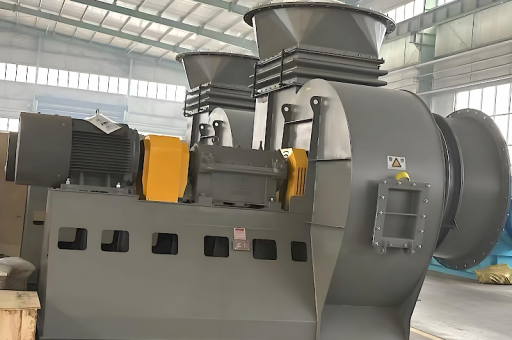
A Carbon Steel Industrial Forward Exhaust Centrifugal Flow Fan is a specialized air-moving device designed for high-volume, low-to-medium static pressure exhaust systems. Unlike axial fans, centrifugal fans use a rotating impeller to increase air velocity by centrifugal force. The forward-curved blade design—where the blade curves in the direction of rotation—allows these fans to move large volumes of air efficiently at lower speeds, making them ideal for industrial exhaust, ventilation, and fume removal.
These fans are built with heavy-gauge carbon steel housings and impellers, offering superior structural strength and resistance to mechanical stress in harsh environments. From foundries to chemical processing plants, they are a standard choice when durability and cost-efficiency are priorities.
Key takeaway: Forward centrifugal fans are not for all scenarios, but in exhaust duties requiring high airflow and moderate pressure, they outperform many alternatives.
Why Carbon Steel? Material Advantages for Industrial Use
Carbon steel is the backbone of many industrial fan systems due to its high tensile strength, weldability, and wear resistance. Compared to aluminum or stainless steel, carbon steel offers:
- Lower cost while maintaining robust structural integrity.
- Excellent fatigue resistance under continuous operation.
- Ease of fabrication for custom housing and impeller geometries.
- Surface treatability: painting, galvanizing, or epoxy coating for corrosion protection.
However, carbon steel is not naturally corrosion-resistant. Therefore, in exhaust systems handling moist or acidic fumes, coatings or liners are required. For dry, abrasive dust, carbon steel’s hardness provides excellent longevity.
NOTE: Many manufacturers offer a standard carbon steel line (e.g., A36, Q235) and a corrosion-resistant coating option.
Exhaust Applications: Where and Why These Fans Excel
Forward exhaust centrifugal fans are specifically designed to pull air from an enclosed space and discharge it through ductwork or directly outdoors. Typical applications include:
- Welding fume extraction
- Boiler and furnace exhaust
- Conveyor dust collection
- Paint booth ventilation
- General industrial HVAC exhaust
Why forward design? Because the forward-curved blades produce high airflow at relatively low rotational speeds, reducing wear on bearings and motors. This makes them quieter and more energy-efficient for continuous exhaust duties compared to backward-curved or radial blade fans.
Critical point: Forward fans are not recommended for high-static-pressure systems (e.g., long duct runs with many bends). Their efficiency drops sharply above moderate pressure.
Design Breakdown: Forward-Curved Blades vs. Backward-Curved Blades
To fully grasp the value of a Carbon Steel Industrial Forward Exhaust Centrifugal Flow Fan, compare it to its most common competitor: the backward-curved blade fan.
| Feature | Forward-Curved | Backward-Curved |
|---|---|---|
| Blade shape | Curved in rotation direction | Curved opposite rotation |
| Airflow | High at low pressure | High at high pressure |
| Efficiency | Medium (60–75%) | High (80–85%) |
| Noise | Lower | Higher |
| Self-cleaning | Poor | Good |
| Cost | Lower | Higher |
In exhaust applications where the fan pulls air from a large open area (e.g., a warehouse or factory floor), the forward-curved design delivers maximum airflow with minimal energy input. For dusty environments, backward-curved fans resist buildup better, but forward fans can be fitted with cleaning ports or coatings.
Performance Metrics: Airflow, Pressure, and Efficiency
For engineers and facility managers, three numbers define a fan’s capability:
- CFM (Cubic Feet per Minute) – volume of air moved
- Static Pressure (in. wg) – resistance the fan must overcome
- Brake Horsepower (BHP) – power consumed at fan shaft
A typical Carbon Steel Forward Exhaust Centrifugal Fan might move 10,000–50,000 CFM at 1–4 in. wg static pressure. Efficiency ranges from 60% to 75%, depending on wheel diameter and operating point.
Selection tip: Always cross-check the manufacturer’s fan curve. Running a forward fan outside its designed pressure range causes motor overload or airflow stall.
Common Questions and Expert Answers
Q1: Can I use a carbon steel forward centrifugal fan for corrosive gas exhaust?
A: Not directly. Carbon steel will corrode quickly in acidic or moist environments. You must apply a corrosion-resistant coating (e.g., epoxy, rubber lining) or use stainless steel. Always consult the fan vendor for chemical compatibility.
Q2: How do I reduce noise from an industrial forward centrifugal fan?
A: Sound can be minimized by (1) selecting a slower speed motor, (2) installing inlet/outlet silencers, (3) using vibration isolators, and (4) ensuring ductwork is smooth and free of sharp turns.
Q3: What is the typical lifespan of a carbon steel fan in a clean industrial exhaust system?
A: With proper bearing lubrication and regular inspections, a carbon steel fan can last 15–20 years. In abrasive or corrosive conditions, lifespan drops to 5–8 years unless protected.
Q4: Is a forward exhaust fan suitable for an explosion-proof system?
A: Yes, but the fan enclosure and motor must be rated for hazardous locations. Carbon steel is non-sparking only when properly designed (e.g., aluminum or bronze impellers for ATEX zones). Discuss with your fan supplier.
Maintenance and Longevity Strategies
To maximize the service life of your Carbon Steel Industrial Forward Exhaust Centrifugal Flow Fan, adopt these best practices:
- Monthly inspection of bearings for temperature, vibration, and lubrication.
- Clean impeller blades every 3–6 months to prevent imbalance and reduce airflow loss.
- Check belt tension (if belt-driven) regularly—too loose causes slippage, too tight damages bearings.
- Inspect housing for rust or pitting, particularly at welds and flanges.
- Replace worn seals to prevent air leakage and efficiency loss.
For fans operating in high-temperature exhaust (>200°F or 93°C), use high-temp grease and monitor shaft alignment more frequently.
Pro tip: Schedule a professional fan performance test annually to compare actual CFM and pressure to original design specs.
Conclusion: Choosing the Right Fan for Your Industrial System
The Carbon Steel Industrial Forward Exhaust Centrifugal Flow Fan remains a cornerstone of cost-effective, high-volume industrial exhaust systems. Its forward-curved blade design offers unmatched airflow at low speeds, ideal for general ventilation, fume extraction, and material handling—provided the static pressure remains modest.
When selecting a fan, match the material of construction to your environment (coated carbon steel for most conditions, stainless steel for corrosive), always review the performance curve, and never underestimate the importance of proper installation and maintenance.
For a durable, reliable, and budget-friendly exhaust solution in dry, moderate-pressure applications, a carbon steel forward centrifugal fan is an excellent choice. Visit a trusted fan manufacturer to request a fan curve and sizing recommendation for your specific system.
For more technical resources on industrial fans, centrifugal blowers, and exhaust system design, explore our knowledge base or contact a sales engineer at [fan].





