
This article's table of contents introduction:
- The Core Challenge: Flue Gas is Aggressive
- Key to "Long Lifetime": The Right Construction
- Typical Specifications for "Long Lifetime" Heavy Duty Fan
- Critical Application Note: ID Fan vs. FD Fan
- Manufacturer Recommendations for "Long Lifetime" Blowers
- To Get a Proper Quote, You Must Provide This Data:
- Summary: Finding the "Long Lifetime" Blower
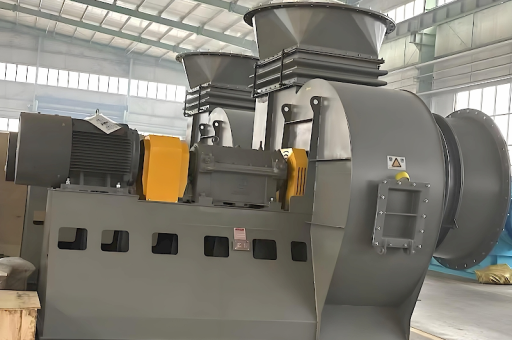
It sounds like you are looking for a heavy-duty, long-lasting centrifugal blower fan specifically designed to handle furnace flue gas (which is hot, corrosive, and often contains particulate matter).
Here is a detailed breakdown of what you need to look for, the key specifications, and the best types of fans for this application.
The Core Challenge: Flue Gas is Aggressive
Standard blowers fail quickly in this environment because of:
- High Temperature: Flue gas can range from 180°C (356°F) for condensing boilers up to 540°C (1000°F) for industrial furnaces.
- Corrosion: Combustion byproducts (sulfur, chlorides) create acidic condensate.
- Erosion: Soot, fly ash, and dust particles sandblast the fan blades.
Key to "Long Lifetime": The Right Construction
For a heavy-duty flue gas application, look for these specific design features:
The Fan Type: Backward Inclined (BI) or Radial
- Backward Inclined (BI) / Airfoil: Best for high efficiency and reducing erosion wear on the blades. Best for cleaner natural gas or light oil.
- Radial / Radial Tip (RTE): The best for heavy duty in dirty flue gas. These have strong, flat blades that are less prone to material buildup and can handle particulate erosion much better than airfoil blades. They are less efficient but much tougher.
Material Selection (Crucial for Longevity)
- Housing: Carbon Steel is standard for up to 400°F (204°C). For higher temps, you need Alloy Steel or Stainless Steel (316L or 317L) to resist corrosion from acidic condensation.
- Impeller (Wheel): This is the heart of the fan.
- High Temp: Made of 316L Stainless Steel or Hastelloy for extreme corrosion.
- Erosion: For coal/biomass flue gas, the leading edges of the blades must have hard-facing (e.g., Stellite, tungsten carbide pads) or be made of AR400 steel.
Shaft & Bearing Protection
- Shaft Cooling: The shaft must be long or have a heat slinger to keep heat from traveling to the bearings. For flue gas over 300°F, the fan must have an external bearing pedestal (not mounted in the housing) or a cooling fan on the shaft.
- Insulated & Cooled Housing: The bearing area often requires a water jacket or forced air cooling to protect lubricants from coking.
Shaft Seal (Leak Prevention)
- Flue gas contains CO and other toxins. The fan must have a purging seal (e.g., labyrinth seal with fresh air injection) to prevent gas leaking out along the shaft.
Typical Specifications for "Long Lifetime" Heavy Duty Fan
| Feature | Standard Fan | Heavy Duty Flue Gas Fan |
|---|---|---|
| Temperature Rating | Up to 150°C (302°F) | 250°C - 650°C (482°F - 1202°F) |
| Wheel Type | Forward Curved (FC) | Backward Inclined (BI) or Radial |
| Material (Impeller) | Aluminum / Mild Steel | 316L SS / Hastelloy / AR400 |
| Bearings | Standard pillow block | High-temp grease or oil bath, externally mounted |
| Motor | TEFC (Totally Enclosed) | Explosion-proof (Class I, Div 2) or Inverter Duty |
| Drive | Direct Drive | Belt Drive (allows speed adjustment for draft control) |
| Lifetime Expectancy | 2-5 years | 10-20+ years |
Critical Application Note: ID Fan vs. FD Fan
- Forced Draft (FD) Fan: Blows air into the furnace. This is moving clean, cool air. A standard fan works here.
- Induced Draft (ID) Fan: Sucks flue gas out of the furnace and out the chimney. You need a Heavy Duty Flue Gas Fan for this. The gas is hot, dirty, and corrosive.
Manufacturer Recommendations for "Long Lifetime" Blowers
These companies are known for building industrial flue gas fans that last decades:
- New York Blower (NYB): Their "RTB" (Radial Tip) and "HP" (High Pressure) series are the gold standard for dirty, hot flue gas.
- Robinson Fans: Specialists in heavy-duty industrial fans, particularly for steel, cement, and power plants.
- Greenheck: Their "EBS" and "VCS" series with high-temperature options are common for commercial/light industrial boilers.
- Howden: A global leader for extremely large and high-temperature flue gas desulfurization (FGD) fans.
To Get a Proper Quote, You Must Provide This Data:
Don't just ask for "a heavy duty centrifugal fan." Provide this to the supplier:
- Gas Temperature: Max/Continuous (e.g., 450°F / 232°C).
- Gas Composition: Is it natural gas, #2 oil, heavy oil, coal, or biomass? (This determines corrosion allowance).
- Flow (CFM / m³/hr): Volume of gas to move.
- Static Pressure (In. WG / kPa): The resistance the fan must overcome (e.g., 10" WG, 20" WG).
- Altitude: Affects gas density.
- Particulate Level: Is it "clean gas" (nat gas) or "dirty gas" (biomass/coal)? If dirty, what is the particle size and concentration (gr/ft³ or mg/Nm³)?
Summary: Finding the "Long Lifetime" Blower
To get a long lifetime for a heavy-duty flue gas fan:
- Choose Radial or Backward Inclined wheel (NOT Forward Curved).
- Specify 316 Stainless Steel or better for the impeller and housing.
- Demand external bearings with temperature monitoring.
- Install a VFD (Variable Frequency Drive) to run the fan at the lowest required speed to reduce wear.
- Budget: A truly heavy-duty flue gas fan will cost 3-10x more than a standard HVAC centrifugal blower. A unit moving 10,000 CFM at 400°F can easily cost $15,000 - $40,000.
Bottom Line: If you want the "Heavy Duty" and "Long Lifetime" you asked for, avoid standard "furnace blowers" (which are for residential HVAC). You need an Industrial ID Fan with the specific material and temperature protections above.





