
This article's table of contents introduction:
- The Core Issue: Q345 vs. Corrosion
- How "Corrosion Resistance" is Achieved (Typical Solutions)
- Specific Threats to this Fan Type
- Typical Engineering Specifications (If you are writing or reviewing a tender)
- Summary
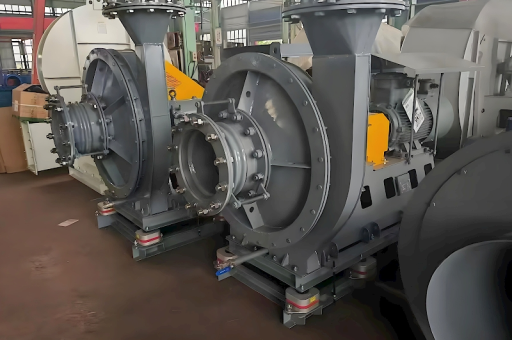
This is a highly specialized topic involving metallurgy, fluid dynamics, and power plant chemistry. A Q345 (now generally superseded by Q355 in GB/T 1591 standards, but still widely referenced) steel casing with a "High-Pressure CFB Boiler Flue Gas Fan" that is "corrosion resistant" presents a specific engineering challenge: Q345 is a low-alloy structural steel, not inherently corrosion-resistant.
Here is a detailed breakdown of what this equipment likely is, the threats it faces, and how it achieves corrosion resistance.
The Core Issue: Q345 vs. Corrosion
- Q345 (Q355): This is a high-strength, low-alloy (HSLA) steel with good weldability, toughness, and mechanical properties at ambient to moderately high temperatures. It is standard for fan casings due to its strength and cost.
- The Problem: The flue gas from a CFB boiler is a chemically aggressive environment. The primary corrosive agents are:
- Sulfur Oxides (SOx): Form sulfuric acid (H₂SO₄) when mixed with water vapor, especially at temperatures below the acid dew point.
- Water Vapor & Condensation: Even at high temperatures, local cooling or shutdown periods can lead to condensation of acidic water.
- Chlorides (Cl⁻): If burning biomass or certain coals, HCl forms, creating severe pitting corrosion.
- Erosion: CFB flue gas contains high loads of fly ash particles that erode the protective oxide layer of the steel.
Conclusion: A bare Q345 casing in a CFB forced draft (FD) or induced draft (ID) fan application will fail rapidly due to acid dew point corrosion and ash erosion.
How "Corrosion Resistance" is Achieved (Typical Solutions)
When a specification calls for a "Q345 corrosion-resistant fan," the manufacturer employs one of the following strategies to protect the base metal:
a) Thicker Sacrificial Material (Not Recommended)
Simply using a thicker Q345 plate (e.g., 10mm instead of 6mm) delays failure but does not prevent corrosion. This is rarely sufficient for high-pressure CFB fans.
b) Internal Rubber or Epoxy Linings (Common)
The internal surface of the Q345 fan housing is lined with a thick layer of chlorobutyl rubber or a specialized epoxy/glass flake coating.
- Pros: Excellent resistance to acid (H₂SO₄) and abrasion. The Q345 provides the structural strength; the lining provides the barrier.
- Cons: Vulnerable to thermal cycling (delamination) and physical damage from large ash clinkers. Repair is difficult.
c) Stainless-Steel Cladding or Overlay (High-End Solution)
The Q345 base plate is overlaid with a corrosion-resistant alloy (e.g., 316L, 904L, or Duplex 2205) using explosive bonding or weld overlay.
- A "Q345+316L" composite plate is very common. The Q345 provides structural strength; the 316L provides acid resistance.
- Pros: Excellent thermal stability, high erosion resistance, no peeling risk.
- Cons: Very expensive.
d) Alloying of the Wear Plate (Wheel/Impeller)
The fan impeller (wheel) is the most critical part. While the casing may be Q345 lined, the impeller is often made entirely of a higher-grade material:
- 16Mn (Q345) with Hardfacing: The leading edges of the blades are welded with a hard, corrosion-resistant alloy (e.g., Stellite or carbide).
- Stainless Steel Impeller (1Cr18Ni9Ti, 1Cr13, or 304/316L): The entire impeller is cast or fabricated from stainless steel for maximum resistance.
Specific Threats to this Fan Type
| Threat | Mechanism | Effect on Q345 Fan | Mitigation (Corrosion Resistant) |
|---|---|---|---|
| Acid Dew Point Corrosion | SO₃ + H₂O → H₂SO₄ (liquid) below ~120°C (248°F) | Rapid pitting, wall thinning, casing leaks. | Keep gas temperature above dew point. Use lining (rubber) or stainless cladding. |
| Ash Erosion | High velocity (>25 m/s) fly ash particles | Cuts through protective oxide layers, destroying the base metal. | Hardfacing (WC, Stellite) on blades. Wear plates at casing inlet. |
| Stress Corrosion Cracking (SCC) | Cl⁻ + Tensile Stress + Temperature | Sudden catastrophic failure of impeller blades. | Use Duplex Stainless (2205) or high-Ni alloys. Avoid 304SS in high-Cl· environments. |
Typical Engineering Specifications (If you are writing or reviewing a tender)
If you are procuring this fan, ensure the specification includes:
- Base Material: Q345B (or Q355B) for casing and structural parts.
- Corrosion Protection:
- Lining: "Full internal rubber lining, 4mm thick, chlorobutyl, rated for 150°C continuous."
- OR: "Stainless steel cladding, 2mm thick 316L on the gas-wetted side."
- Impeller Material: "16Mn (Q345) with WC hardfacing on leading edges, or entire impeller in 1Cr13/316L stainless steel."
- Operating Temperature: "Design for continuous operation at 140°C, start-up at 180°C, acid dew point consideration below 100°C."
- Coating: "External primer: inorganic zinc-rich. Internal: high-temperature phenolic epoxy."
Summary
| Aspect | Detail |
|---|---|
| Base Material | Q345 (Q355) – Good structural steel, not corrosion-resistant. |
| Primary Risk | Acid dew point corrosion (SO₂/SO₃ + H₂O) and ash erosion. |
| True Meaning | The fan is structurally Q345 but uses linings, cladding, or coatings to resist corrosion on the gas side. |
| Most Critical Part | The impeller (rotor) – often made of 1Cr13 (410SS) or 316L, not bare Q345. |
| Common Failure | Failure to maintain gas temperature above acid dew point leads to rapid attack of unlined Q345. |
Bottom Line: A "Q345 High Pressure CFB Boiler Flue Gas Fan Corrosion Resistant" is a compromise design. The Q345 is chosen for strength and cost, while the corrosion resistance is achieved through secondary protection (lining, cladding, or hardfacing). Do not assume the Q345 itself is corrosion-resistant. You must verify the specific lining or alloy overlay used on the wetted surfaces.





