
This article's table of contents introduction:
- Typical Energy Efficiency Range for this Application
- How to Calculate Your Actual Efficiency (if you have pressure data)
- Key Factors that Affect Efficiency in Q235 High-Temp Fans
- Benchmark for "Good" vs "Poor" Efficiency
- Next Step – What You Need to Provide to Get a Specific Answer
- Summary
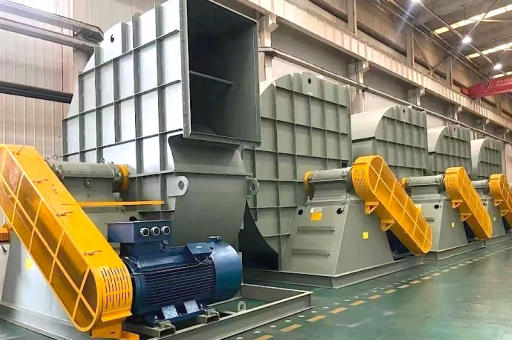
It looks like you are asking for the energy efficiency of a specific high-pressure, high-temperature centrifugal fan (Q235 material, 145,533 m³/h flow rate). However, you did not provide the fan's pressure (static or total), operating temperature, motor power, or rpm.
Without these parameters, I can only give you a general framework and typical efficiency ranges for this type of fan.
Typical Energy Efficiency Range for this Application
For a high-pressure, high-temperature centrifugal fan (often used in boilers, kilns, or industrial exhaust), the expected static efficiency (η) is usually between 65% and 82% .
| Application Type | Typical Static Efficiency | Notes |
|---|---|---|
| Forward-curved (Sirocco) | 55% – 70% | Lower efficiency, often used for higher flow at lower pressure. Not ideal for very high pressure. |
| Backward-curved / Airfoil | 75% – 85% | Best for high pressure. High efficiency, but requires clean gas. |
| Radial / Paddle wheel | 60% – 75% | Good for dirty/high-temp gas, but lower efficiency. |
For high pressure + high temperature, a Backward-curved or Radial blade design is most common. Expect 70–80% efficiency if designed well.
How to Calculate Your Actual Efficiency (if you have pressure data)
You can calculate the fan efficiency (η%) using standard fan laws:
Shaft Power (kW) = ( Flow (m³/s) × ΔP (Pa) ) / ( 1000 × η )
Where:
- Flow = 145,533 m³/h = 43 m³/s
- ΔP = Total pressure rise in Pascals (Pa) – you must provide this
- η = Efficiency (decimal, e.g., 0.75 = 75%)
Example calculation: If your fan has a total pressure of 8,000 Pa (≈ 800 mmH₂O) and shaft power of 450 kW:
- Air Power = 40.43 × 8,000 = 323,440 W = 4 kW
- Efficiency (η) = Air Power / Shaft Power = 323.4 / 450 = 72%
Key Factors that Affect Efficiency in Q235 High-Temp Fans
- Temperature: High temperature (e.g., 200–400°C) reduces air density, which reduces the pressure capability of the fan. Efficiency drops if the fan was sized for cold air but used on hot gas.
- Material (Q235): Q235 carbon steel is standard but corrodes and soffens above 350–400°C. If temperature exceeds this, efficiency drops due to thermal expansion and reduced structural strength.
- Drive system: Direct drive vs. belt drive. Belt drives have ~2–5% mechanical loss.
- Speed control: Variable Frequency Drive (VFD) can improve efficiency at partial loads vs. dampers.
Benchmark for "Good" vs "Poor" Efficiency
For 145,533 m³/h @ high pressure (say 8–12 kPa):
- Excellent: >80% (Backward-curved airfoil, clean gas, proper selection)
- Good: 72–80% (Radial tip, moderate conditions)
- Poor: <65% (Forward-curved, wrong impeller design, high friction losses)
Next Step – What You Need to Provide to Get a Specific Answer
To give you a precise efficiency value for your specific fan, please share:
- Total pressure (Pa, mmH₂O, or inch WG)
- Operating temperature (°C or °F)
- Motor power (rated kW) and actual measured power (if available)
- Impeller type (Backward curved, radial, etc.)
- Application (e.g., boiler ID fan, cement kiln, etc.)
Summary
- Estimated efficiency for your fan size & type: 70–78% (if well designed)
- Best practice suggests >75% is good for high-temp service.
- Without pressure and temperature data, I cannot calculate the exact number.
Would you like help calculating your efficiency once you have the pressure and temperature data?





