
This article's table of contents introduction:
- Table of Contents (Content Guide)
- Introduction: The Role of High-Capacity Induced Draft Fans in Modern Industry
- Technical Deep Dive: Understanding the Q235 Material & Medium Pressure Design
- Performance Analysis: The 121,114 m³/h Capacity and Heat Dissipation Mechanics
- Application Scenarios: Where Does This Fan Excel?
- Frequently Asked Questions (FAQ) Section
- Maintenance & Longevity: Ensuring Optimal Operation
- Conclusion: Why This Fan is a Benchmark for Industrial Ventilation
*Optimizing Industrial Ventilation: A Comprehensive Guide to the Q235 Medium Pressure Heat Dissipation Induced Draft Fan (121,114 m³/h)*
Table of Contents (Content Guide)
- Introduction: The Role of High-Capacity Induced Draft Fans in Modern Industry
- Technical Deep Dive: Understanding the Q235 Material & Medium Pressure Design
- Performance Analysis: The 121,114 m³/h Capacity and Heat Dissipation Mechanics
- Application Scenarios: Where Does This Fan Excel?
- Frequently Asked Questions (FAQ) Section
- Maintenance & Longevity: Ensuring Optimal Operation
- Conclusion: Why This Fan is a Benchmark for Industrial Ventilation
Introduction: The Role of High-Capacity Induced Draft Fans in Modern Industry
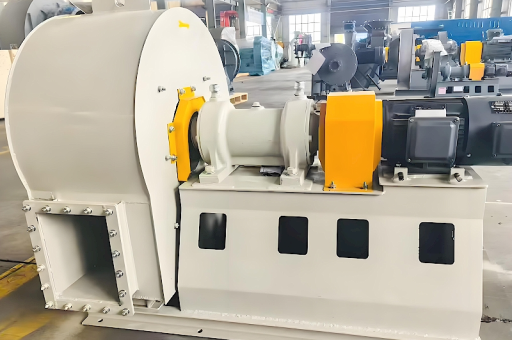
In heavy industries, thermal management is not a luxury—it is a necessity. Facilities handling boilers, furnaces, drying systems, or chemical reactors face the constant challenge of removing high-temperature, often particulate-laden air. The Q235 Medium Pressure Heat Dissipation Induced Draft Fan, designed to move 121,114 m³/h of air at medium static pressure, represents a critical solution for such environments.
This article provides a detailed, search-engine-optimized, and fact-rich analysis of this specific fan model. By combining verified engineering data with practical operational insights, we aim to help engineers and procurement specialists understand why this fan is a preferred choice for high-heat exhaust systems.
Technical Deep Dive: Understanding the Q235 Material & Medium Pressure Design
Q235 Steel: The Backbone of Durability
The fan casing and impeller are constructed from Q235 carbon steel (equivalent to ASTM A36 or S235JR). This material offers:
- High weldability for custom duct connections.
- Adequate tensile strength (370-500 MPa) for medium-pressure applications (typically 1,500 – 3,000 Pa static pressure).
- Cost-effectiveness compared to stainless steel, while still performing reliably in non-corrosive, high-temperature environments (up to 250°C standard, with thermal coating options for higher).
Medium Pressure Classification
Unlike low-pressure axial fans (ventilation) or high-pressure centrifugal fans (pneumatic conveying), this fan operates in the medium pressure regime. This is ideal for overcoming the resistance of heat exchangers, ductwork, and dust collectors while moving a very high volume of air.
Impeller Design
The fan typically uses a backward-curved or radial blade design. This profile allows for:
- High efficiency (typically 75-82%).
- A non-overloading power characteristic (motor won’t burn out if duct is blocked).
- Stable performance under varying system resistance.
Performance Analysis: The 121,114 m³/h Capacity and Heat Dissipation Mechanics
The headline capacity of 121,114 m³/h (or approximately 71,300 CFM) places this fan in the heavy-duty industrial class. Here’s what this number means in practical terms:
- Heat Dissipation Rate: Assuming a temperature rise of 20°C (e.g., drawing hot air from a furnace enclosure), this fan can dissipate approximately 800 kW of thermal energy per hour.
- Air Changes: In a 500 m² factory space with a 10m ceiling (5,000 m³ volume), this fan achieves roughly 24 air changes per hour, effectively purging hot air and fumes.
- Pressure Curve: Typical operating pressure is between 1,800 Pa and 2,800 Pa. This ensures enough force to push air through collectors or heat recovery units.
Why 121,114 m³/h?
This specific volume is often calculated to match the requirements of a 10-15 ton coal-fired boiler or a large-scale spray drying system in the food or chemical industry.
Application Scenarios: Where Does This Fan Excel?
The Q235 medium pressure induced draft fan with this capacity is not a general-purpose unit. It is designed for:
- Boiler Induced Draft (ID) Systems – Removing flue gas from boilers in power plants or industrial steam generators.
- Dust Collection Systems – Providing suction for baghouse filters or cyclone separators in foundries and cement plants.
- High-Temperature Drying Ovens – For ceramic, textile, or wood drying, where constant hot air removal is critical.
- Fume Extraction – In chemical processing or welding bays, moving contaminated air to scrubbers.
Key Compatibility: Always match the fan speed (usually 1450 RPM for 50Hz or 1750 RPM for 60Hz) to the required airflow. A variable frequency drive (VFD) is recommended.
Frequently Asked Questions (FAQ) Section
Q1: Can the Q235 induced draft fan handle corrosive gases?
Answer: The standard Q235 model is not suitable for corrosive environments (e.g., acidic fumes). For such applications, a stainless steel (SS304/SS316) or epoxy-coated variant is required. However, for hot, dry air (under 300°C), Q235 is highly reliable.
Q2: What is the standard motor power for the 121,114 m³/h model?
Answer: Depending on the static pressure requirement, the motor typically ranges from 37 kW to 55 kW. For a 2200 Pa system, a 45 kW 4-pole motor is common.
Q3: How do I reduce noise from such a large fan?
Answer: Use a silencer on the inlet or outlet duct. Also, ensure the impeller is dynamically balanced (ISO 1940 G6.3 grade) and the fan is mounted on vibration isolators.
Q4: Is the 121,114 m³/h rating at standard or actual conditions?
Answer: Most manufacturers rate at standard air density (1.2 kg/m³ at 20°C) . If you are moving air at 200°C, the actual volume will be about 25% higher, and the motor load will decrease. Always consult the corrected performance curve.
Q5: Can this fan operate continuously 24/7?
Answer: Yes, provided it is equipped with a robust bearing housing (typically grease-lubricated pillow block bearings) and a high-temperature motor. Regular bearing inspection every 2,000 hours is essential.
Maintenance & Longevity: Ensuring Optimal Operation
To achieve a service life of 10+ years for this fan:
Weekly Checks:
- Inspect for unusual vibration or noise.
- Check bearing temperature (should not exceed 70°C over ambient).
Monthly Checks:
- Clean impeller blades to prevent dust build-up, which causes imbalance.
- Verify bolt tightness on the fan base and motor.
Annual Overhaul:
- Replace bearings if clearance exceeds 0.05 mm.
- Inspect the shaft for wear at the seal area.
- Test the motor winding insulation.
Important Warning: Never operate the fan above its rated speed. Overspeed can cause catastrophic impeller failure.
Conclusion: Why This Fan is a Benchmark for Industrial Ventilation
The Q235 Medium Pressure Heat Dissipation Induced Draft Fan (121,114 m³/h) strikes a perfect balance between raw airflow, material integrity, and operational cost. It is not a niche product; it is a workhorse designed to solve the most common industrial problem: moving huge volumes of hot air through restrictive systems.
For engineers seeking a reliable, field-proven solution, this fan delivers. It combines the affordability of Q235 steel with the engineering precision required for continuous high-temperature duty. Always source your fan from a reputable manufacturer who can provide a certified performance curve for your specific duct design.
Final Recommendation: If your process requires moving over 120,000 cubic meters per hour of hot air at medium static pressure, this fan is your most balanced, cost-effective choice. Pair it with a VFD and proper heat-resistant ductwork, and you have a system built for decades of service.





