
This article's table of contents introduction:
- What is an SWSI Fan?
- Why SWSI Fans for Boiler Waste Gas (Flue Gas)?
- Common SWSI Wheel Types for Boiler Gas
- Key Design Considerations for Boiler Waste Gas
- Typical Applications in a Boiler System
- Alternatives & Why SWSI Usually Wins
- Summary Recommendation
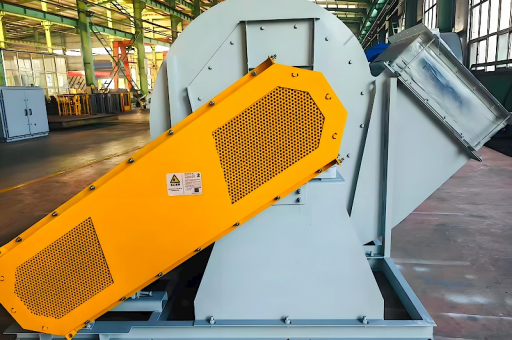
SWSI stands for Single Width, Single Inlet. This is a specific configuration of a centrifugal fan. It is a very common and often ideal choice for handling boiler waste gas (flue gas).
Here is a detailed breakdown of why SWSI centrifugal fans are used for this application.
What is an SWSI Fan?
- Single Width: The impeller has a single row of blades, as opposed to a Double Width (DWDI) fan which has two rows acting like two fans side-by-side.
- Single Inlet: Air enters the fan from only one side of the impeller.
SWSI fans can be either Direct Drive (motor shaft connected directly to fan shaft) or Belt Drive (motor drives a pulley connected to the fan shaft).
Why SWSI Fans for Boiler Waste Gas (Flue Gas)?
Boiler waste gas presents several challenges: it is hot, often contains particulate matter (ash, soot), and can be corrosive due to acidic condensation. The SWSI configuration is well-suited for these reasons:
-
High Efficiency & Static Pressure: SWSI fans are excellent at generating moderate to high static pressures, which is critical for overcoming the pressure drop across a boiler system (heat exchangers, ductwork, scrubbers, and stack). They are generally more efficient at a given pressure than axial fans.
-
Rugged Construction (Handling Particulates): The impeller design of an SWSI fan, particularly "Radial Blade" or "Paddle Wheel" types, is very robust. They can withstand the erosive nature of fly ash and soot better than airfoil or backward-curved designs which are more prone to wear.
-
Versatility in Temperature Control:
- Cooling Shaft: The single inlet design often allows for a cooling wheel or cooling fins on the shaft, isolating the bearings from the intense heat of the boiler waste gas.
- Material Options: The housing and impeller can be constructed from high-temperature alloys (e.g., Corten, 316 Stainless Steel) or carbon steel with internal refractory linings for very high temperatures (800-1000°C+).
-
Ease of Maintenance & Installation: An SWSI fan is a self-contained unit. It has a smaller footprint than a DWDI fan. Access doors can be placed on the side opposite the inlet for cleaning and inspection without major disassembly.
Common SWSI Wheel Types for Boiler Gas
The specific impeller type within the SWSI family is critical:
-
Radial Blade (often called "Paddle Wheel" or "RIM"):
- Best for: Dirty gases, high temperatures, or where the gas stream contains heavy dust or abrasive material (e.g., boilers burning coal or biomass).
- Pros: Very rugged, self-cleaning (blades are flat and often open on the sides).
- Cons: Lower efficiency, higher noise level.
-
Backward Inclined (BI) or Backward Curved (BC):
- Best for: Cleaner gases, higher efficiency requirements (e.g., natural gas or oil-fired boilers with good filtration). This is the most common general-purpose type.
- Pros: High efficiency, stable pressure curve, lower noise.
- Cons: Less tolerant of dust loading; blade build-up can cause imbalance and vibration.
-
Airfoil (AF):
- Best for: The highest efficiency in clean gas applications.
- Cons: Extremely sensitive to dust build-up. Rarely used for boiler flue gas unless the gas is exceptionally clean (post-filtration). The hollow blades can rapidly fail from corrosion or erosion.
Key Design Considerations for Boiler Waste Gas
| Parameter | Why it Matters | SWSI Solution |
|---|---|---|
| High Temperature | Heat reduces material strength; causes thermal expansion. | Use high-temperature steel (e.g., ASTM A387 for housing), shaft cooling (radiator disc), high-temp bearings, and expansion joints in ductwork. |
| Abrasion/Erosion | Fly ash acts like sandpaper on impeller blades. | Use radial blade design, hardened liners (ceramic tiles, tungsten carbide), or replaceable wear plates in the housing and on the impeller. |
| Corrosion | Acidic gases (SOx, NOx) condense in cooler sections. | Use 316L stainless steel or higher-alloy stainless steel for the impeller and housing. Keep operating temperature above the acid dew point (usually >150°C). |
| Vibration | Unbalance due to dust build-up or blade wear. | Install robust bearing frames, use vibration sensors, and ensure easy access for cleaning (inspection doors, clean-out ports). |
| Variable Flow | Boiler load changes constantly. | Use VFD (Variable Frequency Drive) or inlet guide vanes to modulate fan speed/flow efficiently. With an SWSI fan, VFD is the gold standard. |
| Gas Density | Hot gas is less dense; fan must be sized based on actual volume flow (ACFM), not mass flow. | Fan performance curves must be corrected for the specific gas temperature and density at the fan inlet. |
Typical Applications in a Boiler System
- Induced Draft (ID) Fan: The most critical fan. It pulls flue gas through the boiler, economizer, air heater, and pollution control equipment (ESP, baghouse, scrubber) before exhausting it up the stack. This is almost always a large, heavy-duty SWSI fan.
- Forced Draft (FD) Fan: Pushes fresh air into the boiler. Usually cleaner air, but may use an SWSI fan if high pressure is needed for fluidized bed boilers.
- Primary Air (PA) Fan: Supplies air to the coal pulverizers. Often a high-pressure SWSI fan.
Alternatives & Why SWSI Usually Wins
- DWDI (Double Width, Double Inlet): Used for extremely high volumes in a confined space. They are less robust per unit of width and harder to maintain. Not preferred for dirty gas.
- Plug Fans (Plenum Fans): A type of SWSI (usually backward curved) mounted in a plenum box. Used for general ventilation or HVAC, not for high-temperature, dirty boiler gas.
- Axial Fans (Vaneaxial, Tubeaxial): Good for very high volume, low pressure. Not suitable for the high resistance and dirty conditions inside a boiler system.
Summary Recommendation
For boiler waste gas, an SWSI Centrifugal Fan (specifically a Radial Blade or Backward Inclined type) is the industry standard for Induced Draft applications. You need to prioritize:
- Radial Blade if the gas is dirty (solid-fuel boiler).
- Backward Inclined if the gas is relatively clean (gas/oil-fired boiler with high stack temp).
- High-temperature construction (materials, shaft cooling, bearings).
- VFD control for energy savings and precise draft control.
- Abrasion/corrosion protection (liners, stainless steel).
A properly specified SWSI fan will provide reliable, long-term service in this demanding environment. If you have the specific gas temperature, flow rate, and pressure requirements, I can help you narrow down the exact wheel type and materials.





