
This article's table of contents introduction:
- The Components Decoded
- Why is this combination noteworthy?
- Typical Applications
- Potential Problems to Watch For
- Summary Table
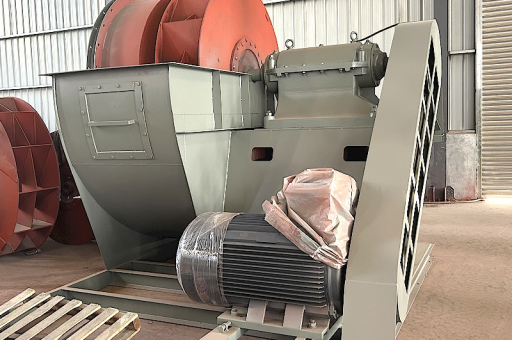
This appears to be a short technical description of an industrial fan system, likely found on an equipment tag, a purchase order, or a maintenance log. Here is the breakdown of what each term means in an engineering context, along with typical application notes.
The Components Decoded
- 6kV Motor: The prime mover is a 3-phase, medium-voltage induction motor rated at 6,000 Volts (typically 6.6kV or 6.0kV nominal). This indicates a high-power motor (usually >200 kW / 270 HP), as anything above 1kV in industrial settings requires specialized switchgear and protection.
- Belt Drive: The motor is not directly coupled to the fan. It uses pulleys and V-belts (likely multi-strand) to transmit power.
- Implication: Allows for speed adjustment (by changing pulley ratios) and protects the motor from fan shock loads.
- Exhaust: The fan is used to remove air, fumes, heat, or dust from a space (negative pressure system).
- 1450 r/Min: This is the Fan Speed, not the motor speed.
- Implication: The motor likely runs at a higher speed (e.g., 1480 rpm for a 4-pole motor) or a lower speed (e.g., 980 rpm for a 6-pole motor). The belt drive ratio ($D{motor}/D{fan}$) is calculated to achieve exactly 1450 RPM at the fan shaft.
- Material Handling Fan: This is the most critical design spec.
- Implication: The fan wheel is designed to handle debris, dust, or solid particles in the airstream. It will have a non-clogging, radial or paddle-blade design (not backward-curved airfoil blades), and the housing will have wear liners.
Why is this combination noteworthy?
Combining a 6kV Motor with a Belt Drive on a Material Handling Fan is a specific engineering choice:
- High Power + High Particulate:
- The 6kV motor is necessary because the power required to move heavy dust-laden air is substantial (likely 300-800 HP).
- The belt drive acts as a mechanical fuse. If the fan wheel hits a piece of tramp metal or clogs with material, the belts will slip or break (absorbing the impact) rather than shearing the motor shaft or destroying motor bearings.
- Speed Flexibility:
Material handling fans often need specific, lower tip speeds to reduce wear on the fan housing and blades. The belt drive allows a 4-pole motor (1480rpm) to drive a fan at a slower 1450rpm, or allows a 6-pole motor (980rpm) to speed up for higher pressure.
- Isolation:
The motor is physically separated from the dirty exhaust airstream, reducing the risk of dust ingress into the motor bearings (a common failure point for direct-drive exhaust fans).
Typical Applications
- Cement Plants: Exhausting clinker coolers or baghouse dust collectors.
- Steel Mills: Exhausting fumes from electric arc furnaces (EAF) or ladle metallurgy stations.
- Mining & Minerals: Ventilation of crusher stations or conveyor transfer points.
- Wood Processing: Exhausting sawdust, shavings, and chips from baghouses.
- Chemical Plants: Handling abrasive or corrosive exhaust gases.
Potential Problems to Watch For
If you are maintaining this unit, pay attention to:
- V-Belt Tension: Because it’s a high-power drive, belt tension is critical. Too loose = slippage & heat; too tight = bearing failure in the motor or fan. Use a belt tension gauge, not just "feel".
- Pulley Wear: The particles in the air can abrade the fan sheave (pulley) grooves over time, causing belt misalignment and vibration.
- Bearing Selection: The fan bearings must be split-pillow-block, spherical roller bearings with a "E" or "ES" designation, rated for heavy radial and axial loads from the belt tension.
- Safety Chucks: Because the shaft is open (belt drive), ensure the fan has a safety disc or torque limiter on the motor shaft to prevent reverse runaway if belts break.
- Motor Protection: A 6kV motor requires a differential protection relay (87) or sensitive ground fault (51N/50N) to prevent catastrophic phase-to-phase faults. A simple overload relay is not sufficient.
Summary Table
| Parameter | Value | Analysis |
|---|---|---|
| Voltage | 6 kV | High power, requires MV switchgear. |
| Drive Type | Belt | Isolates motor from fan, allows speed change, acts as overload fuse. |
| Function | Exhaust | Negative pressure system. |
| Speed | 1450 RPM | Moderate speed for high static pressure capability. |
| Media | Material Handling | Heavy duty, open/radial fan wheel, wear-resistant housing. |
In short: You are looking at a heavy-duty, medium-voltage industrial exhaust system designed to move dirty, abrasive air with high reliability at a fixed speed.





