
This article's table of contents introduction:
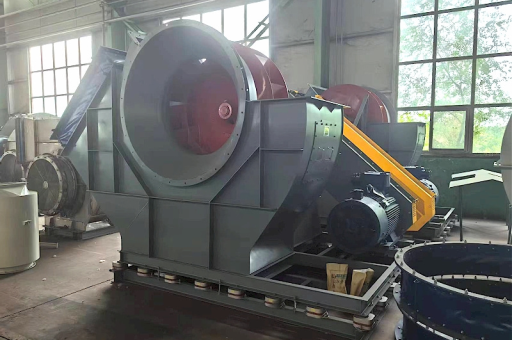
- The Application: Fluidized Bed Boiler (CFB/FBC)
- The Specification: 960 RPM
- Most Likely Fan Type: Centrifugal (Radial or Backward Inclined)
- Engineering Data You Need to Confirm (Critical to Ordering)
- Operational Considerations for 960 RPM
- Summary Recommendation
This is a technical request for a specific industrial fan. Based on your wording, you are looking for an Induced Draft (ID) Fan for a Fluidized Bed Boiler (CFB or BFB) , made of Stainless Steel, operating at a speed of 960 RPM.
Here is a breakdown of what this specification means, the engineering considerations, and the likely type of fan you need.
The Application: Fluidized Bed Boiler (CFB/FBC)
In a Fluidized Bed Boiler, the Induced Draft (ID) fan is located at the exit of the boiler (after the baghouse/ESP and scrubber). Its job is to pull the flue gas through the boiler system, maintaining a slight negative pressure (draft) in the furnace.
Why Stainless Steel?
- Corrosion: Flue gas from burning high-sulfur coal or biomass (especially with circulating fluidized bed (CFB) technology) contains sulfurous and nitric acids. When the gas temperature drops below the acid dew point (typically 90°C-120°C), condensation occurs, causing rapid corrosion.
- Erosion: Fluidized bed boilers have high particulate loading (fly ash). Even though the fan is after the dust collector, a high-chrome or duplex stainless steel (e.g., SS 316L, 904L, or Duplex 2205) is often specified to resist both chemical attack and particle erosion at the blade tips.
The Specification: 960 RPM
960 RPM is the synchronous speed of a 6-pole motor (50 Hz grid: $120 \times 50 / 6 = 1000$ RPM – slip reduces to ~960–970 RPM; or 60 Hz grid: $120 \times 60 / 8 = 900$ RPM – slip reduces to ~960? Likely 50 Hz).
- Speed Analysis: 960 RPM is a medium speed for a large fan.
- Too fast? For very large boilers (>100 MW), 960 RPM would require a massive impeller and dangerously high tip speeds (high stress, high wear).
- Too slow? For smaller boilers, 960 RPM is suitable.
- Implication: This suggests a smaller to mid-sized fluidized bed boiler (e.g., 20–80 MW thermal). The fan is likely a centrifugal fan (radial or backward curved) rather than an axial fan.
Most Likely Fan Type: Centrifugal (Radial or Backward Inclined)
For this specific combination (fluidized bed, stainless steel, 960 RPM), the most common designs are:
| Fan Type | Typical Application in CFB | Pros | Cons | Suitability for 960 RPM & SS |
|---|---|---|---|---|
| Radial (Paddlewheel) | High dust load, high erosion (Early CFB designs) | Very robust, handles high particulate | Low efficiency (~65%), noisy | Excellent for SS fabrication; heavy wall thickness |
| Backward Inclined (Airfoil/Flat) | Modern CFB/FBC after ESP/Baghouse | High efficiency (~85%), quieter | More sensitive to dust buildup | Good; lighter weight reduces stress on motor at 960 RPM |
| Backward Curved (Radial Tip) | Compromise between efficiency & erosion | Good efficiency, handles moderate dust | Moderate cost | Best match for 960 RPM |
Judgment: At 960 RPM, a Backward Curved (BC) or Radial Tip fan is most common. A Radial (Paddlewheel) fan at 960 RPM would have a very large diameter to generate sufficient pressure, making it expensive. A Backward Inclined Airfoil is too fragile for fluidized bed ash unless the dust collector is highly efficient.
Engineering Data You Need to Confirm (Critical to Ordering)
To provide a specific fan model or quotation, the manufacturer will need:
- Flow Rate: m³/s or CFM (At actual flue gas temperature).
- Pressure Rise: Total pressure in Pa or mmWC. (For a CFB ID fan, this is typically high – 6,000 to 12,000 Pa).
- Gas Temperature: Normal temperature (e.g., 140°C) and maximum emergency temperature (e.g., 200°C). This dictates the thermal expansion allowance.
- Dust Loading: mg/Nm³. (Tells you if you need wear plates).
- Material Grade: SS 304? SS 316L? Duplex 2205? (Specify exactly). The housing and impeller may be different grades.
- Motor Data:
- Power (kW) – (Calculate from flow $\times$ pressure / efficiency).
- Voltage (e.g., 400V, 3.3kV, 6.6kV).
- Frequency (50 Hz or 60 Hz). Note: 960 RPM typically implies 6-pole at 50 Hz.
Operational Considerations for 960 RPM
- Vibration: At 960 RPM (approx. 16 Hz), the fan is below the standard 25Hz/50Hz line frequency. This is an advantage for balancing – lower running speed allows for thicker, heavier impellers.
- Critical Speed: Ensure the fan rotor assembly (shaft + impeller) has a 1st lateral critical speed significantly above 960 RPM (e.g., >1500 RPM) to avoid resonance during startup/shutdown.
- Damper: ID fans need heavy-duty inlet box dampers (radial or louver type) to control draft.
Summary Recommendation
You are specifying a Centrifugal Induced Draft Fan, Backward Curved or Radial Tip, Stainless Steel (SS316L or better), 960 RPM (6-pole @ 50Hz), for a Fluidized Bed Boiler.
Next Steps:
- Check your boiler size. If it's a large utility unit (>100 MW), 960 RPM is too slow (fan would be huge). You would need a higher speed (e.g., 1480 RPM / 4-pole).
- Confirm the stainless steel grade. For flue gas with acid dew point issues, use SS316L or SAF 2507 (Super Duplex) for the impeller wheel.
- Request shaft seals. Specify high-temperature mechanical seals or labyrinth seals to prevent flue gas leakage.
If you need a quotation, you must provide the flow, pressure, temperature, and dust load. Without those numbers, no manufacturer can size a fan for a fluidized bed boiler at 960 RPM.





