
This article's table of contents introduction:
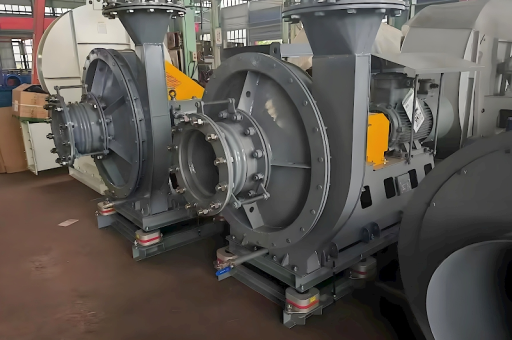
- Material Component: Q345 (Now Q355 in GB/T 1591-2018)
- Mechanical Component: V-Belt Drive
- Purpose: Heat Dissipation (Industrial Centrifugal Fan)
- Key Design Considerations for this Fan
- Common Applications for Q345 Belt-Driven Centrifugal Fans
- Potential Issues & Solutions
- Summary Checklist for Procurement or Design
It appears you are looking for information about a Q345 steel centrifugal fan, driven by a V-belt system, and designed for industrial heat dissipation applications.
Here is a breakdown of what this specification implies, the design considerations, and common applications.
Material Component: Q345 (Now Q355 in GB/T 1591-2018)
- What it is: Q345 is a low-alloy high-strength structural steel (similar to ASTM A572 Gr.50 or S355JR).
- Why it's used for fans:
- Strength: Allows for thinner material than standard Q235, reducing fan weight.
- Heat Tolerance: Better structural integrity at elevated temperatures (up to ~300°C / 572°F) compared to mild steel.
- Longevity: More resistant to vibration fatigue.
- Note: The standard has been updated to Q355, but Q345 is still widely referenced in legacy designs and stock.
Mechanical Component: V-Belt Drive
- Function: Transfers power from the motor (usually an electric motor) to the fan impeller at a controlled speed.
- Advantages for Heat Dissipation:
- Speed Control: You can change the fan speed (RPM) by swapping pulleys (sheaves). This is critical for adjusting airflow to match heat load requirements.
- Motor Protection: The motor is mounted outside the hot airstream. In heat dissipation fans, hot air passes through the fan. If the motor were direct-drive (mounted inside the airstream), it would overheat. The V-belt allows the motor to sit in cool ambient air.
- Amp Draw Control: Slip in V-belts can provide a soft start, reducing electrical stress on the motor.
Purpose: Heat Dissipation (Industrial Centrifugal Fan)
This fan is designed to move large volumes of air or process gases to remove heat from an environment. The main game is airflow against static pressure.
- Centrifugal Design:
- Backward Inclined (BI) Blades: Most common for heat dissipation. They are non-overloading (motor won't burn up if duct is blocked) and efficient for high-pressure, high-volume air movement.
- Radial Blades (Paddlewheel): Used if the air carries dust or hot particles (e.g., furnace exhaust). This design is rugged but louder and less efficient.
Key Design Considerations for this Fan
| Feature | Expected Specification/Recommendation |
|---|---|
| Impeller | Q345 steel. Welded construction. Must be dynamically balanced for high RPM heat applications. |
| Housing (Volute) | Q345 steel. Should have a drain plug for condensation (heat dissipation often creates moisture). |
| Shaft | High tensile steel (e.g., 45# steel or 40Cr) running in heavy-duty bearings. For heat, the shaft must be long (overhung) or have a heat slinger to keep bearings cool. |
| Bearings | Housed pillow block bearings (SKF, FAG, NSK) with high-temperature grease. Self-aligning preferred. |
| V-Belts | SPB or SPC profiles for high power transmission. Must be heat-resistant (static dissipative) to prevent sparks in dry industrial air. |
| Motor Base | Tensioning slide rails required for belt maintenance. |
Common Applications for Q345 Belt-Driven Centrifugal Fans
- Oven & Furnace Exhaust: Removing hot air from industrial ovens, dryers, or kilns.
- Boiler Forced Draft (FD) & Induced Draft (ID): Pushing air into a boiler or pulling hot flue gas out.
- Air-Cooled Heat Exchangers: Pulling ambient air over finned tube coils.
- Dust & Fume Extraction: Moving hot, contaminated air through baghouses or scrubbers.
- General Building Ventilation: Exhausting hot air from factories, foundries, or smelters.
Potential Issues & Solutions
- Thermal Expansion: Q345 expands when hot. The belt drive requires proper alignment. If the shaft gets hot, it lengthens, which can misalign pulleys quickly.
- Solution: Use light-duty shaft couplings or ensure motor plates have slots for realignment.
- Belt Heat Degradation: Rubber belts exposed to high ambient heat (even if motor is cool) will crack.
- Solution: Use FHP (Fractional Horsepower) or high-temperature belts (e.g., Gates Predator or Optibelt Red Power). The belt must be protected from direct radiant heat by a shroud or reflective shield.
- Vibration: High RPM + heat + belt tension = potential for severe vibration.
- Solution: The base frame must be rigid (steel base bolted to concrete inertia block). Flexible connectors on inlet/outlet ducts to prevent vibration transmission.
Summary Checklist for Procurement or Design
- CFM (Airflow) vs. SP (Static Pressure): What is the resistance of the duct system?
- Max Operating Temperature: Is it continuous 80°C (176°F) or peaks of 250°C (482°F)? (This affects grease, bearing type, and impeller clearance).
- Motor HP & RPM: Determine the required belt ratio.
- Sound Level: Belt drives are slightly louder than direct drive. Is 85 dBA a limit?
- Material of Construction: Verify if the entire fan (housing, wheel, shaft) is Q345, or just the housing.
Recommendation: If you are specifying this fan for a high-temperature process (over 150°C / 302°F), ask the manufacturer about heat-treated shafts and expansion joints in the housing. A standard Q345 fan without these modifications will likely fail at the bearings or wear down the V-belts prematurely.
Let me know if you have a specific airflow (CFM) or temperature requirement—I can help you estimate the motor size and belt ratio.





