
This article's table of contents introduction:
- The Fan Type: Backward Curved Centrifugal Fan
- The Specific Pressure: 2177 Pa (Low Pressure)
- The Application: Drying
- The Drive Mechanism: V-Belt Driven
- Typical System Components & Use Cases
- Operational Advantages of a Backward Curved Fan for Drying
- Potential Challenges & Considerations
- Summary Table
- Conclusion
This is a very specific piece of industrial equipment. To give you the most accurate and useful analysis, I need to break down what each component of your description means and what the typical applications, advantages, and considerations are.
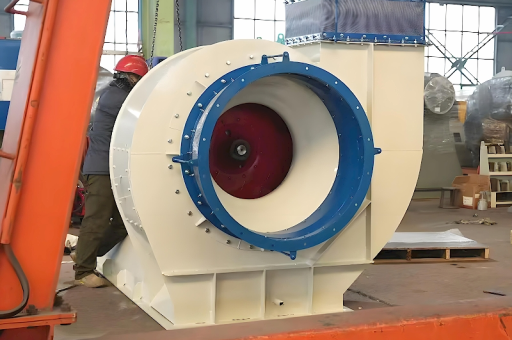
Here is a detailed breakdown of a Low Pressure 2177Pa Backward Curved Centrifugal Fan, Drying, V-Belt Driven.
The Fan Type: Backward Curved Centrifugal Fan
- How it works: Air enters the fan axially (along the shaft) and is thrown outward radially by the spinning impeller. In a backward-curved design, the blades curve away from the direction of rotation.
- Key Characteristics:
- High Efficiency: These are among the most efficient centrifugal fan designs.
- Non-Overloading Power Curve: This is a critical safety feature. As airflow decreases (e.g., due to a clogged filter), the power consumption of the motor decreases. This prevents the motor from burning out.
- Flat Pressure Curve: They can maintain a relatively stable pressure over a wide range of airflow rates.
- Quieter Operation: Generally quieter than forward-curved or radial-blade fans at the same duty point.
- Low Pressure Application (2177 Pa): 2177 Pa (Pascals) is a low static pressure for a centrifugal fan (approx. 8.7 inches of water gauge / 218 mmWG). This dictates the application.
The Specific Pressure: 2177 Pa (Low Pressure)
- What it means: 2177 Pa is the maximum static pressure the fan can overcome at its design point.
- Why "Low Pressure"? In centrifugal fan classification:
- Low Pressure: Typically < 2500 Pa (250 mmWG) – used for ventilation, general air movement.
- Medium Pressure: 2500-5000 Pa – used for light industrial processes.
- High Pressure: > 5000 Pa – used for pneumatic conveying, dust collection with long duct runs.
- Implication: This fan is not designed to push air through long, narrow ductwork or heavy materials. It's designed to move large volumes of air at relatively low resistance.
The Application: Drying
This is the most important clue. The fan is specifically selected for a drying process. This tells us about the air conditions and system requirements:
- Hot Air Handling: Drying involves heated, often humid air. The fan must be able to handle temperatures up to maybe 80-120°C (176-248°F), depending on the specific process.
- Material in Airstream: Drying often involves dust, lint, or particulates (e.g., in grain, textiles, chemicals, food). A backward-curved fan is good for this because:
- It is less prone to clogging than a forward-curved fan.
- Blades are self-cleaning to some extent.
- Air Flow: The fan moves hot, dry air over the product (e.g., in a dryer oven, fluid bed dryer, spray dryer, belt dryer). The 2177 Pa pressure allows for some ductwork, filters, and a modest pressure drop across the dryer itself.
The Drive Mechanism: V-Belt Driven
- How it works: A motor turns a small sheave (pulley), which is connected by V-belts to a larger sheave on the fan shaft.
- Why V-Belt?
- Speed Control: The fan speed (RPM) can be easily changed by swapping the sheaves. This is crucial for matching the fan's performance to the exact drying system requirements (adjusting airflow/pressure).
- Torque Management: Provides a smooth start and can handle the inertia of the heavy fan wheel.
- Motor Protection: In case of a jam, the belts will slip before the motor burns out.
- Cost-Effective: Cheaper initial installation than a variable frequency drive (VFD) motor, though a VFD is more efficient and precise.
Typical System Components & Use Cases
This fan is likely part of a larger drying system:
| Component | Function |
|---|---|
| Inlet Filter/Hood | Prevents large debris from entering. |
| V-Belt Drive & Motor | Provides power and speed adjustment. |
| Backward Curved Fan | Moves the drying air. |
| Heater (Gas/Electric/Steam) | Heats the air before it enters the process. |
| Dryer Vessel/System | Where the product is dried. |
| Exhaust Ducting | Removes the moisture-laden air. |
Typical Applications:
- Industrial Ovens: For drying paint, coatings, or parts.
- Textile Drying: Moving hot air through fabric.
- Food Processing: Drying grains, seeds, pasta, pet food.
- Chemical Processing: Drying powders or granules.
- Wood Drying: Kiln drying (though this might require higher pressure).
Operational Advantages of a Backward Curved Fan for Drying
- Non-Overloading: If your dryer filter gets clogged, the motor won't burn out. The power draw drops.
- Efficiency: Saves energy costs over the long run, especially important for continuous drying.
- Durability: Robust design handles the thermal and particulate stresses of drying.
Potential Challenges & Considerations
- V-Belt Maintenance:
- Belt Tensioning: Must be checked regularly. Loose belts slip and lose efficiency; tight belts wear out bearings.
- Sheave Wear: Alignments are critical. Misaligned sheaves wear belts and bearings quickly.
- Heat: If the fan housing gets very hot, the belt drive, motor, and bearings might need to be located outside the hot air stream (e.g., using a shaft seal).
- Thermal Expansion: The fan housing, impeller, and shaft all expand with heat. The drive system and bearings must accommodate this.
- Dust/Conveying: At 2177 Pa, you are not pneumatically conveying large particles. You are moving air to remove moisture. Expect light dust loading, but not heavy material transport.
- Motor Sizing: A V-belt drive introduces about 5-10% efficiency loss compared to a direct drive. The motor size must account for this.
Summary Table
| Feature | Characteristic | Implication |
|---|---|---|
| Type | Backward Curved Centrifugal | High efficiency, non-overloading power curve, flat pressure, quieter. |
| Pressure | 2177 Pa (~8.7" w.g.) | Low pressure. Good for ductwork, filters, and moderate process resistance. |
| Application | Drying | Handles hot, humid air with some dust/lint. |
| Drive | V-Belt | Provides adjustable speed (RPM), smooth start, protects motor. |
| Maintenance | Moderate | Belt tension, sheave alignment, bearing lubrication critical. |
Conclusion
You are describing a low-pressure, backward-curved centrifugal fan designed for a drying process. It is driven by a V-belt for speed adjustability. This is a robust, efficient, and flexible solution for moving heated air through a drying system where the pressure drop is moderate (less than 2500 Pa).
The "low pressure" designation means it's ideal for high-volume, low-resistance drying applications (e.g., ovens, conveyor dryers, fluid beds) rather than for conveying heavy materials or pushing through highly restrictive ductwork. The V-belt drive allows the operator to fine-tune the fan speed to match the specific drying requirements.





